
Living on the Equator
These are the sights, sounds, and small rituals that made up an average day in Kisumu. They weren't remarkable then because they happened every day. Looking back, they're the details I treasure most.
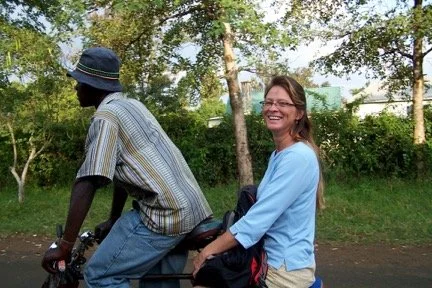
By the time this photograph was taken, I had stopped feeling like a visitor. Riding through town on the back of a boda-boda had become just another way to get home.
On the equator, the sun is relentless. Every morning I smooth sunscreen across my face and shoulders before pulling on my decidedly unfashionable sun hat. It may be silly looking, but it keeps things cooler. The heat rarely lets up except for an hour or two around sunrise.
Because Kisumu sits almost directly on the equator, the sun rises and sets at almost exactly the same time every day of the year, around seven in the morning and seven in the evening. There is no daylight saving time. It's always summer, and flowering trees seem to bloom in perpetual color.
Primary school children learn English from their earliest years, and among the very first phrases they master are "How are you?" and "Fine." As I walk or ride my bicycle through town, those greetings come from every direction.
"How are you?"
When I answer, "Fine. How are you?" the children collapse into giggles. Sometimes I'll begin to speak to someone, and before I've said a single word, they'll grin and answer, "Fine."
It makes me laugh every time.
Children and adults alike sometimes call us mzungu—white person. A boda boda driver hoping for a fare might simply call out, "Hey, white lady! Let's go!"
Children playing in their yards will race to the gate shouting, "Mzungu!" as though they've made the discovery of the century. I never mind. I smile, wave, and ask the expected question.
"How are you?"
Young Maasai men are often in town working as security guards at private homes. Wrapped in traditional red cloth worn as skirts and shawls, they try very hard not to stare at me, just as I try very hard not to stare at them.
No matter where you are—in the city or a village, inside a meeting or reading quietly at home—there is always a rooster crowing. While I'm writing this, one is announcing himself outside. Walking into town, another answers. During meetings at work, yet another joins in. Kenya, at least in my memory, always has a rooster somewhere clearing his throat.
Before dawn, though, when even the roosters are still sleeping, another sound drifts across town. From Mosque Road, the Muezzin's call to prayer floats over our back wall and through my bedroom window. His ancient song is gentle and haunting, awakening Muslims for their morning prayers while quietly waking me as well.
The only place in Kisumu to find familiar Western food is Mon Ami, a restaurant inside the Nakumatt shopping center owned by an Indian family. Expats gather there, but so do Kenyans, especially on weekends to watch European football and dance. I usually order a personal pizza and beer. For an hour or two, it almost feels like home. They've added hamburgers to the menu, so I'll have to try one next time.
Even though Kisumu has several dry cleaners, I prefer washing my clothes by hand in a purple wash tub using baby shampoo. Shirts, skirts, blue jeans, bed linens—everything gets washed that way.
At first I carefully hid my bras and panties on the clothesline. Eventually I stopped worrying and pinned them up with everything else. In the equatorial heat, even a heavy pair of blue jeans dries in two hours.
Every morning and evening people sweep their yards, gathering fallen leaves and seed pods into neat piles. Push brooms are uncommon. Instead, most people use handmade brooms fashioned from bundles of sticks tied together and sold in markets throughout town.
Our groundskeeper, Paul, sweeps our driveway every day, bent low as he pulls those branches across the dusty ground. It must take 3,455,698 strokes of his small broom to finish the job.
Another Paul works at TICH, where each morning he mops the crimson-painted cement floors until they shine. He mops both inside and outside, although the distinction is blurry. Windows stay open. Interior walls stop short of the ceiling. Doors don't seal tightly. Outside has a way of becoming inside.
The rhythmic swish... swish... swish of Paul's mop in the bright morning sunlight is oddly comforting. Our house has those same crimson floors, and I mop them with potpourri-scented disinfectant. They shine, and the whole house smells clean.
Shopping is never a quiet affair. Merchants standing beside their market stalls call out,
"Karibu! Please come closer and look for a long time."
They repeat the invitation, step into my path, and do everything short of taking me by the arm.
"I live here," I tell them. "I'll be back."
Their response never changes.
"When? Tomorrow?"
About the Author
Cindi Brown is a Georgia-born writer, porch-sitter, and teller of truths, even the ones her mama once pinched her for saying out loud. She runs Porchlight Press from her 1895 house with creaking floorboards and an open door for stories with soul. When she’s not scribbling about Southern music, small towns, stray cats, places she loves, and the wild gospel that hums in red clay soil, you’ll find her out listening for the next thing worth saying.
