
Priests on Tour
Sunday, July 10, 2005 — Kisumu, Kenya
Mrs. Ruprah catches me one morning as I leave our compound. She excitedly tells me five Sikh priests from India will be visiting the next day to pray for the Ruprah family and business, and she wants me to put on my Punjabi suit and join them.
They'll start at 5 a.m., so she wants me at their house by 4:30.
Okay.
"You know the CD? Sonya's CD?" she asks.
"Yes."
"You can bring, nay?"
She's talking about a CD full of photos from a neighbor's wedding. I think she's asking me to take pictures of the five priests so they can be added to her copy.
She's very pleased when I say yes to everything. Taking my hands, she tells me she will remember me for the rest of her life.
And not only will she remember me for the rest of her life, she says, but she thinks of me as her daughter.
I blush and smile.
At lunch, I walk to town to pick up the Punjabi suit Mrs. Ruprah had helped me choose. The shop owner set it aside for me, but I'm concerned it might be a little tight through the chest and want to try it on without a T-shirt underneath.
There is no fitting room.
The shopkeeper steps next door to Dr. Sokwala's office and asks if I might use the back room. Dr. Sokawla is the doctor I saw when Kenya broke me a few weeks after arriving here, and she’s treating my high blood pressure.
When I walk in, Dr. Sokwala is sitting behind her desk, talking on the phone. A piece of cloth hangs in the doorway to the back room, which is up three steep steps. Once I've pulled on the top, Dr. Sokwala pushes the curtain aside and stops when she sees me.
"Hi, Dr. Sokwala," I say, feeling a bit foolish about using her office as a dressing room.
She acts as though this happens all the time.
"I'm trying this suit on. What do you think?"
"What's going on down there?" she asks nonchalantly, pointing to my khakis.
"Well, I wanted to see if the top is too tight."
"Put the pants on. Then we'll see."
She doesn't move so I put the pants on.
She says I'm beautiful, like her daughter.
"How old is your daughter?"
"Thirty."
"Does it look too tight through here?" I ask, indicating the bust line.
"No. It's beautiful. You're beautiful."
Gee whiz. I'm blushing and smiling again.
"It looks like it was custom-made for you."
She's staring at the suit the whole time, just as I always stare at the gorgeous suits worn by so many of the Sikh women here, in fantastical hues.
"I can't take my eyes off of you," she says.
I know exactly what she's talking about.
Early the next morningm very early, like around 2 a.m., the Ruprahs begin moving their heavy wooden furniture across the stone and marble floors.
For two hours, I float in and out of sleep as the scraping noises flare and recede, flare and recede. Dishes clank as though they're stacking a million plates and saucers and cups.
At 3:30, I hear Samuel the guard's footsteps outside. He walks to the window above my bed, above my head, and gently says, "Cynthia."
Of course, I'm already awake and thank him for the "call."
Then I'm up, making coffee, putting on makeup and slipping into my new Punjabi suit, complete with scarf.
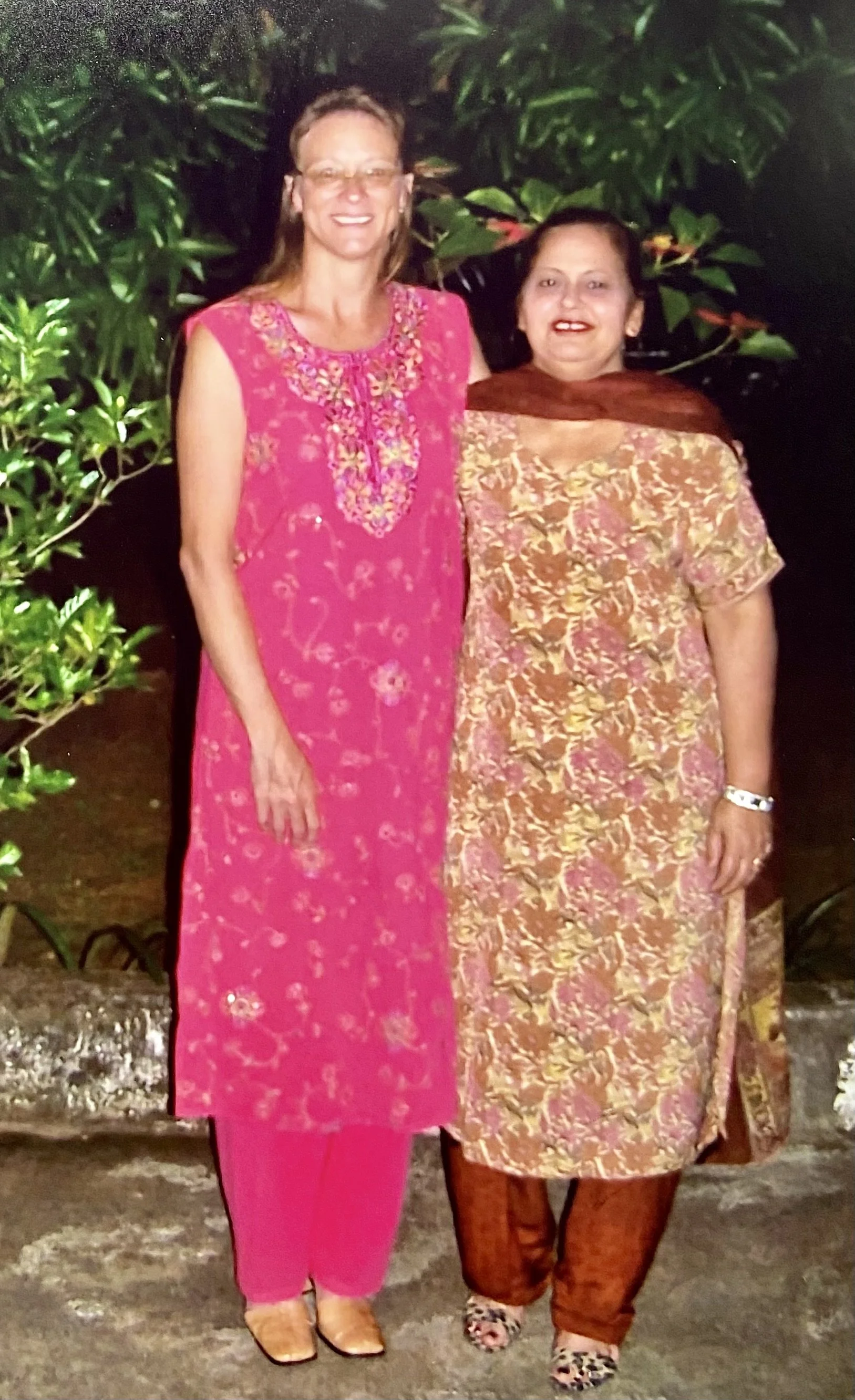
Mrs. Ruprah and me in her garden before the early-morning Sikh service at her home in Kisumu. She had insisted I wear my new Punjabi suit—and would spend much of the morning helping me figure out what to do next.
By 4:15, cars are entering the gate and voices carry through the darkness. I peek from my front window, curious, because I thought only the Ruprahs would be here for the blessing.
The yard has been transformed.
It's like waking on a winter morning to discover that snow has fallen overnight. Instead of snow, though, the Ruprahs' yard is covered with white plastic chairs.
There must be 200 of them, lined up in circles and squares. The heavy wooden furniture with burgundy velvet upholstery has been moved under the pavilion. A table draped in white holds plates and pitchers, huge serving bowls and drink dispensers.
It looks like a wedding is about to take place.
I cross the backyard and enter the Ruprahs' house through the patio door. All the furniture is gone. In its place, soft cushions line the floor beneath white sheets.
Mrs. Ruprah tells me to cover my head. This is easier said than done.
The scarf is long and silky and shifts easily unless it's balanced, looped or hung just right. I've watched the women here handle their scarves as though they're appendages, naturally wrapping them this way and that for effect and solid anchoring.
I fumble. Then I freeze, praying it won't move. I'm very awkward with the scarf and hope no one notices. Of course they're noticing.
A few women are sitting on stools, and we greet one another. They stare at my clothes and talk among themselves in Punjabi until I become uncomfortable.
And from this moment on, I'm uncomfortable.
I want to experience new cultures and know very well that new experiences must be met with an open mind and a willingness to look foolish. We can't get things right all the time. Learning a new culture can be like learning a new language or a new dance. Sometimes we say and do silly things in our early attempts.
But I'm not prepared this morning to look silly. It's too early. And they're all still staring at my clothes. Finally, one brave soul I've never met asks, "How much did you pay for your suit?"
I'm taken aback. What to say?
I fall back on the old adage that honesty is the best policy and tell them, because they're all leaning in with anticipation, even those who don't speak English, and say, "Four thousand shillings." That’d be approximately $35 or $40 USD.
They nod knowingly and assure me it's a good price. My discomfort grows.
The living room has been transformed into a small gurdwara, a space for Sikh worship. At the front, the Guru Granth Sahib—the sacred scripture Sikhs regard as their eternal Guru—rests beneath richly colored cloths. The eldest priest sits nearby, incense curling around his gray-and-black beard.
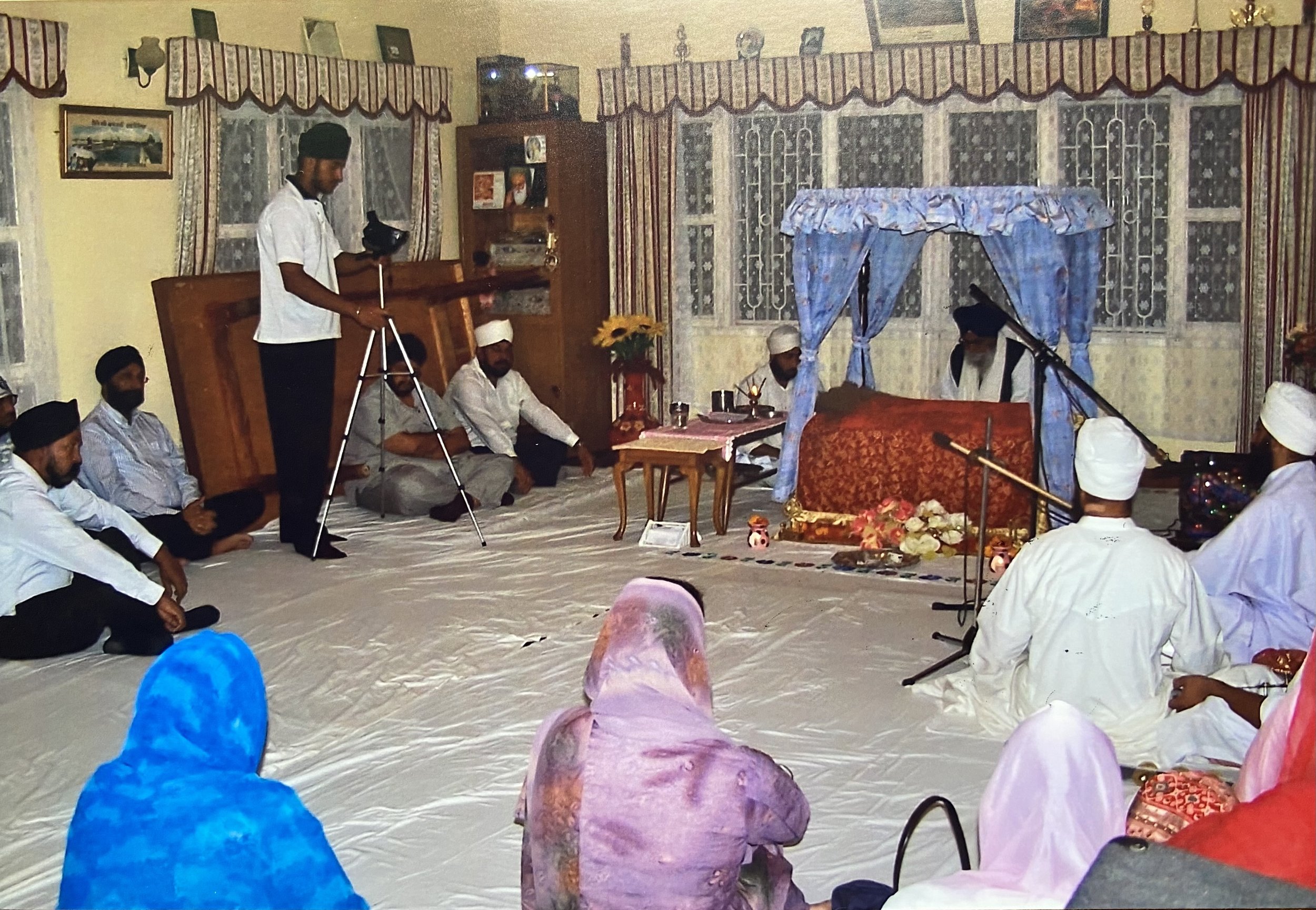
By 5 a.m., the Ruprahs’ living room had become a place of Sikh worship, with priests singing prayers and guests filling the floor, hallways and adjoining rooms. Kisumu, July 2005.
Five visiting priests from India sit to the right side of the room, microphones at the ready and speakers pointing toward the center.
Mrs. Ruprah says, "Come."
She leads me toward the center of the room, where a small line has formed before the Guru Granth Sahib.
I watch carefully.
People stand briefly with their hands together, then kneel and bow, lowering their foreheads to the floor in reverence. They leave an offering.
From where I'm standing, though, I can't quite tell exactly what they're doing. What if I do it wrong in front of all these people?
And who knew there would be so many people here? The yard is nearly covered with cars. Cars line both sides of the road, up and down.
The five visiting priests seem to be bored out of their skulls and they each do an almost-imperceptible double take when they see me.
They all wear white turbans and beautiful tunics reaching just below their knees. The tunics flow around them as they sit cross-legged, their legs and feet covered.
With Mrs. Ruprah coaching me in front of the crowd, I kneel, place five 20-shilling pieces into the offering plate, put my hands on the floor and lower my forehead.
This position presents one's backside rather prominently to the crowd.
It's hard not to notice some of the spreads as they're being presented. Most people, being kind, look away when I present mine.
The men sit on the left side of the room and the women on the right. At 5 a.m., the priests begin singing Sikh hymns and prayers. The loudspeaker is behind my right shoulder, and I can feel the beat of their drums and the shaking of a stick tambourine.
Voices, good, bad and everything in between, mingle together.
Guests look toward the musicians or toward the floor. People keep coming and coming, lining up to bow and leave their offerings.
It's 5:30, and I'm thrilled to be seated close to the wall, safely out of everyone's line of sight.
Then Mrs. Ruprah taps me on the shoulder. "Come."
I think, Not again.
"Where's your money?" she asks.
"I put it in the plate."
Apparently, I was only supposed to put 20 shillings into that offering plate. The rest goes into another plate in front of the singing priests.
Oops.
Mrs. Ruprah leaves and promptly returns. She taps me again and pushes a 100-shilling note into my hand.
"Come."
Awkwardly, because my feet are bare, the women are sitting close together and the scarf remains wily, I rise and follow Mrs. Ruprah to the line in front of the musicians.
I'm relieved to see that I don't have to kneel and put my forehead to the floor again.
I imitate the hands-together, bowed-head motion, trying to put some sincerity onto my face but not entirely sure what I'm sincere about.
Then I melt back into my place among the extended knees of the women and sit very, very still to keep the scarf from sliding down the back of my head.
More singing. More percussion. More people entering, bowing, leaving offerings.
It's 6:20 a.m.
I begin studying the intricate cut of the priests' tunics. The style is quite masculine, though the garment is long and flowing. The neck has a short collar, and a yoke across the shoulders drops into lovely angles along the arm seam. The fit is beautiful, stretching across broad shoulders and flowing toward the waist.
More people arrive. They're sitting in the dining room, the hallway, even the bedrooms.
It's 7 a.m., and the priests are still going strong.
My scarf has slipped only twice. The woman behind me has kindly alerted me both times. When I make a startled, anxious face over having exposed the crowd to my bare head, she laughs out loud.
An older woman sitting in front of me has her bottom planted on part of my scarf.nShe looks at her watch.
My crossed legs seem to be frozen as the singing grows more intense, and the congregation begins responding as part of the prayer. Then everyone stands.
I feel true relief. It's over. We're leaving this room.
I just want to get outside so I can take this wretched, though exceedingly gorgeous, scarf off my head. But no one moves.
In a moment, everyone starts to go down again, and I imitate them. Except they're not sitting, they're bowing.
I squat and lower my head as much as possible, making sure the scarf is still attached to me.
The woman behind me hits my butt with the back of her hand.
"Stand up," she whispers.
We all stand together.
Fine. We're standing. The awkwardness will soon be over.
Then everyone sits again.
"You can sit down," the woman whispers.
More singing prayers.
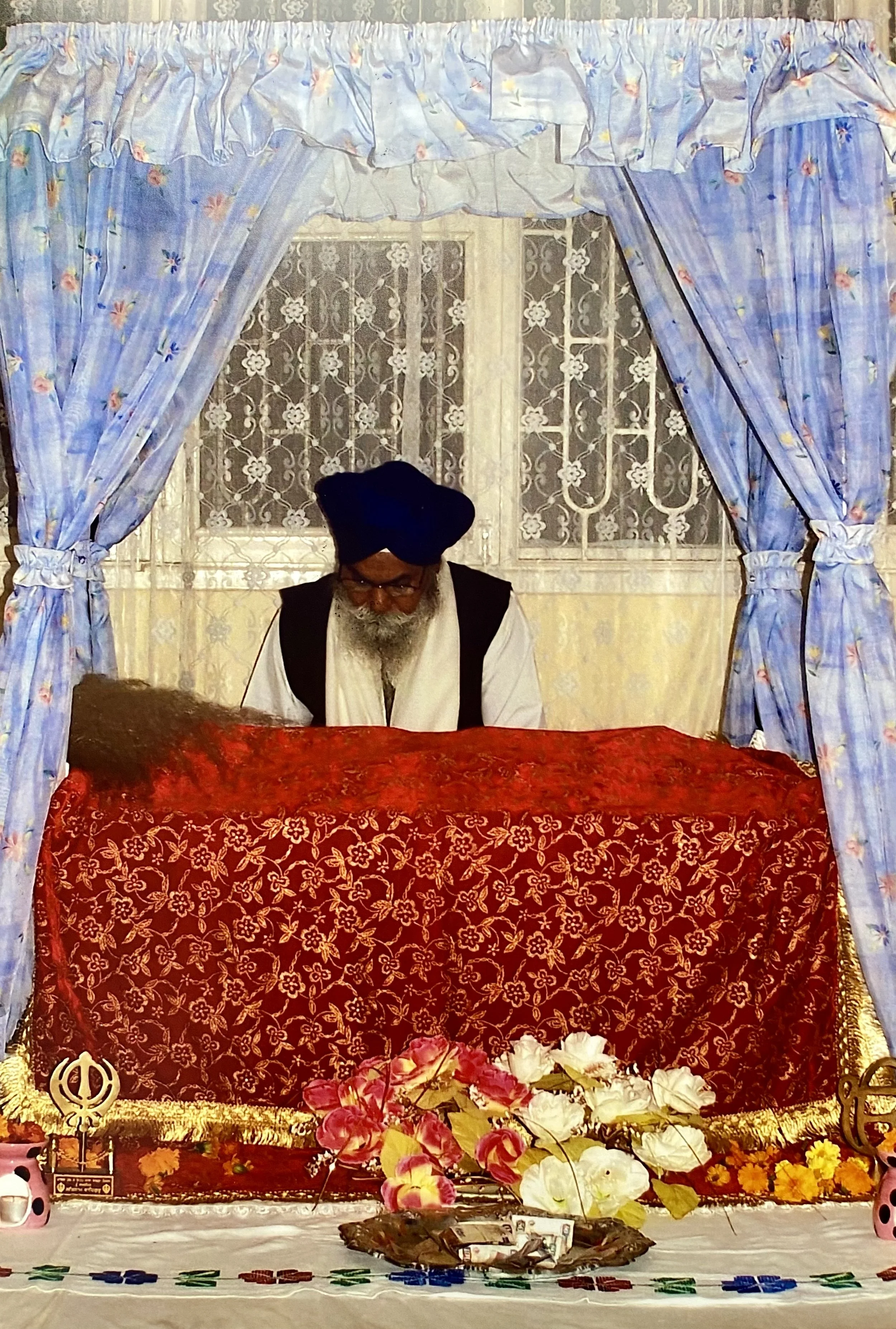
An elder Sikh priest at the sacred space prepared for the Guru Granth Sahib in the Ruprahs’ living room, where prayers and hymns continued through the early morning. Kisumu, Kenya, July 2005.
A man rises and begins working something dough-like in a bowl, shaping portions for the priests. Then another man carries the bowl through the congregation, placing some of the warm mixture into our open, cupped hands.
Everyone receives it respectfully and eats.
"You can eat," the woman whispers. It's really good and tastes like cobbler crust that hasn't cooked all the way through. Very buttery, which is what makes it so good.
I later learn that this is karah prashad, a sacred Sikh offering traditionally made from flour, ghee and sugar and shared among those present.
A woman sitting beside me, who seems from her stern looks to disapprove of my very existence, hands me a napkin to wipe the grease from my palms.
Then it's over.
"You can get up," the woman behind me says.
I thank both women for their guidance, checking one last time to make sure the scarf is in place.
It's now 7:30. I'm supposed to be at work at 8.
Everyone moves outside for chapati, dal and other goodies. Raju, the Ruprahs' son, is wearing a turban, the first time I've ever seen him in one. He won't let me take his photograph.
He and another young man are in charge of serving the priests, carrying trays of food and drink back and forth from the kitchen.
I go to my little house across the yard, change into jeans, grab my backpack and leave for work.
The visiting priests are out in the front yard now, leaning against Mercedes and BMWs and talking among themselves. I wonder why they're not in back talking with everyone else.
They look at me as I cross the compound in my jeans and backpack. They seem to be bored out of their skulls and they each do an almost-imperceptible double take when they see me.
When they leave the Ruprahs' house, the priests will head to the family's foundry, where sugarcane-processing equipment is made. They'll pray and sing in the workshop for an hour, blessing the business and praying for its prosperity.
I head off to work, leaving behind the white chairs, the priests, the food and the beautiful scarf I never did learn how to keep on my head.
For three hours that morning, I hadn't understood much of what was being said. I hadn't known when to sit or stand, where to put my money, how to bow or even what I was eating.
But whenever I got lost, someone showed me what to do.
Usually Mrs. Ruprah.
"Come," she'd say.
And I would.
