
Family Lines & Fault Lines
The Green and Fitchett Families
After seeing Norfolk through two lenses, one orderly, one unraveling, it’s helpful to look more closely at the man who stood at their intersection. Buddy Green did not arrive on that dark, dirt road unformed. His body carried the imprint of two Southern legacies long in the making, one forged in labor and collapse, the other in saltwater and ceremony.
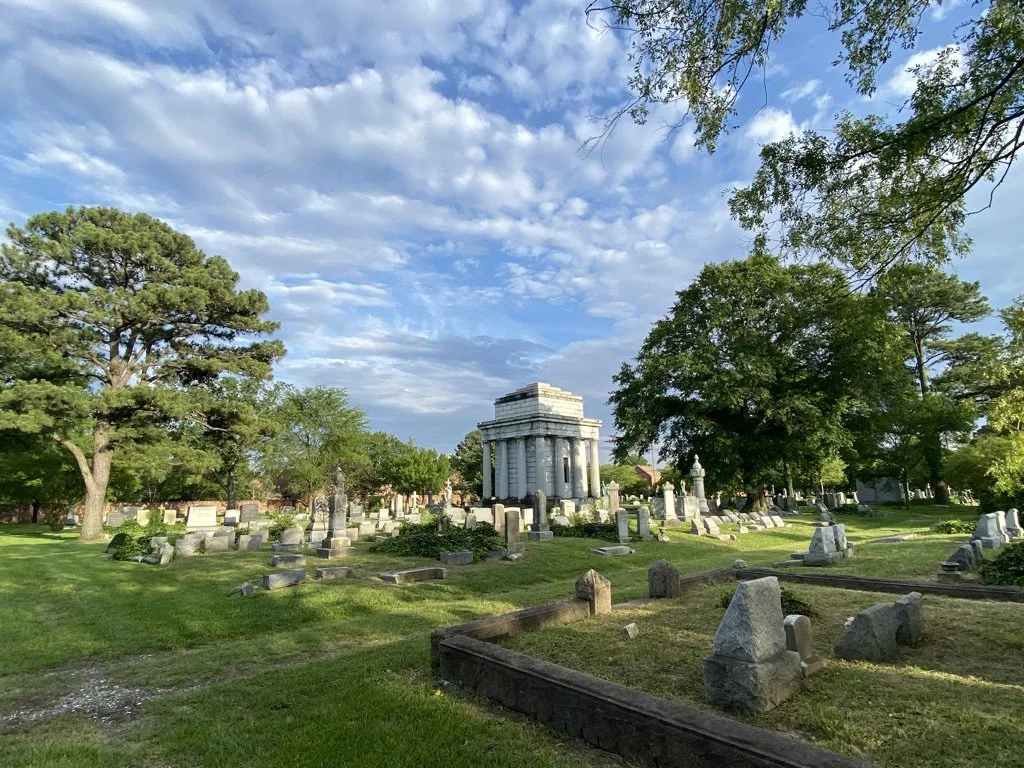
Elmwood Cemetery in Norfolk, Virginia, one of the city’s oldest burial grounds where many of Buddy Green’s maternal ancestors were laid to rest, their lives recorded in stone, church rolls, and civic memory.
The Green Family
Buddy’s paternal line, the Greens, was shaped by working-class endurance and gradual disintegration. His grandfather, William John Green, born in Quebec in 1852, migrated to Norfolk and spent most of his life as a stevedore, likely employed by Furness Withy, a British shipping firm. The 1920 census lists his trade as “furnace whitling,” almost certainly a mis-transcription of a high-heat industrial position, suggesting physically punishing dockside labor well into his later years.
William John died in 1922 of cerebral hemorrhage, arteriosclerosis, and paralysis. His life ended as it was lived, under pressure, vessel walls strained and worn. He and his wife, Elizabeth A. O’Connor, raised at least eight children, though some, like Elizabeth (b. 1890) and Dave (b. 1892), appear to have died young or vanished from record.
Among the sons who survived, a troubling pattern emerged; early death, illness, isolation:
Daniel J. Green, a former Norfolk police officer turned roofer, died at thirty-eight in 1931 of chronic myocarditis. He was found alone in a vacant house on East Freemason Street, ill, possibly addicted, and estranged.
Henry Vincent Green, Buddy’s uncle, died in 1944 of myocardial deficiency. Divorced, he was living with his sister at the time of his death.
John Emmet Green, a plumber, lived longer than his brothers and raised a large family, yet still died of cerebral thrombosis from arteriosclerosis.
Michael Joseph Green, Buddy’s father, a World War I veteran and plumber, outlived his siblings but not their fate. He died in 1968 of arteriosclerotic heart disease, cerebral thrombosis, and diabetes.
The Green men were not doomed by nature alone. They were shaped by punishing labor, unresolved trauma, and what appears to be a generational pattern of alcohol dependence. Their addresses at 150 O’Kelley Avenue, 431 West 29th Street, and 204 32nd Street, trace a modest, often tragic cartography across Norfolk.
The house at 431 West 29th stands like a quiet monument. That’s where Henry died, where Daniel’s body was taken before burial, and where the family repeatedly retreated to recover, or to unravel.
The Fitchett Family: Salt and Stability
In contrast, Buddy’s maternal line, the Fitchetts, offered a more anchored inheritance. His grandfather, William Sidney Fitchett, born in Mathews County in 1864, spent more than fifty years on the water as a tugboat pilot out of Ocean View. It was a respected and essential role in Norfolk’s harbor economy, one that demanded skill and trust.
A member of Ocean View Lodge No. 335 A.F. & A.M., the Master Mates and Pilots Association of America, and the Ocean View Methodist Church, William Sidney embodied civic duty and maritime pride. His obituary described a man rooted and respected, a patriarch who raised multiple children, retired with honor, and was buried at Elmwood Cemetery with full Masonic rites. He lived in Norfolk for sixty-four years before moving late in life to South Carolina to live with a daughter.
His wife, Margaret Ann “Maggie” Hundley Fitchett, died in 1918. Her parents, William J. Hundley and Ann Elizabeth “Eliza” Forrest, also lived and died in Norfolk and were buried at Elmwood. Their home on Pool Street remained in the family for more than forty years, a rare marker of residential continuity.
William Sidney and Maggie raised a large family whose lives, though not untouched by loss, unfolded with greater stability:
William Herod Fitchett, a World War I veteran and railway clerk, died at forty-three of spinal meningitis and cardiac complications.
Margaret Sidney Fitchett Albrecht lived into her eighties.
John Walford Fitchett, a C&O Railroad captain, died suddenly of a heart attack at seventy.
Annie Elizabeth Fitchett Elms and Lucille Catherine Fitchett Elms Baker lived long lives, the latter to age ninety-eight.
Isiah Fitchett died in infancy.
Sadie Fitchett Green, Buddy’s mother, died of liver cirrhosis and bilateral bronchopneumonia, an end likely accelerated by alcoholism and chronic respiratory distress.
Here, deaths occurred in homes, hospitals, and nursing care, not vacant buildings. Names appeared regularly in church bulletins, civic records, and cemetery logs. Such ordered lives did not eliminate grief, but it shaped how the family held their loss.
Bloodlines Converge
What emerges is a portrait of two bloodlines converging in one man, Buddy Green. The Greens carried vascular fragility, punishing labor, and a recurring pattern of collapse, men worn down early, often alone, often undone by bodies and habits that failed them faster than time should have allowed.
The Fitchetts offered something different. Ritual, rhythm, maritime order, and faith, structures designed to hold loss rather than dissolve under it. Together, these lines formed the inheritance Buddy carried into adulthood, one that at times steadied him, at times strained him, and ultimately failed to save him.
Buddy was not born of monsters. He was born of plumbers and pilots, police officers and railroad men, of women who buried children and women who lived to nearly one hundred. What distinguishes his lineage is not tragedy alone, but its density and direction. Those repeated early deaths, strikingly similar causes, men dying estranged or alone, and little evidence that suffering was ever named or examined. Pain moved through these families not as a single rupture, but as a current, relentless and largely unchallenged.
To understand Buddy and his family history is not to excuse him. It is to recognize the haunted blood that moved through his veins, and the long, unbroken chain of pressure, silence, and unresolved loss that shaped his hand long before it ever pulled a trigger.
Harming or Healing
This story does not end with Buddy Green’s lineage or with the violence he committed. What people inherit is not only biology or circumstance, but response, how we carry pain, hide it, normalize it, or pass it forward within families. Buddy Green’s life shows what can happen when inherited pressures go unexamined and unresolved. Bill Allman’s death shows how far that unexamined pain can reach, generation after generation.
Duane and Gregg carried a different burden. Their inheritance was not violence, but the aftermath of violence, including grief without explanation, absence without repair, and a childhood shaped by shock rather than safety. As physicians and trauma researchers would later observe, adversity does not disappear simply because it goes unnamed.
When pain is unexamined, it does not dissolve, it adapts.
Healing, therefore, is not automatic. It requires reflection, support, and a willingness to look directly at what hurts, conditions often absent in families and cultures trained to endure rather than to ask why. For boys like Duane and Gregg, coming of age in the 1950s, grief was rarely named and psychotherapy remained stigmatized. Pain was something to outgrow or outrun, not something adults helped children understand.
In fact, to this day, most cycles of trauma persist not through malice, but through silence.
And yet, within this story, there are exceptions, people who today are choosing the harder path of self-examination and reaching backward as they move forward. Galadrielle Allman and Shannon Allman represent a different response within the extended Allman family, one marked by inquiry rather than avoidance, by the courage to look closely at what others often turn away from.
Their pursuit of self-healing suggests that while trauma may be inherited, it is not fixed.
About the Author
Cindi Brown is a Georgia-born writer, porch-sitter, and teller of truths, even the ones her mama once pinched her for saying out loud. She runs Porchlight Press from her 1895 house with creaking floorboards and an open door for stories with soul. When she’s not scribbling about Southern music, small towns, stray cats, places she loves, and the wild gospel that hums in red clay soil, you’ll find her out listening for the next thing worth saying.
