
The Trial of Buddy Green
On a cold December night in 1949, Bill Allman was killed. This series follows the ripple effects, from courtroom to clemency, from grief to guitars, and the music that rose from it all... music that outlasted everyone who played it. Read the full series introduction here.
Courtroom as Theater
The Norfolk courthouse didn’t need marble halls or velvet ropes to command respect. Its arched windows and solemn façade spoke loudly enough. This was a place where lives could change with the bang of a gavel.
Here, in 1951, Michael Robert “Buddy” Green stood trial for the murder of Second Lieutenant Willis “Bill” Turner Allman.
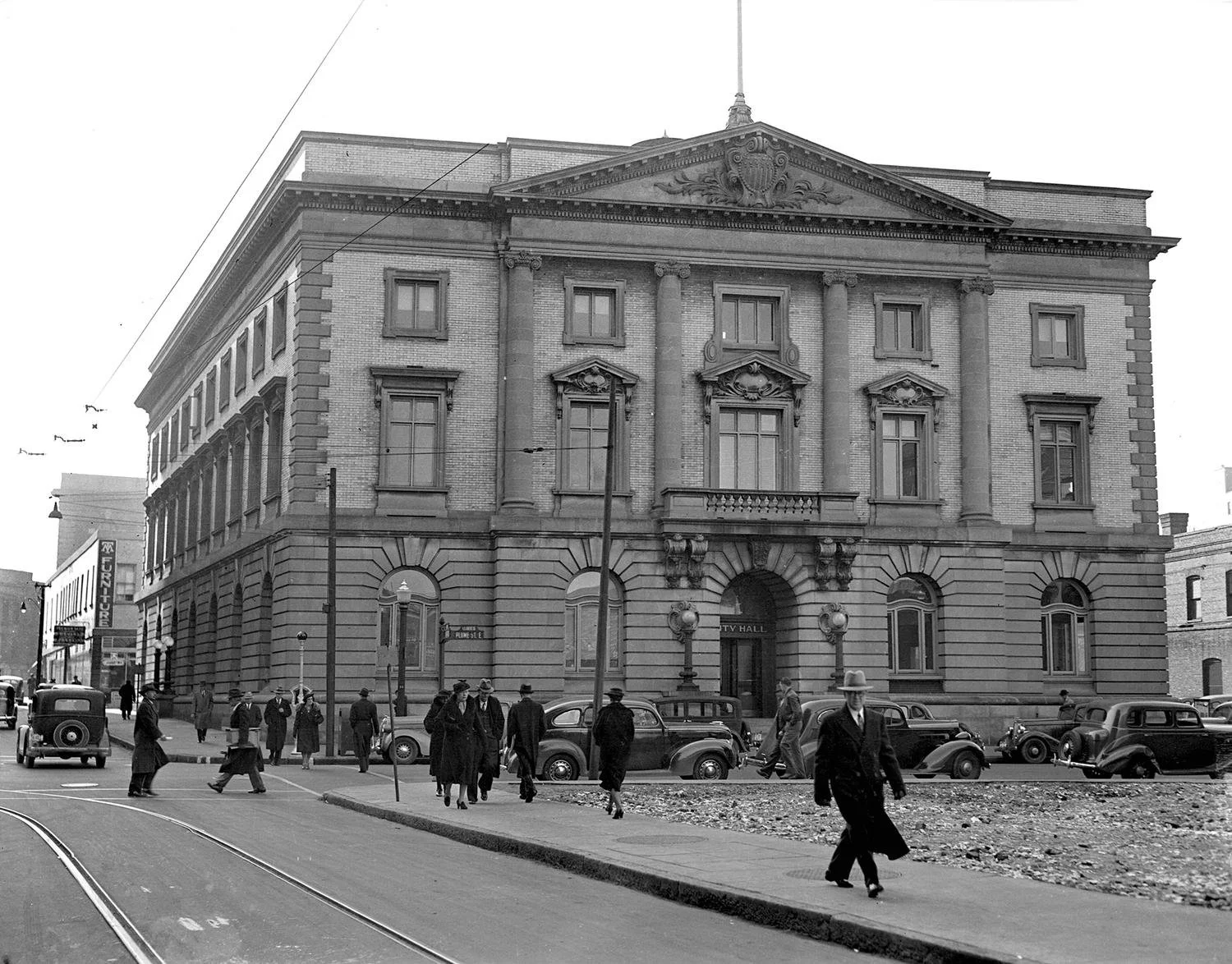
Old Princess Anne County Courthouse, Norfolk, circa 1937. Duke Brickhouse, future neighbor and longtime Norfolk attorney, recalled practicing law here before its replacement. “It had hidden doors and passageways,” he said, places in the courthouse where power and shame met behind wooden panels.
Buddy’s trial drew attention, but not headlines. Norfolk was a Navy town, and its people were pre-occupied building the city. Newspapers covered the basics of the robbery, murder, fleeing suspect, and his confession. There were no protests. No photographs of a grieving widow or orphaned young sons.
But for the men who presided over the case, the judge, lawyers, psychiatrists, this was more than just another docket entry. It was a story about law and order in a South still trying to define both.
This courtroom was shaped by men who understood authority as something earned through command. Judge Floyd E. Kellam, a veteran of the First World War, presided with the bearing of an officer, his bench less a place of inquiry than a post of control. Order mattered. Hierarchy mattered. Justice, as practiced here, was firm and unsentimental, a system built to function, not to feel. This was not a room designed for interior lives or damaged souls. It was designed to hold the line.
Jerry at the Rail
A solider was assigned to accompany Jerry to the trial of her husband’s killer. Every day she entered the courtroom with her military escort and watched the proceedings, although deep down she had no interest in Buddy, his story, court testimony, or even his ultimate punishment.
Buddy had already taken too much from her and nothing any one did would give Bill back to her. She simply wanted to compartmentalize Bill’s death and focus on the road ahead, making a living and raising their boys.
Jerry must have seen Buddy’s parents, William and Sadie Green, sitting in the courtroom, along with his sisters Sarah and Lucille (Lucy), and his 28-year-old wife, Marie.
Buddy and Marie had a daughter, born in 1947, the same age as Gregg. Most days Marie sat in the front row, just behind Buddy, and watched as the prosecutor tried to convince the jury that Buddy was guilty of first-degree murder, armed robbery, and carrying a concealed weapon.
The Ashburn Legacy
Buddy’s attorney, 50-year-old Willard Reynolds Ashburn, Sr., was a partner at Ashburn, Agelasto & Sellers, a respected law firm in the prestigious Citizens Bank Building downtown. He hadn’t built that reputation in a vacuum: his grandfather, Alexander H. Ashburn, had been one of Norfolk’s best-known justices of the peace, a man so esteemed that when he died in 1905, the flag at City Hall flew at half-mast in his honor.
Even at just five years old in 1905, Willard would have grown up in the shadow of that civic legacy, carrying the family’s good Ashburn name into every courtroom he entered. His record in other cases shows a man who believed in due process and had little patience for grandstanding. Ashburn was trying to do what lawyers are often asked to do. Salvage something human from a situation long past justice.
Willard’s wife of twenty-two years, Elisabeth Bartee Corprew Ashburn, was equally well-positioned in Norfolk, a pillar in pearls, the kind of woman whose name was engraved into every civic effort that mattered. She was a founding member of First Presbyterian Church, a founder and president of the Virginia Beach Garden Club, a founder of the Junior Virginia Beach Garden Club, the original Virginia Beach Library, and a member of the Princess Anne County–Virginia Beach Historical Society, the Princess Anne Country Club, and the Women’s Auxiliary of the General Hospital of Virginia Beach, of which her husband was one of the original founders.
Elisabeth came from the kind of Norfolk family that built churches, ran dry goods counters on Granby Street, and held tight to their exclusive corner of West Freemason through fires, depressions, and the slow crawl of postwar recovery.
They were merchants on Granby and Freemason streets, which once defined Old Norfolk’s social map. Business registers from the 1870s–1880s list them consistently as a major dry goods and notions house. In Norfolk’s boom years after the war, these stores served both local families and sailors docking at port.
Her grandfather’s store changed names as often as Norfolk changed hands, from Campe & Corprew, to Corprew & Hunter, to Corprew, Armstrong & Co., each new partnership a quiet testament to survival in lean times. While it wasn’t Macy’s, Campe & Corprew was definitely part of the city’s downtown mercantile fabric, placing the Corprews firmly in the respectable merchant class that powered Norfolk’s commercial rebirth after the war.
That hard-earned prosperity, passed down through fraternal orders, church pews, and a string of good addresses, stood in sharp contrast to Buddy’s drift and grift. What must Elisabeth have thought, looking at her husband in court, spending his bright mind and good name defending a man whose life was so recklessly untethered to the safeguards her own family had built for generations?
After all, Elisabeth had built half the town with committee meetings and cucumber sandwiches. Together, Willard and Elisabeth had proven themselves to be a mid-century power couple in this tidewater municipality.
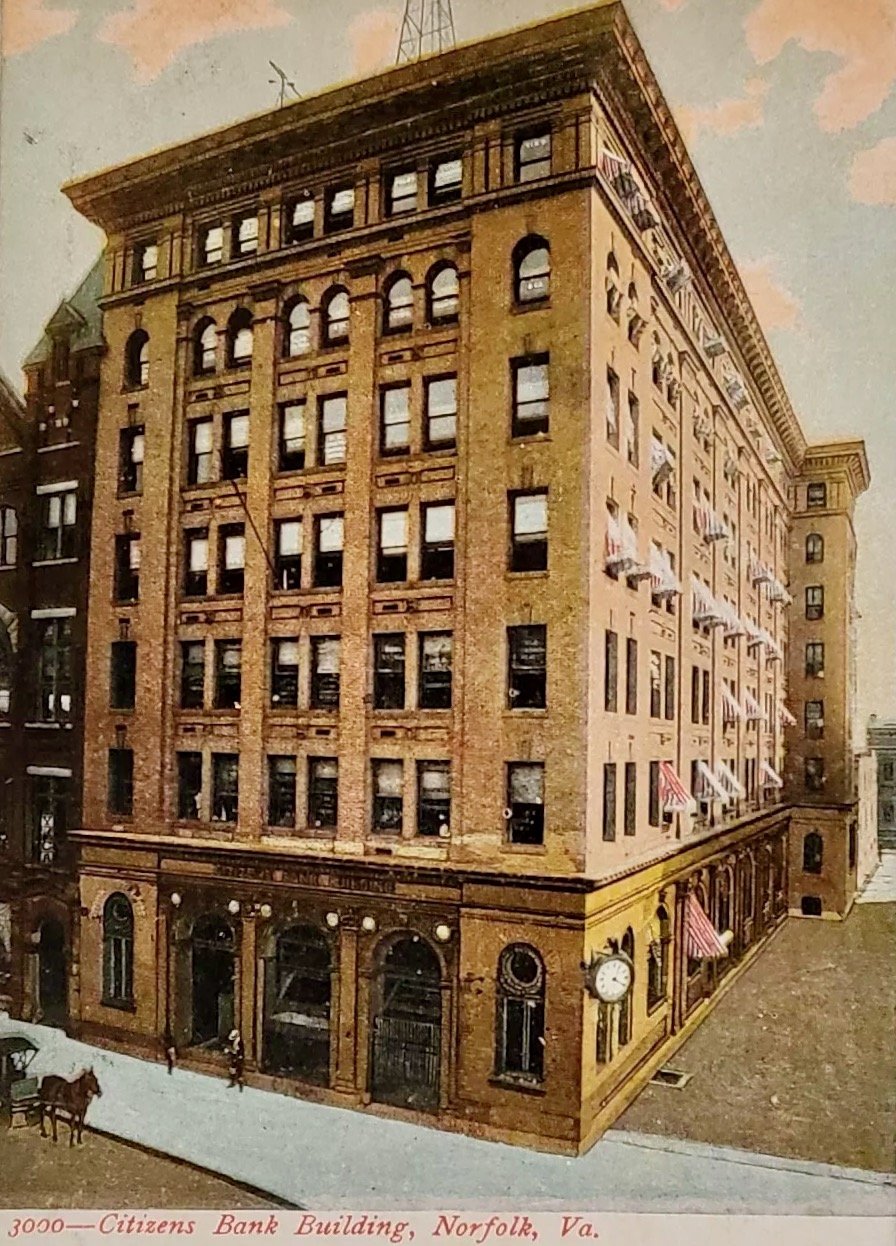
Citizens Bank Building (later known as the BB&T Building), downtown Norfolk, early 20th century, the office where Willard R. Ashburn Sr., Buddy Green’s lawyer, worked and planned his defense mid-century. Today, this building survives as a protected historic landmark, preserved as part of Norfolk’s architectural heritage and a testament to the city’s early civic and commercial power.
The Insanity Plea and Dr. Blalock’s Verdict
Ashburn knew how to build a defense, too. He pled Buddy’s case on the grounds of temporary insanity, arguing that something in him had snapped on that dirt road. But the court turned to the man whose word on the criminal mind carried more weight than any lawyer’s plea, Dr. Joseph R. Blalock.
By then, Dr. Blalock was already Superintendent of Southwestern State Hospital, one of Virginia’s oldest mental institutions, once known as the Southwestern Lunatic Asylum. A Johns Hopkins-trained psychiatrist with advanced degrees from Columbia and Wake Forest, Blalock had spent decades studying patient behavior, criminal insanity, and the subtle lines between illness and intent. He published papers, gave lectures from New York to Hawaii, and led the hospital through sweeping changes in psychiatric treatment, enough that they’d later name a building for him, the Blalock Food Service Center.
Before the jury heard closing arguments, they listened to the quiet, clinical voice of Dr. Joseph R. Blalock, the man called to decide if Buddy Green was sane enough to stand trial.
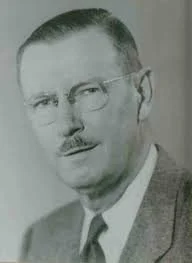
Dr. Joseph R. Blalock
Psychiatrist whose testimony shaped the court’s view of Buddy Green’s mental state.
When Buddy was sent up to Southwestern State Hospital for observation, Dr. Blalock watched him the way he’d watched hundreds of troubled men before. In the end, Blalock found no break in Buddy’s mind, no fracture he could write down in the medical charts.
Buddy, he told the court, was sane. He had known what he was doing on that dirt lane. He was fit to stand trial and answer for the storm he’d unleashed.
And yet, storms have a way of circling back, and sometimes they ride the rails. Just four years later, in the fall of 1955, Dr. Blalock’s own wife, Marie, and his ten‑year‑old niece were killed when Norfolk & Western’s Train No. 14 struck the car she was driving through a rural Virginia grade crossing. A skull fracture, a shattered life, no criminal mind to probe, no motive to unearth. Only steel and speed and the terrible truth that the same world which gave Buddy the means to kill for pocket money could take a decent woman’s life for nothing at all.
He Didn’t Know Why He Did It
Sometime during the trial Police Chief Mapp testified that Buddy had said to him, just after the murder, that he “didn’t know why he did it.”
In that single line, Buddy admitted his guilt. He did it, and he didn’t blame anyone else. But in the same breath, he shrank from responsibility for the why, wrapping his confession in a fog. It was an admission and an evasion all at once, the kind of shapeshifting a man like Buddy could pull off when it served him best.
That shrinking was just one side of Buddy. A man who could sleep in his childhood bed with a rifle could also stand up in court later, or in a parole hearing years down the line, and insist he’d been wronged, that he’d cracked so badly he deserved mercy.
He didn’t say he heard voices. He didn’t claim he’d blacked out. He didn’t even claim the bullet was an accident. He just said he didn’t know why he did it.
Chief Mapp, the steady spine of Princess Anne County, carried that line into the record so the town would remember. Buddy never had a reason for murdering Bill Allman that could hold up to the light.
That single line, “I didn’t know why I did it,” would sit there for decades like an unanswered question. Years later, when the governor commuted Buddy’s death sentence to life, he’d claim Buddy had “cracked” on that dirt road, that the storm in him had finally come loose. But the record says otherwise. Dr. Joseph R. Blalock, Virginia’s most trusted psychiatric mind, had spent weeks with Buddy, studying the cracks. He found none in the mind, only in the man.
Buddy was deemed sane enough to stand trial because he was sane enough to have known he pulled the trigger and drove away to lie in his childhood bed.
Judge Kellam Holds the Bench
Calmly, knowingly, Judge Floyd E. Kellam watched it all from his bench; faces, eyes, the twitch of a cuff, the hush that fell when a witness tripped over the truth. Sometimes the coughs and gasps told him more than any sworn testimony. He was a Virginian who wore his conservatism like a tailored suit, not flashy, but ironed stiff with expectation.
Kellam came from Princess Anne County stock. The Kellams were a local dynasty, a family of judges, lawyers, and circuit clerks who tended the legal backbone of Virginia Beach before it was a city. His father, Abel Erastus Kellam, had sixteen children and kept the courthouse ledger steady for twenty years. The judge’s brother Richard read law in his brother Floyd’s own office before becoming a federal judge himself, a brother who handled land deals, World War II espionage, paratrooper drops, and naturalization ceremonies in Williamsburg, all with the same calm precision Floyd brought to his wooden bench.
At the bench sat Judge Floyd E. Kellam, a tall, silver-haired man who would guide the proceedings and ultimately decide what mercy, if any, the law would allow.
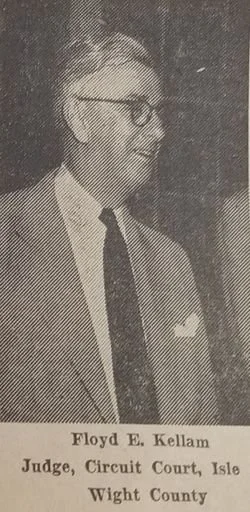
Judge Floyd E. Kellam
Circuit Court judge who presided over Buddy Green’s trial in Isle of Wight County.
By the time Buddy faced him, Kellam was a seasoned arbitrator of respectability, known for rejecting theatrics and moving trials along briskly. He believed in hierarchy, manners, and justice, not always in that order. He’d sit later on Virginia’s Supreme Court of Appeals and have a high school named in his honor, the Knights of Kellam carrying his family’s coat of arms in black and gold.
Yet Judge Kellam’s steadiness was rooted in more than law, it was anchored by the home he built with Annie Bateman Kellam, the kind of proper Southern lady who carried the Old South’s gentility into the new century. Annie grew up in a one-room schoolhouse, earned her teaching degree at Farmville, and let herself be wooed by Floyd’s daily letters until she said yes to marriage in 1927. She never missed a vote after suffrage came through, entertained politicians in her parlor, and taught her daughters that the privilege of community meant giving back.
Their daughters Rebecca (Becky) and Anne would go on to establish a scholarship at the high school bearing their father’s name, proof that public service ran straight down the Kellam line. In the same courthouse where Judge Kellam ruled on the fate of men like Buddy Green, Annie and her daughters kept the city’s charities, gardens, and church circles blooming, a reminder that behind every civic pillar stood women shaping what stayed standing.
In Buddy’s case, Judge Kellam set the tone. He watched Willard Ashburn spin the insanity plea. He listened when Dr. Blalock testified that Buddy was sane, storm or no storm. And when Police Chief Mapp repeated Buddy’s own pitiful dodge, “I didn’t know why I did it,” Kellam watched the jurors’ eyes flicker, weighing what was cowardice and what was crack.
In Buddy, Kellam likely saw more than just a killer. He saw a symptom of post-war rot, of undisciplined manhood, of danger seeping into the corners of respectability Princess Anne families like the Kellams had spent generations building.
In Kellam’s courtroom, pillars held. The storm could rage outside but inside, the gavel would come down hard enough to remind everyone where the backbone still lived.
Sheriff Malbon’s Watch
Calmly, knowingly, Judge Kellam watched the trial from his bench. And not far from the rail stood Sheriff C. Roger Malbon, Sr., the man who made sure Buddy never left the courthouse to disappear into the night. Malbon was newly minted as Princess Anne County’s sheriff when Buddy’s trial began. He was young, red-haired, and already known for running his department like a fiefdom. He was the lawman you wanted when your county was half farms and half streetcars, a place on the verge of being swallowed by the city lines of Norfolk and the resort sprawl of Virginia Beach.
Like the Kellams, the Malbons were old Princess Anne stock, another dynasty that built bridges, both literal and political. But the two families wore a legacy tinged with rivalry. The Kellams ran the court, the Malbons ran the backroads, the cells, and the keys that locked men up when judges laid down the verdict.
And if the tension with Sheriff Malbon ever spilled outside the courtroom, well, in Princess Anne County, a Malbon was just as likely to be kin as to be your next fight at the polls.
Malbon’s father had served as county supervisor, and Roger himself would spend the next four decades shaping southeastern Virginia’s highways, banks, and ballot boxes. When the time came, they even named a bridge after him. The twin spans on I-64, once known as just the “twin bridges,” were renamed the Malbon Bridges in his honor. Cross them today and you cross a piece of the old county backbone that men like Malbon laid down, one mile at a time.
So unspoken tension sat quiet in the room every day Malbon walked Buddy in and out of Kellam’s courtroom, his boots scuffing the pine floors, his eyes on the back of Buddy’s neck like a man anticipating anything and everything.
He oversaw Buddy’s arrest, his booking, his transport. He might have leaned on the bars of Buddy’s cell when the day’s testimony wound down, asking questions the court didn’t bother with. In those weeks, Buddy was Malbon’s responsibility.
Sheriff Malbon came from a line that knew how to bend politics to keep the county stitched together, but this trial showed how fragile those seams could be. He was the last link in the chain that kept Buddy from vanishing into the salt marshes and bus stations that ran north and south.
In 1951, Malbon was just a new Sheriff with a badge, walking Buddy to the courthouse rail every morning and back to his cell every night, assisted by deputy Rufus Rodgers.
Malbon was Kellam’s counterweight, a political rival whose job was to keep the storm contained when the gavel finally fell, guilty or not guilty.
Conviction and Sentencing
With closing arguments from both sides made, Kellam gave the jury instructions for their deliberation of Buddy’s guilt or innocence. Jury duty is a great civic duty, he was sure to remind them, and a great responsibility. Take your time to get it right, he was probably saying.
It didn’t take long, however, for the jury to decide Buddy’s fate. After just an hour and twenty-two minutes behind the closed doors of the Princess Anne County Courthouse, twelve men filed back in to announce what everyone in the room already suspected. Buddy Green was guilty of first-degree murder.
Under Virginia law, that meant death by electrocution.
When the clerk read the verdict aloud, Michael Robert “Buddy” Green, unemployed plumber’s helper from Ocean View, didn’t flinch. He had claimed mental incompetence at the time of the killing, but now he just turned to the front row and caught his wife’s eye. Marie was his war bride from Italy, learning in public, in real time, that her husband of four years was going to be put to death by the state.
Buddy winked at Marie. Encouragingly. Like a schoolboy caught stealing hubcaps instead of a man found guilty of shooting Second Lieutenant Willis Allman in a muddy field off Little Creek Road.
Or maybe Buddy’s wink was meant to telegraph that he was fine, so Marie wouldn’t worry.
Buddy’s poor mother, Sadie, gray-haired and worn out from the months of testimony and lawyer’s fees, erupted from her seat: “They can’t do it, they can’t do it… he was framed.” But the bailiffs moved in. Sheriff Malbon and Deputy Sheriff Rufus Rodgers flanked Buddy on either side as they led him out. Buddy paused just long enough to kiss his wife, the last public gesture of tenderness before the prison walls closed in.
Maybe that kiss was the last tenderness to ever pass between Buddy and Marie.
His attorney, Willard Ashburn, filed a motion to set the verdict aside, claiming it went against the law and the evidence. But motions were just paper, and the iron bars at the county jail were real. Buddy’s life would now tick down toward execution, one appeal at a time.
In the days that followed, the courthouse settled back into its routine. Sheriff Malbon returned to his office, the judges rotated their dockets, and Buddy waited for the state to decide when he’d die by electric chair.
On August 24, 1951, Judge Floyd E. Kellam denied Buddy’s bid for a new trial and pronounced the date his life would end. November 20, 1951.
“May the Lord have mercy on your soul,” Judge Kellam said to Buddy from his bench.
Buddy shot back, “And on your’s too.”
The judge’s words and Buddy’s startling retort settled like dust in the somber courtroom, the electric chair was waiting for him at the end of an autumn road he could no longer outrun.
But bars and locks are only as strong as the men who watch over them. On a cool October night, two months after Kellam slammed the gavel and shut his case, Buddy found the one opening in Malbon’s jailhouse fortress.
Was Buddy man enough, or scared enough, to slip through it?
About the Author
Cindi Brown is a Georgia-born writer, porch-sitter, and teller of truths, even the ones her mama once pinched her for saying out loud. She runs Porchlight Press from her 1895 house with creaking floorboards and an open door for stories with soul. When she’s not scribbling about Southern music, small towns, stray cats, places she loves, and the wild gospel that hums in red clay soil, you’ll find her out listening for the next thing worth saying.
