
Priestly Boys
In 2005, while I was living in Kisumu, Kenya, I rented the carriage house inside the walled compound of the Ruprah family. Mrs. Ruprah quickly decided that being my landlord was insufficient. She folded me into her family and the local Indian community, taking me to weddings, celebrations, homes and, eventually, a Sikh temple. One Friday afternoon, she invited me to lunch with local Sikh priests.
Friday, May 20, 2005 — Kisumu, Kenya
I'm heading to Kakamega today for Kiswahili lessons. It'll take an hour and a half in a matatu, and we're supposed to arrive by 4 p.m. But first there's time for lunch with the Ruprahs, who have invited the priests from the Sikh temple.
Lunch is at 1, so I arrive at 12:30. The TV is tuned to an Indian station, and we watch a soap opera filled with beautiful Indians speaking Hindi. Mrs. Ruprah hits the remote until she finds an English-speaking channel and there sits Donald Trump behind a conference table.
I'm hooked immediately, even though I'd never watch The Apprentice in the States.
What draws me in isn't the drama or the backstabbing, but the clothes and accents and scenes of New York streets; all the things I don't see here in Kenya. I'm reminded what the world looks like with white people in it. Sometimes I long to be surrounded by white faces.
They show the front of Trump Tower, and I remember buying Jaime's high school graduation present, a woven-metal writing pen, in a shop on the ground floor. I remember walking down Fifth Avenue with Kelly DeBoer from Lincoln, Nebraska, and buying white chocolate from the Lindt store.
Ahh, New York. Ahh, the United States.
Ahh, "You're fired," all the way to Kenya.
Raju, son of the Ruprahs, pulls into the drive. Mrs. Ruprah turns off Donald and his apprentices and goes to greet the guests.
There are three priests and one woman, the wife of the elder priest. The men are striking in pure white suits and black turbans. The two young priests sport raven-black beards. The elder priest's beard has gone gray, but there's a bit of glee in his eyes behind his wire-framed glasses.
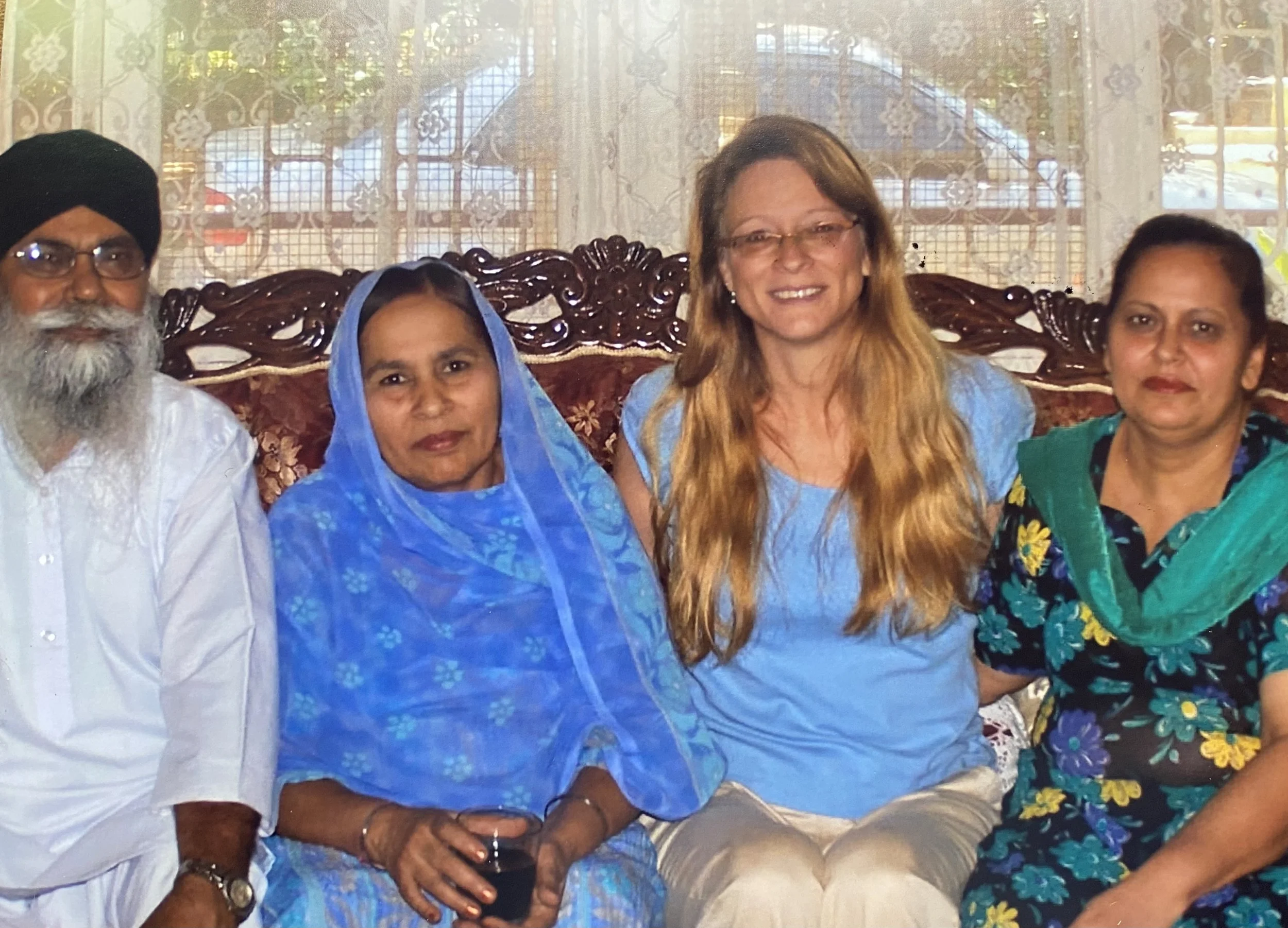
From left: a Sikh priest and his wife—still holding her glass of warm Coke—me, and Mrs. Ruprah during lunch at the Ruprahs’ home in Kisumu, May 2005. Mrs. Ruprah had long since stopped treating me like a tenant and folded me into her family and community.
They're all quite handsome in their loose, flowing clothes. Pristine. They wear satin slippers with silver embroidery, pointed at the toe and made entirely of cloth. They look wonderfully comfortable.
Mrs. Ruprah asks me to show them the photos from the wedding, so I retrieve my laptop from my house across the yard and set it up in the living room, where Raju is serving warm Coke in small glasses. The wedding photos play as an automatic slide show.
Then Mrs. Ruprah asks me to take photos of the guests, so I cross the yard again and come back with my camera. We take pictures and settle down to chat while we wait for Mr. Ruprah to arrive from the foundry.
Punjabi is flying around the room, and I sip my Coke, waiting in case someone says something in English.
I glance up at the priest's wife. She's looking at me and talking. Then I look at the handsome young priest next to her.
He's looking at me, too.
I scan the room.
Everybody is looking at me.
"What are you saying?" I ask Mrs. Ruprah.
It's rare for me to ask what people are talking about. They'll include me by interpreting if they want to. But all those eyes have gotten the better of me.
Mrs. Ruprah asks, "How old are you?"
"Oh, Good Lord! I can't believe you're telling them my age!"
Everybody laughs.
"Forty-one," I say.
The priest's wife pats her stomach. Mrs. Ruprah pats her stomach. They say, "Fat," then point at me and say, "Slim."
Now I'm embarrassed.
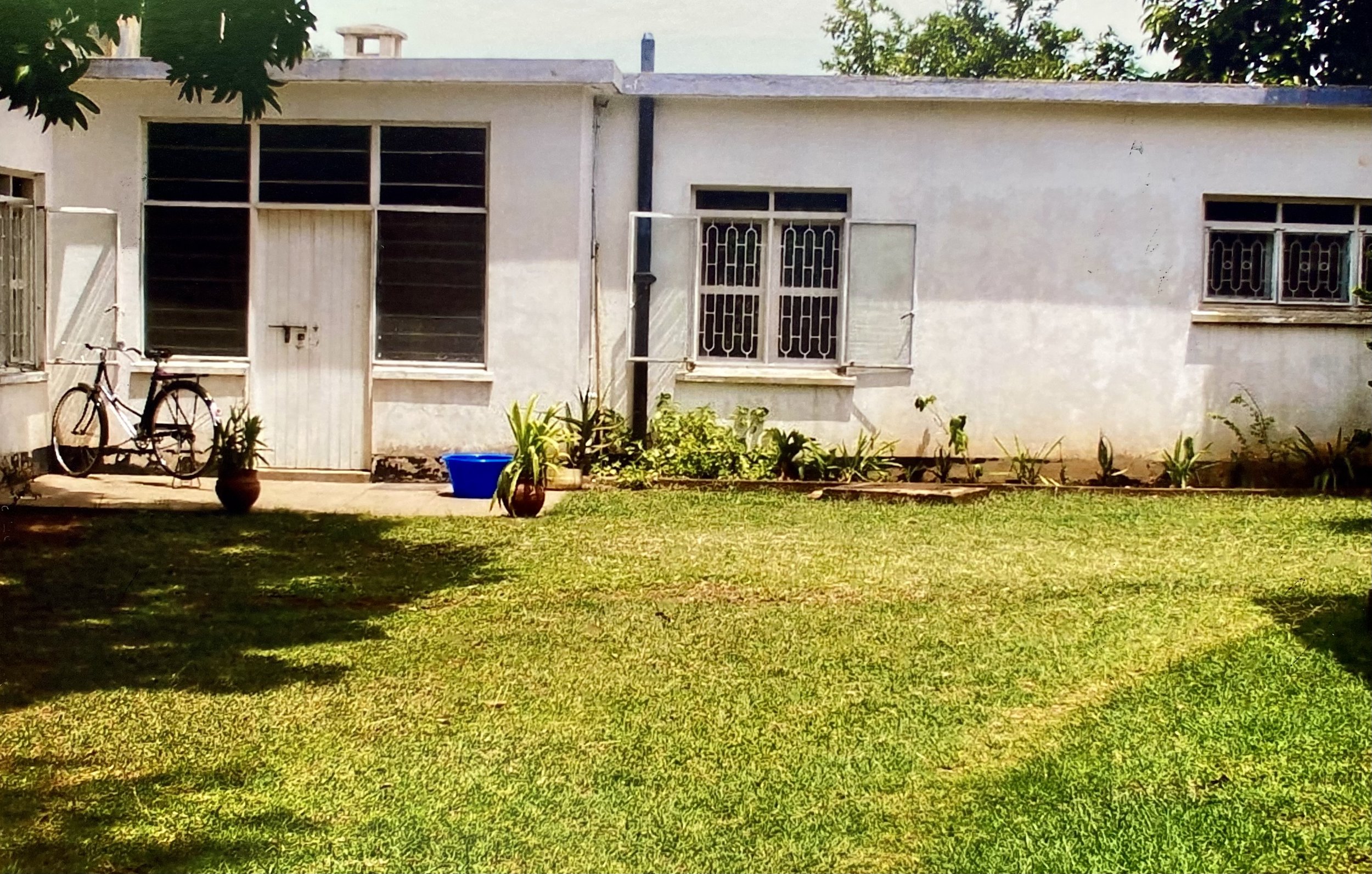
The carriage house I rented inside the Ruprahs’ walled compound in Kisumu. The bicycle at the door was how I got around town, including my daily trips to the Tropical Institute of Community of Health and Development where I worked.
When Mr. Ruprah arrives, Mrs. Ruprah goes to the kitchen and calls to me through the opening between the kitchen and dining area. She pours food into serving dishes and passes them through to me, and I place them on the table. Raju mixes one part Sunfill, a Coca-Cola product that comes in various flavors, with four parts cold water in case our guests want something besides water.
The table is set for nine.
We settle into the carved wooden chairs, and the two young priests dig in unreservedly, piling food onto their plates and not bothering much with passing the serving dishes. Somehow, the rest of us manage to get what we want.
The priest's wife gets a kick out of putting a piece of pickled lemon rind on my plate. It’s one of the most flavorful things I've ever eaten.
The meal is entirely vegetarian and delicious. After lunch, Mr. Ruprah heads back to the foundry, taking one of the young priests with him to drop off at the temple.
I ask about their understanding of God.
The eldest priest, sitting on my right, spreads his arms wide.
"God is all," he says. "God is everything."
I take him to mean that God is present everywhere—in us and throughout creation. Sikhism teaches belief in one God, and its tradition was shaped by ten human Gurus, beginning with Guru Nanak. The Gurus are revered as spiritual teachers, not worshipped as gods. A picture of Guru Nanak hangs above the dining table, although, like Christians imagining the face of Jesus, Sikhs cannot know exactly what he looked like.
The young priest tells me he is 25 years old and will marry in December.
"Is she from Kisumu?" I ask.
No, she's from India.
"What's her name?"
Well, he doesn't exactly know.
His parents back in India are busy finding a wife for him. If they choose a girl, he tells me, he will marry her.
"Tell them to make sure she's beautiful," I say.
When Raju translates, the young priest blushes.
Our guests speak very little English, and although Raju translates, he can't always capture the exact nuance of my questions. But we do okay, me, Raju and the priests, at understanding one another.
The elder priest tells me he plays and sings prayers while the younger priest plays the drum. I must come to the temple one Saturday, a holy day, and hear them sing. Mrs. Ruprah tells them I'll be on the coast for the next two weekends.
Then I must come when I return.
"You'll do this," Mrs. Ruprah says, demonstrating by placing her scarf over her head.
No one enters the gurdwara, the Sikh place of worship, with a bare head. Everyone covers their head as a sign of respect; Sikh men who wear turbans are already covered, while other visitors use a scarf or other head covering.
Mrs. Ruprah leaves the room and returns carrying a miniature piano.
"It's an old harmonium, from the seventies," Raju says.
The keys are pearly yellow, and the back panel opens so it can be pumped toward the instrument to push air through it, something like an accordion.
Mrs. Ruprah puts a multicolored songbook in my lap, and the priest chooses a prayer to sing. While his left hand pumps the harmonium, his right hand plays the keys, and he sings a Sikh hymn.
Then Mrs. Ruprah hands a pan lid to the young priest to use as a drum.
He feels silly playing a pot lid.
So Raju plays it instead.
We all laugh and enjoy the music.
It's lovely, even though everyone agrees the harmonium is old and out of tune.
About the Author
Cindi Brown is a Georgia-born writer, porch-sitter, and teller of truths, even the ones her mama once pinched her for saying out loud. She runs Porchlight Press from her 1895 house with creaking floorboards and an open door for stories with soul. When she’s not scribbling about Southern music, small towns, stray cats, places she loves, and the wild gospel that hums in red clay soil, you’ll find her out listening for the next thing worth saying.
