
Robert Lee Coleman: A Life in the Key of Blues
Held Here: Presence in Profile is a long-form portrait series devoted to the people who stayed. Those artists, archivists, entrepreneurs, and visionaries whose lives and labor have quietly shaped Macon’s cultural identity. Each story traces how creative work, carried out over time and in place, becomes Presence, and how that Presence continues to steady and sustain the city’s creative life.
This profile features Robert Lee Coleman, a Macon-born guitarist whose church-honed touch and deep-pocket groove carried him from neighborhood stages to tours with Percy Sledge and James Brown, and then back home again. A quiet giant of soul, funk, and blues, he has spent decades turning local clubs into classrooms, mentoring younger players even as his own riffs echo on classic records.
More than a sideman to history, Robert is one of its anchors in Macon, a living bridge connecting Black church basements, soul revues, Southern Rock circles, and the new generation now finding its place in the city’s sound.
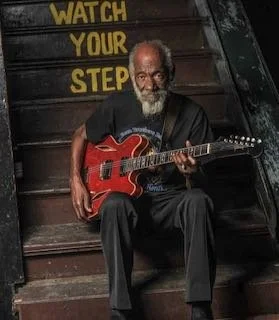
On a bright spring morning in downtown Macon, the regulars at Famous Mike’s on Poplar instantly look up and wave when an eighty‑year‑old man wearing a burgundy knitted cap eases through the door.
They already know who Robert Lee Coleman is. They know his breakfast order, too.
His manager, Johnny Mollica, hangs back on the sidewalk finishing a phone call while Robert makes his careful way inside. He moves slowly these days, accepting a steadying elbow or the back of a chair when it’s offered, but there’s nothing tentative about his presence. The room shifts around him the way it does when a beloved regular walks in.
"Ramblin' Man?" Stephanie the waitress asks, grinning, before he even sits. Scrambled eggs, cheese grits, and biscuits with sausage gravy. Famous Mike's sits just a few doors from Grant's Lounge, in the middle of a stretch of Poplar Street that Robert has known his whole life, and their menu is full of Allman Brothers-related dishes.
When asked if he'd played the bars around here, Robert pulls his head back and makes a face that says the question barely deserves an answer. Then the grin breaks through. "I played most of the bars around here," he says, with the emphasis of a man who considers the ones he missed to be their loss.
On the walls, Duane Allman stares out from Skydog posters, festival bills are layered like sediment with birthdays and anniversaries and another year the music refused to die. On several of those posters you can find the name Robert Lee Coleman.
He settles into the booth with the practiced ease of someone who has stepped onto stages for thousands of shows. His fingers, long and tapered, curl around a Styrofoam coffee cup the way they’ve curled around guitar necks since he was a boy holding his stepfather’s acoustic under the bed.
When he lifts the cup, it trembles just a little, yet the sound that comes out of those hands does not.
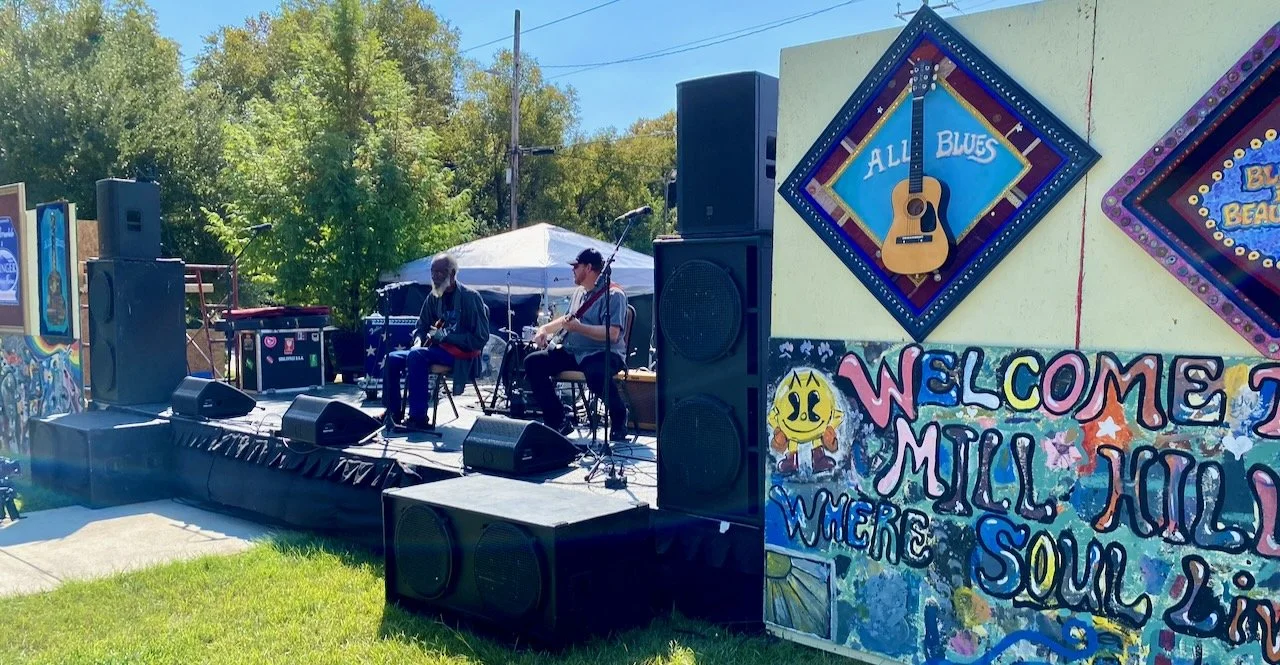
A few months earlier, at the All Blues Music & Arts Revival, he stepped toward the small bandstand with that same unhurried gait, accepting the steadying hands offered to him. He’s spent a lifetime arriving exactly where he is meant to be, and that day was no different.
He settled into his chair, guitar leaning against him like an old companion. His band watched closely, waiting for a glance, a nod, one of those small signals musicians understand when they know how to listen. Robert nodded and began to play.
The sound did not burst forward. Notes emerged deliberate and unhurried, shaped by decades of juke joints, sanctuaries, road miles, and long nights when the blues was both his livelihood and his language. His voice, unforced, met the microphone with a gentleness that carried across the grass. Around him, the festival eased into motion.
The Ocmulgee River ran just past the edge of the Mill Hill neighborhood where the blues festival was held, flowing close enough to hear on quiet mornings. Macon grew up on that river, a cotton-shipping port city whose antebellum economy moved through these very banks, carried by hands that belonged to men and women who were not paid for the carrying. Music came down that river too, or up from it.
Robert’s childhood friend and trumpeter, Newton “Newt” Collier, has traced the city's sound back further than most, and he’ll tell you that Black musicians arrived by riverboat to play banjo and fiddle for cotton buyers, a performance economy layered inside a brutal one, African hymns translated into the commercial language of the wharf. That was a long time ago, and the notes Robert played on that blues festival stage had ancestors from way back then.
The bandstand had faced art exhibits and the Church of Duane Allman, a rolling shrine to the guitarist who once called this city home, handmade by artist and festival organizer Johnny Mo, also known as John Mollica, Robert’s manager.
Inside the Mill Hill Community Arts Center, volunteers were moving soul food plates. Outside, folks placed their folding chairs in any available shade.
The afternoon had unfolded in Blues time.
Those who gathered throughout the day came for the music and art. Those who came early came for Robert.
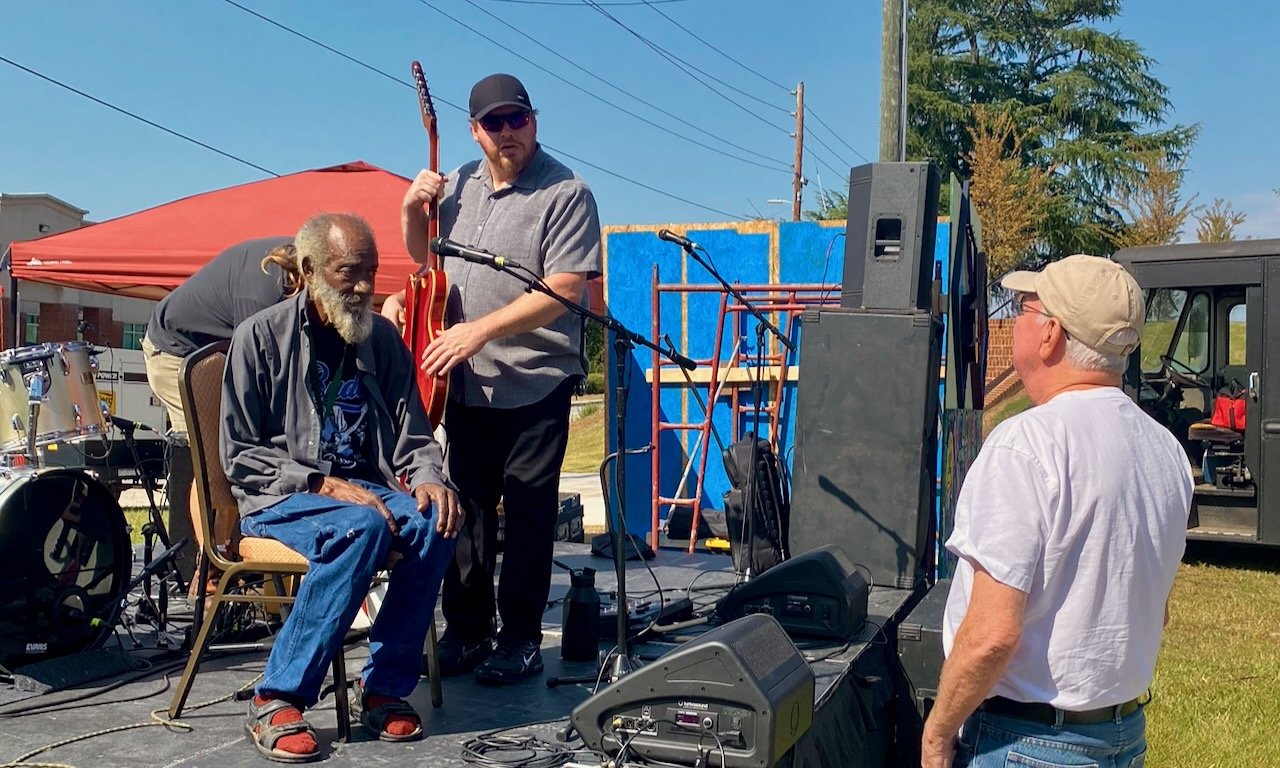
Robert Lee Coleman prepares to open the All Blues Music & Arts Revival on October 18, 2025, in Macon.
When he played, conversations softened. A few people turned in their chairs. Others leaned in without realizing they had done so. His tone was clean and unmistakably human. A handful of listeners stood near the stage, attentive and still. Others paused along the walkway. Photographers moved through the sunlight to capture the moment.
There was no showmanship, no need for flourish, only the patient endurance of a man who has played through eras of change without surrendering his voice. You could hear the echo of horns from another time in his phrasing.
Those who saw him just ten years ago remember a kinetic showman, a player who could move across a stage with the snap and swagger of rhythm and blues athleticism. He’d kick-stand his way across the stage like Chuck Berry. In fact, folks have called him Macon’s own Chuck Berry. Time has slowed that motion, but not the music’s power. Today, younger players study the space between his notes and his finger placement and pick patterns as closely as audiences once watched his footwork.
This is the blues as Robert speaks it.
He’s a hometown musician still playing the instrument he loves. He played soul and funk with Percy Sledge and James Brown, but in his heart Robert is a bluesman, full stop. Always has been. He’ll tell you to your face.
Today, he’s 80 years old and still stretching notes like a sermon. Still bending time with that unmistakable thumb-pick tone that once fired up James Brown’s bandstands.
“I’m gonna play until I die,” he has said.
For folks who know about Robert Lee Coleman, his playing is sacred. For the lucky folks who stumble in unknowing, it’s a revelation.
Those of us who were there that afternoon understood we were witnessing something precious. We were watching continuity. We saw Robert’s life in music that began in this city, traveled the world’s stages, and returned home, where he is held by the community to which he has given so much.
Robert and his blues did what they’ve always done at the All Blues Music & Arts Revival. They gathered us, held us for a while, and reminded us who we are.
The blues, the way Robert speaks it, also reminds us of where we are.
That morning at Famous Mike's, watching him curl his fingers around his Styrofoam coffee cup, it was easy to hear those same notes still in the air.
Roots and Reverence
The Coleman family came to Macon the way most Black families came to Macon, by degrees, through labor, along roads that didn’t always have names.
Robert’s father, Calvin “Red” Coleman, appears in the 1949 Macon city directory as an employee of Taylor Iron Works on 5th Street, heavy industrial work in a city that had made its money for generations on cotton, brick, and iron.
Before that, in earlier census records, Calvin is listed as a farm laborer alongside Robert’s mother, Eula Mae Thomas Coleman. The arc from rural field to city foundry was one generation’s work, and it was ongoing when Robert was born in 1945.
On his mother's side, the roots go further back and deeper into the ground. Eula Mae Thomas was born in Montezuma, in Macon County, the daughter of Alf Thomas and Carrie Lary Banks.
Carrie's grandfather, Alfred Lary (Robert’s maternal great-great-grandfather), was born enslaved in Georgia around 1849. His parents had been brought from Virginia before him, which means the institution of slavery had already moved this family across state lines. Alfred was freed as a teenager into a world that had abolished the law of ownership but preserved most of its architecture. He built a life anyway in the post-war decades when doing so required a specific kind of moral resolve that isn't recorded in census documents.
Alf Thomas's father, Martin Thomas (Robert’s paternal great-grandfather), was born into the same Georgia around 1846, old enough that slavery and war shaped his entire coming of age. By 1910, he and his wife Fannie Pack Thomas were living on Central Avenue in Griffin, Georgia. Fannie was taking in laundry at age fifty, their son Ed hauling freight at a livery stable at nineteen. Fannie had given birth to eleven children but four of them had not survived. Martin, in his mid-sixties, was no longer working. Their youngest child still at home was 12-year-old Alf Thomas, Robert’s grandfather.
Alf Thomas, born in Pike County, shows up in a 1917 draft registration in Griffin, Georgia, his occupation listed as truck driver for Persons‑Hammond Hardware Company, a local firm advertising everything from stoves to farm equipment in the early twentieth century. The family’s labor moved with the region’s economy: timber, hardware, hauling, the kinds of jobs that kept central Georgia’s small cities running.
By 1940, when Robert wouldn’t be born for five more years, his immediate family had gathered along Macon Road in Byron, just outside Macon. His parents Calvin and Eula Mae were living with their children, and Eula Mae’s parents, Walter Banks and Carrie Lary Banks, were nearby, if not at the next farm. Towns like Byron held families in transition: close enough to Macon’s industrial work to matter, far enough from the city to still feel like the rural Georgia they had come from.
On his maternal side, two men in Robert’s family had been born into bondage in Georgia in the 1840s, on two separate branches of the same tree. Their descendants, Carrie Lary and Alf Thomas, would meet, marry, and have a daughter named Eula Mae.
Eula Mae's son would pick up a guitar and play with Percy Sledge and James Brown.
From Alfred Lary and Martin Thomas, both born into bondage in Georgia in the 1840s, to Robert Lee Coleman on a concert stage took only one century. That’s close enough in time that the family stories could have been passed mouth to ear generation after generation.
Robert’s father Calvin “Red” Coleman died in March 1973, age 67, a member of Macon’s Rising Star Society and the Helping Hand Society, mutual‑aid organizations that filled the gaps left by institutions that were never built for people like him. His funeral service was held at New Corinth Baptist Church and he’s buried at Liberty Cemetery. By 1973, Robert was living in New Jersey, carrying the education of Percy Sledge and James Brown into the world.
Everette Lee “Steel” Emory, Robert’s stepfather, was born in 1924 in Laurens County, GA, and died in 1990 at sixty‑five, having followed a similar path of hard work from rural farm routes into Macon industry.
Everette worked steady jobs that built mid-century Macon, employed at Cherokee Brick Company and later Joe Barry Septic Tank Company. After his divorce from Robert’s mother, he went on to marry Beatrice Jones and they raised a family. His family put a guitar on his headstone, the carved bronze outline of an instrument resting beneath his name at Middle Georgia Memory Gardens, showing the world how important that instrument was to Everette.
As a boy, Robert ached to touch Steel's guitar from the beginning. Everette kept it in a corner, behind the bed, and the household rule was clear without being spoken. "When Mama and him would go to town," Robert recalled, "I'd watch them until they were out of sight, then I'd go climb under the bed. I'd lay the guitar on top of me and play it. They might be gone one or two hours and I'd stay there the whole time." He taught himself from chord charts and from watching. He has never read sheet music. "I play what I hear," he says. "I play by ear." It is the same way he still plays today.
Robert talks about Everette often, the man who played with such authority and joy that the boy watching him decided, without one formal lesson, that the guitar was what he wanted to master.
Robert’s family history stretches back to the first fragile years of freedom in Georgia. In the generations that followed, his descendants labored in fields and timber camps, built families during the rise of Jim Crow, anchored themselves in church and community, and carved stability from scarcity. Each generation advanced not by leaps, but by persistence, preserving dignity, protecting kin, and holding fast to possibility.
By the time Robert was born, that inheritance had taken root in Macon’s working neighborhoods, with faith, resilience, mutual care, and the unspoken understanding that survival itself was a form of triumph. His father and stepfather worked fields, iron, brick, and septic lines in and around Macon. His mother raised her children in that same city and lived long enough to see grandchildren and great‑grandchildren carry the name forward.
Eula Mae Thomas Coleman, born in Montezuma and a member of Davis Temple Church in Macon, was more than a mother of musicians. She was an evangelist, which Robert translates simply and plainly: "She was a preacher." In mid-century Macon, a Black woman who led a church was a pillar of daily life in ways that stretched from Sunday mornings to days of the week. She visited the sick, counseled families in crisis, and carried the weight of a congregation that had no other institution to lean on. The measure of how much she meant to Robert is in what happened when she died in 1997. He didn't pick up a guitar for two years. Music left him the way it leaves a person when the ground crumbles beneath them. She is buried at Bibb Mount Zion Baptist Church Cemetery, not far from the Macon she anchored for decades.
Instead of picking brick or cotton, though, Robert picked strings. If he rarely speaks of the past, it may be because he carries it in rhythm and the quiet authority with which he holds a guitar. The music moves forward, but the strength beneath it was forged before he played his first note. He played his way through Sledge’s soul revues and Brown’s funk laboratories and then came home to a Sunday‑night bandstand, still stretching notes that have been trying to get free along this stretch of middle Georgia for a very long time.
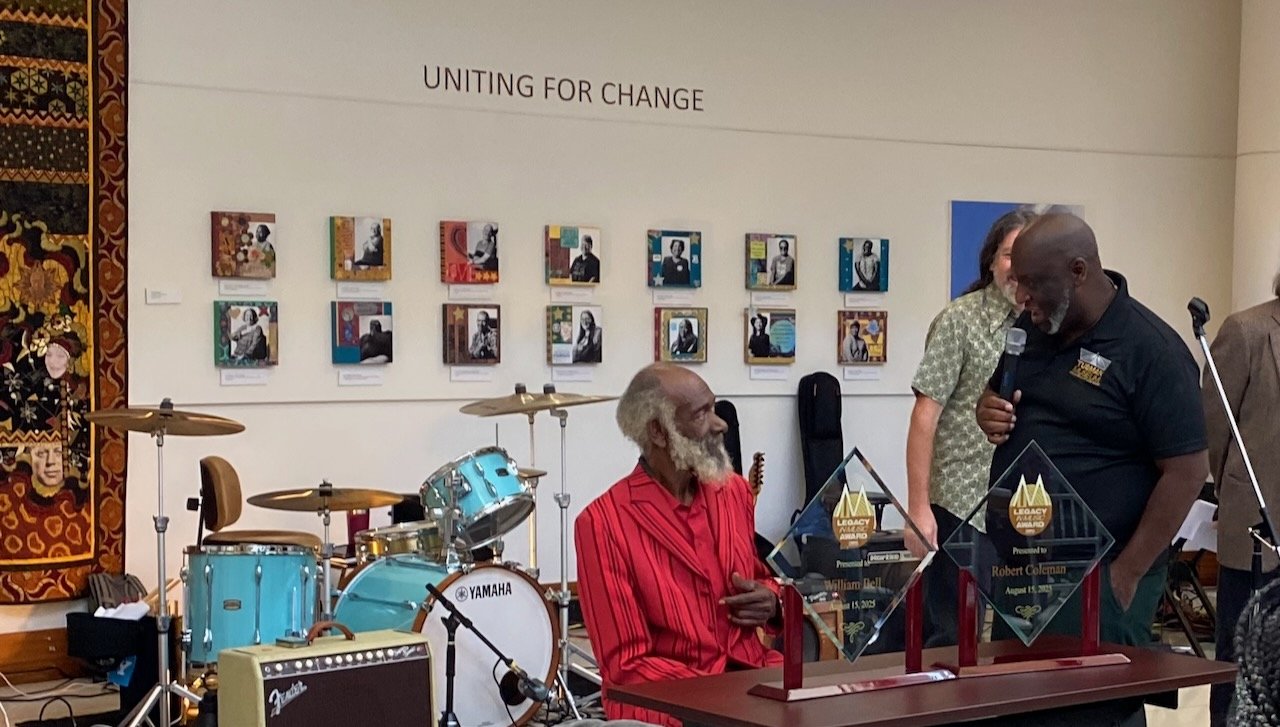
Robert Lee Coleman receiving his Legacy in Music Award at the Tubman Museum.
Making the City
Macon was built before it was heard. The cotton warehouses along the Ocmulgee, the rail lines threading into the piedmont, the brick facades of Cherry Street, did not arrive fully formed. It was made by hand, much of it Black hand, across generations when that labor was taken without payment and then, afterward, paid too little.
The men who laid the foundations of Macon’s civic life did not always get to live in the buildings they raised. But they lived nearby. And in those nearby streets, something else was being built.
The city’s brick industry depended heavily on Black labor well into the twentieth century. At Cherokee Brick, at the yards along the river, men turned clay into the material from which Macon made itself permanent. Black brick masons organized into their own local, Local No. 4, one of two masonry unions in town, working within a segregated system that shaped who labored where and how that labor was recognized. They knew the walls of the city because they had helped raise them.
Calvin Coleman hauled iron at Taylor Iron Works on 5th Street. Everette Emory pressed brick at Cherokee and later ran septic lines under yards and roads. Robert didn’t lay brick or pour iron, but he carried the same tradition into a different medium, working for decades as a carpenter, hired by Macon contractors to build and repair homes, doing everything, Robert says, “except laying brick.” The work these men did was heavy, physical, imprecise in its rewards, a wage that barely kept pace with the cost of a rented house in a neighborhood that better-off Macon rarely entered.
They weren’t romantic jobs. They were survival work, the kind that makes a man tired in a specific way, tired in his wrists and his back. But the week ended, and then came Saturday and Sunday.
And on those evenings, in Tindall Heights and the Pleasant Hill neighborhood where Robert Lee Coleman and Little Richard Penniman grew up, and in the church corridors, music was the other kind of work, the kind that didn’t take from you.
In 1921, Charles Douglass opened the Douglass Theatre on a street Black Maconites could walk down freely, and the space became a gathering point for Macon’s sound. Talent nights. Touring acts from the Chitlin’ Circuit passing through. A boy named Otis Redding watching from the audience, then eventually standing at the front of it. The building itself emerged within the separate-and-unequal world of Jim Crow, where Black audiences and performers built their own institutions because equal access to white-controlled venues was denied. The Douglass became a cultural anchor, not apart from the city, but necessary to it.
James Brown cut his first demos in Macon. Little Richard was already shaping the vocabulary of rock and roll in the rooms of Pleasant Hill before any major label knew his name. The Allman Brothers came later and built Capricorn Studios into a place where the blues, gospel, and country threads of central Georgia’s music history could be pulled into something called Southern rock, though the Black roots of it were older than any label.
What all of these artists shared was not just geography. They shared an education from porch steps and Sunday services, from juke joints at the edge of working neighborhoods, in a city that had trained its Black residents in endurance and then watched, sometimes without acknowledgment, as that endurance turned into art.
Everette “Steel” Emory came home from Cherokee Brick and picked up a guitar. That is not a remarkable sentence in Macon. It happened in hundreds of houses, in dozens of neighborhoods, for most of the twentieth century. What made Everette particular was the quality of it, the authority Robert still talks about when he recalls watching his stepfather play, a boy sitting attentively on the living room floor, not yet old enough to understand what he was seeing but old enough to feel it.
No formal lessons trained Robert’s hands. No one explained music theory or chord structures. There was just a man who had worked all week with his hands and was now, in the evening light, doing something entirely different with them.
Robert watched.
Then he picked up the guitar himself.
Those years on the road with Percy Sledge and within James Brown’s musical world, the decades of bandstands and blues sets, the nights back home all came from that first act of watching.
Macon made its musicians the way it made its buildings. Through labor and a kind of accumulated pressure that eventually had to go somewhere. The iron and brick and clay went into walls.
The music went somewhere else.
Tindall Heights and Pleasant Hill
Tindall Heights was built tight with brick rows, narrow streets, children running the same loops between porches and ball courts. In the years when Robert was coming up there, the neighborhood held more than families making rent. It held a kind of low-level hum, horns practicing after supper, a radio pushing gospel and rhythm and blues through thin walls, somebody’s auntie calling from a kitchen window. Trumpeter Newton Collier lived in those blocks too. So did Arthur “Bo” Ponder, already humming melodies under his breath. Before any of them set foot in a studio or on a tour bus, they were simply boys in a neighborhood that happened to sit in the path of a rising musical current.
If Macon’s mills and foundries shaped the workday, places like Tindall Heights shaped the off hours. Church choirs and school bands were extensions of the neighborhood, not separate from it. Kids walked from those apartments into sanctuaries where the music was sanctified and loud, and into community centers where band directors expected as much focus as any foreman on a line.
The sound of the city, with its blues bending toward soul and gospel shading into rhythm and blues, was not an abstraction. It was what came through the windows at night and what waited at the end of the bus ride in town.
The neighborhood held more than musicians. It held the whole architecture of a working Black community in mid-century Georgia. Otis Redding Sr., father of a boy who would become one of the most important voices in American music, worked as a civilian laborer at Robins Air Force Base down the road in Warner Robins, one of the few employers in the region that offered Black men relatively stable industrial wages, however unequally distributed.
The Redding family lived in Tindall Heights. His son, born in 1941, grew up on the same streets, attended Ballard-Hudson High School, competed at the Douglass Theatre talent shows, took music lessons from Gladys Williams, and spent his formative years being shaped by the same neighborhood that held Robert Lee Coleman and Newton Collier and, just over the neighborhood line in Pleasant Hill, Robert O'Neal (later known as Bobby O’Dea), and Richard Wayne Penniman.
These were not coincidences of geography. Tindall Heights and Pleasant Hill were where Black Macon families lived because those were the places they were permitted, and in practice often restricted, to live under segregation. That system compressed an entire city’s worth of ambition, talent, and creative energy into a few square miles. What grew from that compression, entirely against the system’s intentions, was a musical culture that would reach far beyond Macon.
Not all of those workers were allowed to live in the towns they were helping build. In the early 1940s, Black laborers constructing Robins Field (later Air Force Base) were pushed into a settlement known as Jody Town, one of several communities in Middle Georgia that grew vibrant cultures under segregation’s restrictions and would later be cleared away in the name of progress.
In Tindall Heights and Pleasant Hill, around the children, a web of adults quietly kept the engine turning.
Mrs. Gladys Williams was, by any honest accounting, one of the most important musical figures in the neighborhood who never left it. She was already a legend by the time these boys were finding their way, and she ran her music life out of living rooms, churches, and downtown rooms, playing seven days a week and somehow still making space on Saturdays for students. She had studied at the Hampton Institute in Virginia on scholarship provided by an anonymous donor, receiving formal training almost no Black woman in Georgia could access. She came home to Macon and became its first Black female bandleader, leading an orchestra versatile enough to play square dances at white VFW clubs one hour and blues at a Black club the next.
Mrs. Williams’ home was listed in the Green Book, which meant that when touring artists came through Macon, they knew exactly where to go. James Brown, Otis Redding, and Sammy Davis Jr. came through her door. Williams ran Sunday talent shows that Redding attended as a teenager and hosted the kind of informal sessions where a working musician could sit beside a touring star and understand, by proximity alone, what the next level required. She turned down recording contracts because she would not leave Macon. WIBB DJ and personality Hamp Swain, who knew everyone, put it plainly: “Between Gladys Williams and Clint Brantley, they were everything in Macon. Everything.”
Band director Robert L. Scott Jr. held another piece of the pipeline at Ballard-Hudson High and the Booker T. Washington Community Center, drilling Black teenagers in reading charts and holding their parts, insisting they treat band practice as seriously as any job. Even if Robert never sat in Scott’s classroom or took a lesson at Mrs. Williams’ piano, he grew up in the shadow of their standards. His friends and neighbors did, and that expectation had a way of traveling.
Downtown, Clint Brantley’s rooms gave all that practice somewhere to land. His clubs like the Two Spot, the Key Club near Walnut and Fifth, and Club 15 were small on the outside and enormous on the inside—if you were a teenager in Macon hearing them talked about in Tindall Heights.
But Tindall Heights did not exist in isolation. Just over its shoulder sat Pleasant Hill, and between them the two neighborhoods formed a single musical geography, close enough that the same trumpet could carry from one set of porches to the other.
Pleasant Hill was the older story. Organized in 1872 as a neighborhood built by Black Maconites for Black Maconites, it grew across the following decades into a self-sustaining community shaped by both resilience and restriction. Segregation, by its perverse logic, concentrated Black professionals, institutions, and capital into the neighborhood, creating a place where Black doctors, lawyers, and business owners lived and worked within walking distance of one another. Pleasant Hill had its own hospital (Lundy Hospital), its own library (Amelia Hutchings Library), and stately homes with manicured lawns lining its streets. It was listed on the National Register of Historic Places in 1996.
By the mid-twentieth century, it was one of the most prosperous Black neighborhoods in central Georgia, and it was where a boy named Richard Wayne Penniman was growing in a hip-roof shotgun house, getting ready to leave Macon and become Little Richard.
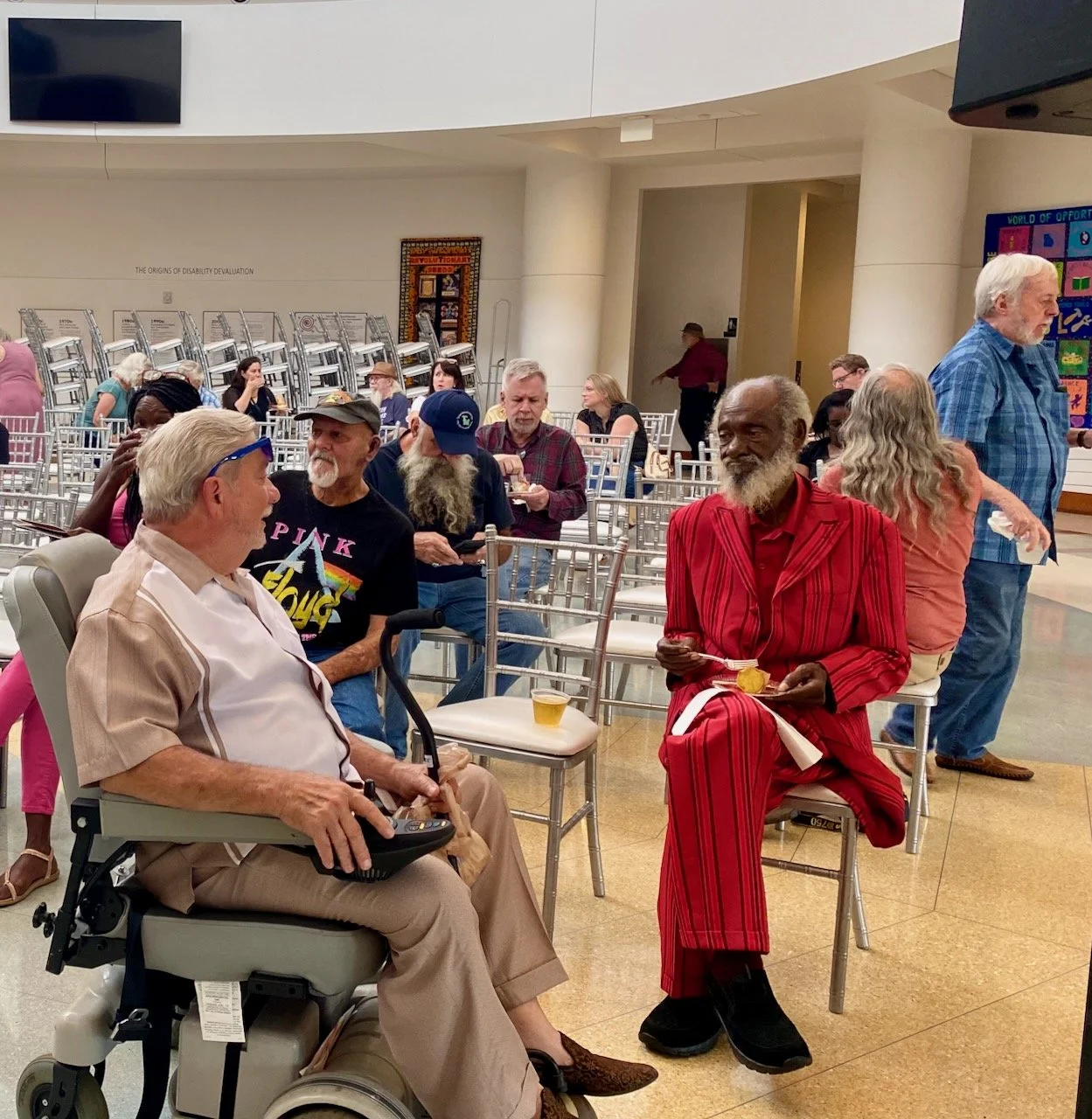
Robert Lee Coleman speaks to admirers as The Tubman Museum fills with folks gathering to honor him and William Bell of Stax Records. In the crowd are Kirk West, Tim Griggs of Capricorn, and Paul Hornsby, musician and architect of Southern Rock.
Bobby O'Dea (Robert O’Neal), an organist who would go on to perform alongside Robert in the 1980s, grew up in those same Pleasant Hill blocks, in the same years, running with the same crowd as Penniman. They played together as teenagers, assembling a sound in rooms that didn't yet have a name. When Bobby left Macon to see what the road offered, he carried that education with him.
Then Interstate 75 arrived. Construction began in the mid-1960s, part of the federally funded highway system initiated under President Dwight D. Eisenhower, designed to improve national mobility and, in part, to support military transportation in times of emergency.
In Macon, as in cities across the country, the route chosen carried local consequences. The highway cut directly through Pleasant Hill, bisecting one of the city’s oldest and most established Black neighborhoods. Approximately two hundred homes were taken. Streets that had once connected families, churches, and businesses were severed. One half of the neighborhood was physically separated from the other.
The Little Richard House on Fifth Street was moved to avoid demolition. Many other structures were not preserved. Doctors’ offices, small businesses, and the accumulated architecture of Black professional life in Pleasant Hill did not survive the construction.
What was disrupted was more than the built environment. Pleasant Hill had functioned as a close-knit community shaped by proximity, where children moved easily between homes, where music traveled through open windows, where mentorship and watchfulness were shared across blocks. The interstate fractured that continuity.
The change was permanent. While the highway fulfilled its broader purpose as infrastructure, the cost of its placement was borne locally, altering the physical and social fabric of the neighborhood in ways that could not be restored.
And as that fabric was torn, something else shifted with it. The same conditions that had once concentrated musicians, the shared space, constant proximity, the easy passing of sound and influence, began to loosen. Some players left in search of opportunity elsewhere. Others carried the sound of Pleasant Hill outward, into studios, onto stages, into cities that would benefit from what had been formed in a much smaller place.
Robert Lee Coleman grew up in Tindall Heights, not Pleasant Hill, but Newt Collier, who grew up in Tindall Heights too, puts it plainly: “They were different neighborhoods but the same music neighborhood.” The same institutions claimed them both. The same web of adults quietly kept the engine turning.
Clint booked the touring acts rolling through the Chitlin’ Circuit and stocked his bands with local players, rotating young horns and rhythm sections into working lineups. It was in those rooms that Newt Collier slipped in underage, shadowing older trumpeters like Obe Kimbrough and Harold “Shang-a-Lang” Smith, learning the unspoken rules of how to follow a singer you’d never rehearsed with, how to keep the groove steady when the floor got crowded.
Whether or not Robert found his way through those club doors as a boy, he certainly heard the stories about who had gotten the call and who had held the gig.
There was another stream feeding the neighborhood too, one that ran through Robins Air Force Base down the road. Black servicemen from the base band came into Macon on their off days, bringing with them big-band charts, jazz training, and the polish of formal military ensembles. One of them, a trumpeter and organist named Sammy Coleman from Texas, took to Macon as much as Macon took to him. He moved into the neighborhood, walked the same sidewalks, and became a kind of older brother to younger players, leading them down to Brantley’s clubs, teaching them nightclub etiquette and how to keep a crowd on its feet.
Service musicians like Sammy made the line between base and city porous by sharing what they had learned in uniform, like discipline, timing, listening hard, and then slipping into the local bands and, through them, into the ears of boys like Robert.
A kid in Tindall Heights only had to step outside and listen to a trumpet working through a passage a few doors down, a guitar being tuned after a long day’s shift, someone practicing the same vocal run over and over in their bedroom.
When Robert finally wrapped his hands around a guitar neck, he was not beginning from nothing. He was stepping into a line that had already been laid out in front of him in a neighborhood that understood music as both escape and work.
Those Early Days
In a neighborhood where music moved easily between houses, it also lived inside Robert’s own home.
His stepfather, Everette “Steel” Emory, was one of those rare players who could sound like anybody. According to Robert, Muddy Waters, Hank Williams, Lightnin’ Hopkins all lived in Everette’s fingertips. People urged him to record. They raised the money for it more than once. But Everette never would play for a recorder. The music stayed in the room, in the moment, passed from ear to ear rather than pressed into vinyl.
As a small child, Robert had already found his way to the instrument on his own. He would lie on the floor beneath the bed, the guitar resting above him, hidden from view, working out sounds in secret while the house was empty. That’s where Everette kept his guitar, behind the bed, within reach but not offered, the rule understood without being spoken.
And yet, for all the music that surrounded him, for all that lived in Everette’s hands, there was no moment of invitation. No handing down. No “Here, son. Try this.”
“He didn’t ever show me nothing,” Robert said years later. “Any time he grabbed the guitar at the house, I’d sit down cross-legged in the living room and watch him play. I wasn’t even in school yet.” That would’ve been around 1950 or so.
Robert doesn’t speak with anger, and rarely elaborates on his stepfather’s story, but there’s a quiet question still hanging in the air after all these years.
Why not?
Maybe Everette didn’t know how to hand down the thing he carried in his bones. Or maybe he simply believed Robert would find his own way. On that he was right, because somehow Robert learned anyway.
“I’ve never had a lesson in my life,” Robert says. “Nobody ever showed me. I just play what I hear.”
And what he hears, the world now hears, too.
Everette may never have sat his stepson down for formal instruction but he did something more powerful. He placed the instrument within reach and filled the air with its voice.
Apprenticeship in Sound
Robert didn’t grow up with lessons or sheet music, but he did grow up watching. Eyes wide, fingers itching to imitate, he learned by stealing moments, by standing close enough to see how a chord was fretted, to hear the difference between a bent note and a missed one. He listened harder than most kids, mimicking movements until pitch and tone settled into his hands.
Like so many Southern greats, his first real stage was the Black church. He was around thirteen, after Everette was no longer in the home, when he began backing gospel singers, learning to leave enough space for the Spirit and the soloist. That early foundation became a compass he never really lost.
By the early 1960s, Macon was a forge for sound. On a Saturday night, a teenage Robert might be at Ann’s Tic Toc Room, the Elks Club, the Two Spot, or Club 15, the same rooms where Little Richard, Otis Redding, and James Brown had already set fires and moved on. The walls in those places held memory a young guitarist could feel.
When he formed the Underground Railroad with childhood friends Arthur “Bo” Ponder, Clarence Lucas, and Calvin Arline, the name did more than look good on a poster. In a Southern city where segregation still shaped bus routes and bar lines, and the Civil Rights movement was gathering force, “Underground Railroad” spoke in code and in plain language at once. Movement, resistance, and brilliance were just under the surface, freedom carrying on sound. People understood what they were saying, even if no one said it out loud.
Around the same time, Robert and Bo Ponder were collaborating on something more private: a handwritten book of original songs.
“I’d sit with my guitar and play,” Robert said, “and Bo would write everything down.”
They were seventeen. Bo later took Otis Redding's place in the Pinetoppers when Otis left for the road, and people in the neighborhood called Bo "Lil O" because he could sound uncannily like Otis; could sound like anybody, really. Some people said Bo sang better than Otis.
Bo Ponder died a few years ago, and that handwritten book of songs has not been found. Robert doesn't have a copy. What they wrote together as teenagers, two boys from Tindall Heights with a guitar and a notebook, is gone, the way so much of this history goes. Unremarked, unarchived, irreplaceable.
Robert was coming up at a moment when Macon’s music was shifting in real time. Gospel harmonies slipped out of sanctuaries and into Saturday-night dance halls. Blues phrasing met horn sections and sharp backbeats. Rhythm and blues thickened into soul, and soul leaned toward funk, as working bands adjusted to what dancers demanded and what the times required.
Musicians like Robert learned to move between styles without abandoning their roots, just as he had watched Everette do, building a sound as fluid as the audiences they played for.
He wasn’t walking that road alone. Boyhood friends who became musicians, like Arthur “Bo” Ponder and Newton Collier, were on the same circuit, learning on Macon stages, carrying their craft to regional and national bands, then bringing new ideas back home.
Arthur "Bo" Ponder had a different kind of gift. He possessed a specific and sophisticated musical skill that speaks directly to how musicians in that world learned. Bo could take on the full personality of any singer he was covering, not just the voice, but the body. Otis Redding didn't exactly dance; he did a fast shuffle, a locked rhythmic communication between his feet and the band. When Bo sang Otis, he shuffled like Otis.
When Bobby Womack's records became popular and Bo turned his attention there, he became Bobby Womack, borrowing the posture, the lean, the way the phrasing changed when the lyric got heavy. It was mimicry only in the way that close study is mimicry. You don't reproduce a man's body on stage unless you have watched him the way musicians in that world watched each other: with the focused, hungry attention of someone who understands that what they are seeing is the lesson.
Together, young people from Tindall Heights and Pleasant Hill, like Robert, Newt, Bo, and Bobby formed a quiet brotherhood of working players who helped give the city its evolving voice.
Two Schools
By 1964, Robert Lee Coleman had already logged what most musicians would consider a full education. He'd learned guitar without a single formal lesson, by practicing relentlessly to sound like Muddy Waters and Lightning Hopkins. He'd carried the gospel through the Silver Bells and the Morningstars at church. He'd held down residencies at Macon clubs and house parties, barbecues, and back rooms downtown.
Then Percy Sledge came to town.
Sledge heard Robert's band at Clint Brantley's club in 1964 and left that night with the horn players. A few days later, someone sent for the guitarist. Robert packed up and went. He was nineteen years old. What followed was six years on the road across the United States, through Europe, into the Caribbean and Africa, playing behind a man who understood, deeply, that the best soul music moves the way grief does. Slowly, and in waves.
Sledge was not a technician's singer. He was a confessor. His voice on "When a Man Loves a Woman,” recorded at Fame Studios in Muscle Shoals with Spooner Oldham at the organ, didn't dazzle you with runs. It stayed inside a feeling until the feeling became unbearable. The raw delivery of a former hospital orderly from Alabama crystallized what Southern soul was. It sure didn’t sound like the polished assembly line of Detroit.
Robert was already in Sledge's touring band when the song hit number one in 1966. Night after night, on stages in venues he'd never have found from Macon, he had to hold that feeling in place, to be, as his manager John Mollica would later put it, a guitarist who knew what not to play.
This was the first school. In this School of Soul, Sledge taught Robert how to stretch a note. How to sit inside a tempo without crowding the singer. How to let the space between phrases breathe. A guitar in a soul ballad is less a lead instrument than a second voice, one that comforts, responds, and asks back. The church vocabulary Robert had been building since childhood found its full context on those stages.
He came home in early 1970, tired of the road.
He stayed in Macon for only a handful of months before James Brown came to town.
Robert later recalled the sequence plainly. "About 1970 James came here and picked me up."
After restructuring his band and building the J.B.’s from the ground up, Brown was assembling a 13-piece operation built around funk, the newest, hardest thing he wanted to pursue. He needed players who could execute with no give.
Bo Ponder, who had played with Robert in Macon bands since they were twelve years old, remembered the moment Brown heard his friend play. "Robert Lee's playing blew James Brown's mind," Bo said. "James said, 'I've got to have that guitar player.'"
This was the second school, the School of Funk, and it ran on entirely different rules. This was boot camp compared to sledge’s congregational feel. Brown micromanaged song arrangements and demanded absolute show discipline.
He was known to penalize his band members for missed notes or other infractions. But Robert was cool with it, he explained, because he’s a Taurus and Brown was a Taurus, “so we got along just fine,” Robert said.
Where Sledge's band asked the guitar to sing, Brown's asked it to lock in and disappear into something larger. The J.B.'s played like one instrument made of thirteen people. In the studio, Brown would walk down the line and hum each player their part, expecting them to catch it and hold it exactly. There was little room for expression in the conventional sense. A guitarist might be handed a single note and told that the note was everything. Coleman himself described it this way: "With James you've got to play parts. I was the lead guitar player. So I might just play one note in a song, and that's all James wanted to hear."
Robert found his restraint as he laid down the clipped, interlocking stabs alongside Hearlon “Cheese” Martin on the 1971 single “Make it Funky.” He stood on the Apollo stage in New York, relentlessly grooving on the live album Revolution of the Mind. His most documented contribution from those years is the guitar lick at the heart of "Hot Pants,” a clipped, repeating groove that locks with the drums and bass into a syncopated pulse. Brown pushed to have the label reprint the writing credits to include Coleman's name. "That's the only lick he let me have," Coleman said, and laughed. The groove on "Hot Pants" has since become a template often sampled, cited, and replicated in the canon of early funk and in hip-hop productions decades later.
Sledge taught Robert how to stretch a note. Brown taught him where to put it.
Together, those years with Sledge and Brown created a dialect that Coleman carries still. It’s the sound of gospel expressiveness welded to razor-tight percussive funk, in the same body. A sound built somewhere between the church, where he learned to feel music, and Brantley’s clubs, where he learned to make a room move.
Music Maker co-founder Tim Duffy, who has worked with Robert for years, put it plainly. "Percy Sledge and James Brown, they needed Robert's sound to make that music. They could've had anyone, but they wanted their own guys."
What's notable is how Robert held onto both educations without letting either one swallow the other. He came back to Macon both times. The road had changed him, expanded his sense of audience and profession and geography, but it hadn't relocated him. The city was still there when he returned, smaller now in some ways, quieter, the clubs cycling through owners and names.
When Capricorn Records declined and the broader music scene shifted, he let the fading industry go and returned to local bandstands, keeping that lineage alive in the rooms where it started.
After returning to Macon, Robert settled into a regular band slot at The Rookery through the 1980s, where he and Bobby O'Dea built their house band on Cherry Street. Years later, separate from that chapter, he took on a Monday-night residency at the Back Porch Lounge that lasted for several years, ending only a couple of years ago.
After three years with James Brown, he had simply walked away.
“I got tired,” he says. “The road is hard. It’s nothing to mess with.”
Most players would’ve stayed for the fame or the money or the proximity to greatness. But Robert knew who he was, and more importantly, where he came from. He came back home to red dirt, not red carpets. To something slower, but no less sacred. Something that has lasted.
543 Cherry Street
Robert came home the way a lot of road musicians come home. Quietly, without announcement, carrying the weight of what he'd seen and the relief of putting down the road. He walked away toward peace and sanity, not in defeat but with intention.
By the early 1970s, Robert had toured with Percy Sledge through the soul‑revue circuit and spent time inside James Brown's operation, one of the tightest and most demanding musical machines in American popular music. Whatever those years gave him as far as timing, stage presence, and knowing how a band is supposed to move as a single organism, he carried it back to the same city where Everette had first shown him what a guitar could do.
He came home to Macon’s cracked sidewalks, old jam buddies, and a hot music scene that rarely got the headlines.
He made a quiet living working at a junkyard, mowing grass, doing side gigs while slipping back into the city’s musical bloodstream. The Rookery. The Back Porch Lounge. He became a fixture, a mentor, a band director, a steady performer, not a flashback.
Capricorn Records was still running when Robert came back, the Allman Brothers still trading on their Macon mythology, the city still lit with the particular energy of a place that had convinced itself it was the center of something. But that energy had a short shelf life. Phil Walden's label filed for bankruptcy in 1979, and the machine that had turned a mid‑sized Georgia city into a recording capital began to wind down. The national press moved on. The touring acts found other homes. Macon was left with itself.
What it had left was not nothing. It had Grant's Lounge. It had musicians who had nowhere particular to go and no particular reason to leave. And it had The Rookery, which opened in 1976 at 543 Cherry Street, a burger‑and‑beer room with a small stage, the kind of place where you could hear Rickie Lee Jones on a Tuesday and a local blues duo on a Wednesday and nobody found that strange. The room was not glamorous. It was functional, which is its own kind of gift to a working musician.
The Rookery was just a gritty, music-loving joint where Robert linked up with keyboardist and Macon mainstay organist Bobby O’Dea. Together, they built a house band that turned weeknights into jam sessions and that tiny stage into backwoods baptisms.
Their R&B grooves spilled out into sidewalk crowds.
Bobby's name doesn't appear in many written histories, which is its own kind of statement about how the record has been kept. But in every account of Robert's Rookery years, Bobby is there as the organist who called tunes and steered harmonies while Robert stretched notes above him. Between the two of them, the room had a pulse. Players coming through Macon would find it.
Kyler Moseley, who has spent years documenting what happened in these rooms, notes that mostly R&B groups performed at The Rookery in the 1980s. That says something worth sitting with. In a decade when Macon's documented music story was pivoting toward college rock and new wave, when the cultural conversation was moving away from the Black‑rooted sound that had built the city's reputation, Robert and Bobby were still holding down a bandstand playing the music that mattered.
Cherry Street was not Muscle Shoals. It was not the Apollo.
It was The Rookery where the kitchen smelled like fries and the stage was just big enough for maybe three bodies. But for a young guitarist or horn player or singer coming up in Macon in the 1980s, it was exactly the right size.
On any given night, touring players drifted in. Allman Brothers alumni Dickey Betts and Jaimoe might stop by to sit in, and younger musicians hovered along the edges, hoping for a nod, or a chance to just rush the stage with their instrument at the ready. Robert was known for giving that nod but he didn’t teach by talking, he taught by playing, just like he’d taught himself to play. The young folks had to listen more than they played. And if he nodded at them mid-song, that meant something. Something to tell their best friend about.
Chris Hicks, who would go on to play with The Outlaws and anchor the Marshall Tucker Band for decades, credits Robert and Bobby with folding him into Macon's musical circle, not through a formal introduction or a business transaction, but through the older, quieter process of being allowed to stand near greatness and listen.
You came in. You paid attention. If you were ready, someone noticed. That is how it has always worked in rooms like this, in cities like this, and Robert understood his role in it as clearly as he understood his role in any song. He was the keeper of the bandstand. He held it open.
The Rookery is still there on Cherry Street, one of the oldest restaurants in downtown Macon, the kind of institution that outlasts the eras it passes through. It became the birthplace of Bragg Jam, Macon's summer music festival, which now fills local clubs with hundreds of musicians in a single afternoon.
The line from a quiet 1980s R&B house band to that annual celebration is not a straight one, but it runs through the same address. Robert and Bobby were part of the bridge, men who kept the current moving when nobody was watching, when the labels had gone quiet and the national press had looked away. They played because the city needed playing. The groove doesn't stop just because the cameras do.
The man across the bandstand from Robert carried his own road in his hands. Bobby O'Dea was born Robert O'Neal, a name he shared with his musical partner. He had grown up in Macon as a high school friend of Richard Wayne Penniman, the boy who would become Little Richard. His earliest bands were the same bands, the same rooms, the same Pleasant Hill and Tindall Heights streets. Then Bobby left and saw the world that music could open.
In the 1960s, he traveled with Rahsaan Roland Kirk, the blind multi-saxophonist who played three horns simultaneously and bent jazz into shapes most musicians wouldn't attempt. Bobby was at the keyboard behind one of the most demanding and original bandleaders of the era, playing rooms that expected something extraordinary and receiving it.
Later, while living in Toronto, Bobby was part of a band that backed Motown's biggest acts when the Revue came through. Toronto offered Black American musicians steadier work and a different kind of freedom than the Jim Crow South. At some point he also served as the halftime organist for the traveling basketball troupe that became the Harlem Globetrotters, playing arenas full of noise and spectacle, keeping the energy moving for thousands of spectators.
Bobby settled back in Macon in the mid-1970s. And that was that. He came back home not in defeat, but in the quiet way a man chooses where he wants to spend what remains. He assembled Bobby O'Dea and Friends, a revolving band of local musicians, and became a fixture in downtown Macon's nightspots. He was known, the Telegraph would later say, as "a mentor who always encouraged young musicians and was happy to jam with anyone."
The Rookery was one of his regular rooms, with Robert Lee Coleman on stage. Two men named Robert, both back from roads most people in the audience couldn't imagine, playing blues and R&B on Cherry Street while the kitchen ran burgers and the crowd came and went.
Most of the people in those rooms had no idea what they were hearing. That is not a criticism of Macon. It is simply how it works. The depth beneath a performance is invisible unless someone tells you where to look.
Robert knew. Bobby knew. The musicians who came in young and stood close enough to listen knew, or came to know. Chris Hicks was one of them.
Bobby O'Dea was still playing on May 4, 2001, at age seventy-one, sitting in with Chris Hicks at the Downtown Tavern on Duane Allman Boulevard. He came off the stage and talked to friends at the bar and then collapsed. He was pronounced dead at the hospital, but he went out the way he had always moved; in a room, with music still in the air.
Chris, the man Robert and Bobby had folded into Macon's circle, was present at the end of it.
Bobby never recorded much, but what he left behind lives in the hands and ears of people like Robert Lee Coleman and Chris, who were paying attention when it mattered.
In a town famous for its legends, Coleman ensured the line never broke.
Yet, when Eula Mae Coleman, Robert’s mother, passed away in 1997, something in Robert did break and he went quiet. He didn’t pick up a guitar for two years. He just couldn’t play or perform. Grief does that, and worse.
“She was everything,” Robert says. “Music left me for a while. I had to find my way back.”
He found his way back, slowly, and then all at once.
“Went to a house party, they talked me into playing, and I couldn’t,” Robert says. “Nothing came out. And I heard it, plain as day. ‘If I give you a gift and you don’t use it, I can take it.’”
He picked the guitar back up after that and hasn’t put it down since.
The New Century
By the 2000s, Robert had joined up with Big Mike and the Booty Papas, laying down thick, funky lines that could melt the paint off a jukebox.
Then came his partnership with Music Maker Foundation, the North Carolina-based nonprofit that had been quietly documenting and supporting overlooked Southern musicians since 1994. The Foundation took Robert to globalFEST in New York, stages in France and Australia, and festivals where the world finally saw what Macon had always seen, a quiet giant of a guitar-playing man. Duffy had spent decades helping aging Southern musicians, many of them legends in the shadows, record their work and receive royalties, healthcare support, and travel opportunities.
With Music Maker’s help, Robert recorded two full-length albums:
One More Mile(2018): A raw, live-feeling set that captured his swampy soul and conversational guitar tone.
What Left (2022): A reflective, groove-forward statement that includes one of his most moving tracks: “The One Who’s Gone.”
Both albums feature standout collaborations. Macon bluesman Benny Mobley played harmonica and added fire. Production finesse gave Robert room to breathe while keeping the focus on his voice and guitar. The sessions didn’t polish Robert, they did something much more profound by honoring him.
“Guys like Robert are the real secrets to American music history,” Duffy says. “It still exists, but it’s getting harder to find.”
Through Duffy and Music Maker Foundation, Robert toured with Larry Howard, the Macon-based guitarist who had come up through Grinderswitch and Capricorn Records and later moved into Christian blues. Two men who had taken entirely different roads out of Macon's music scene found themselves, in the end, on the same stage, which was, in its quiet way, exactly the kind of thing Macon had always made possible.
In August 2025, Robert’s storied history got its due. He was awarded the Legacy Music Award from the Tubman Museum in Macon, alongside William Bell, the first hitmaker for Stax Records in Memphis.
Robert was honored for his contributions to rhythm and blues, and to Macon, her musicians, and the city’s musical heritage.
And he’s still contributing. For a while you could find him every Monday at the Back Porch Lounge, still wearing red pants, still bending strings like they’re made of light. Some nights there would be a full house. Other nights it’d be mostly regulars and a few folks playing cards. Didn’t matter. He played anyway.
“I play harder on that stage than I ever did with James Brown,” he said once about the Back Porch Lounge. “With James, you had to stick to parts. Here, I just play.”
The Note Remains
Legacy is earned by showing up, over and over. Making the charts or the headlines helps get more eyes and ears on artistic works, but it could all be over in a flash, the spotlight moving on. Back in Macon, Robert found satisfaction in smaller spotlights and smaller rooms.
It was enough.
He continues to show up in the clubs, in the corners, at Gallery West, in the muscle memory of a hundred young guitarists who learned by watching him bend a note so slow and clean it stopped conversation mid-pour.
He still shows up at Grant's Lounge, too, the room just down Poplar from Famous Mike's, where he has performed since Grant's opened in 1971. When Johnny confirmed an April 11 date there recently, it prompted something close to a small celebration. The band around Robert these days is younger, with players like Nathan Harper on guitar and Shawn Oakley or Elbert Gadsden on bass, musicians who sought Robert out rather than the other way around, because they recognized in him something worth standing next to. The rotation changes, but what doesn't change is the reason they keep showing up. They want to be in the room when Robert nods and the music starts.
“Robert leaves so much space it’ll make you uncomfortable,” says Johnny. “You’ve got to be patient to play with him. You can’t be afraid of silence. Every note he plays means something.”
To this day, Robert plays with musicians half his age, never talking down, never grandstanding. His mentorship is intuitive. He shows them how to listen. How to wait. How to mean it.
Even blues prodigy Christone “Kingfish” Ingram, fresh off a sold-out show at Macon’s Capitol Theatre, made a beeline to Grant’s Lounge to find Robert and jam. They stayed on stage all night, trading licks like equals.
That’s the power of Robert’s presence. He doesn’t seek attention, yet when he plays, everything stops. Maybe because he remains grounded by something deeper:love.
When people ask how long he plans to keep playing? He says, “I could go right behind in the backyard by myself and play," he says. "I don't care. I enjoy it."
Legacy Music Award
The rotunda of the Tubman Museum filled slowly one afternoon, voices rising beneath the high walls as guests drifted toward the buffet tables. The gathering felt like a family reunion with musicians, historians, longtime fans, and neighbors arriving to honor Robert Lee Coleman and William Bell, two men whose music had traveled far beyond Middle Georgia.
John brought Robert early and settled him in a chair near the front while Robert’s band began setting up. Cables stretched across the floor. Amplifiers hummed to life. The instruments waited.
Robert wore a red suit with thin black stripes, the kind of suit he’s always worn on stage for flash and finesse. Up close, he was soft-spoken, gentle, and attentive. When it became clear that navigating the buffet would be difficult, he accepted a small plate of meatballs and mini hot links, and a glass of wine. He ate slowly, graciously, as people began to arrive.
They approached him the way people approach someone whose work has shaped their lives; with reverence and gratitude. Some were old friends. Others introduced themselves as admirers who had been listening for decades. Robert greeted each one with the same quiet kindness.
Across the room stood William Bell of Stax Records, a voice that helped define Southern soul. His presence tied Macon to Memphis, reminding everyone that the currents of Southern music have always flowed between cities and studios.
Musicians moved easily through the gathering. Tim Griggs from Capricorn arrived with music producer Paul Hornsby. Kirk West, photographer and former Allman Brothers Band road manager, sat quietly toward the back, observing. Newt Collier stepped forward, another bridge to an earlier era, a horn man whose own time with Sam & Dave intersected with the Stax sound. Conversations throughout the room braided history and memory into the present moment.
The ceremony itself was brief. Photographs were taken and applause filled the rotunda. The honors recognized more than the careers of these two men. They acknowledged lifetimes of music generously shared.
Robert was being honored not simply for where he had played, or with whom, but for what he had sustained. The blues as lived language, the discipline of showing up, the loyalty of remaining rooted in Macon while his sound traveled the world. He has mentored younger musicians, anchored bands, and embodied a continuity stretching from juke joints and church pews to festivals and museum halls.
When the band began to play, the room transformed. The sound rose, full and electric, and the rotunda answered. So did the grateful audience.
Later, Robert stepped outside for a cigarette, leaning into the afternoon light. He had been celebrated, photographed, applauded, yet he stood there simply as himself, chatting with friends, ready to go inside and play.
Because for Robert Lee Coleman, the playing has never really stopped.
That cigarette break outside the Tubman is the kind of moment Robert has always known how to find: a pause between the ceremony and the playing, a doorway between being honored and being himself. From the museum steps, it's a short walk back to Poplar Street, where the honoring has never required a rotunda or a certificate.
Robert Lee Coleman Today
When Robert was old enough to sneak into clubs, Poplar and the surrounding streets were thick with live music. The bars and lounges along that downtown strip formed a circuit that working musicians could walk in a single night, guitar in hand, slipping from one doorway to another. He played “most of them,” as he says, back when there weren’t any music heritage brochures or festival maps, before anyone thought to call this stretch a district.
Decades later, the clubs have changed names or disappeared altogether, but the geography hasn’t. Grant’s Lounge still holds its ground on Poplar, the “Original Home of Southern Rock” where Black and white bands once shared a stage when they weren’t supposed to share much of anything at all. A few doors down, Famous Mike’s carries that history in a different form. Breakfast plates sliding across the table next to walls crowded with Allman Brothers and Skydog posters.
Famous Mike’s itself carries a story. Founder Mike “Big Dog” Seekins turned the place into a shrine to Macon music, rebranding an earlier restaurant and moving it downtown in 2018 so fans could eat surrounded by Southern rock memorabilia. Before his sudden death in 2025, Seekins was known as a tireless promoter of the city’s music heritage, a GABBA supporter whose burger names, wall art, and morning greetings all pointed back to the bands that made Macon famous.
When Mike died unexpectedly in 2025, Macon grieved not only a restaurateur but a caretaker of its memory. The outpouring of tributes made clear how much of the town’s musical heartbeat had been pulsing quietly from his kitchen and from these walls.
The man who once tore up stages with James Brown and Percy Sledge now sits beneath the posters, sipping coffee from a Styrofoam cup. These walls are Robert’s mirror. His name threads through the Skydog posters. His friends stare back at him from photographs: Duane and Berry, sidemen and bandleaders, road managers and drummers who passed through Macon’s rooms and sometimes never quite left.
Robert walks into Famous Mike’s at eighty the way he once walked into area bars at twenty, moving through a three‑block radius that still holds the stages where he learned to make a living out of music. The difference is not that the city finally recognizes him (they haven’t done so well by Robert, some folks think). The difference is that the same streets now hold him more gently.
After all, Macon shaped him. It gave him church basements and neighborhood bands, brick‑dust air and ironworkers in the family, the stubborn expectation that you show up on time and do the job. In return, he gave the city what it did not always know it needed. A blues vocabulary sturdy enough to carry soul, funk, and Southern rock without breaking, a presence onstage that could stand next to giants and still sound unmistakably like home.
Even when the gigs carried him away, his center of gravity stayed here.
When the road ran out, Macon was where he pointed his feet.
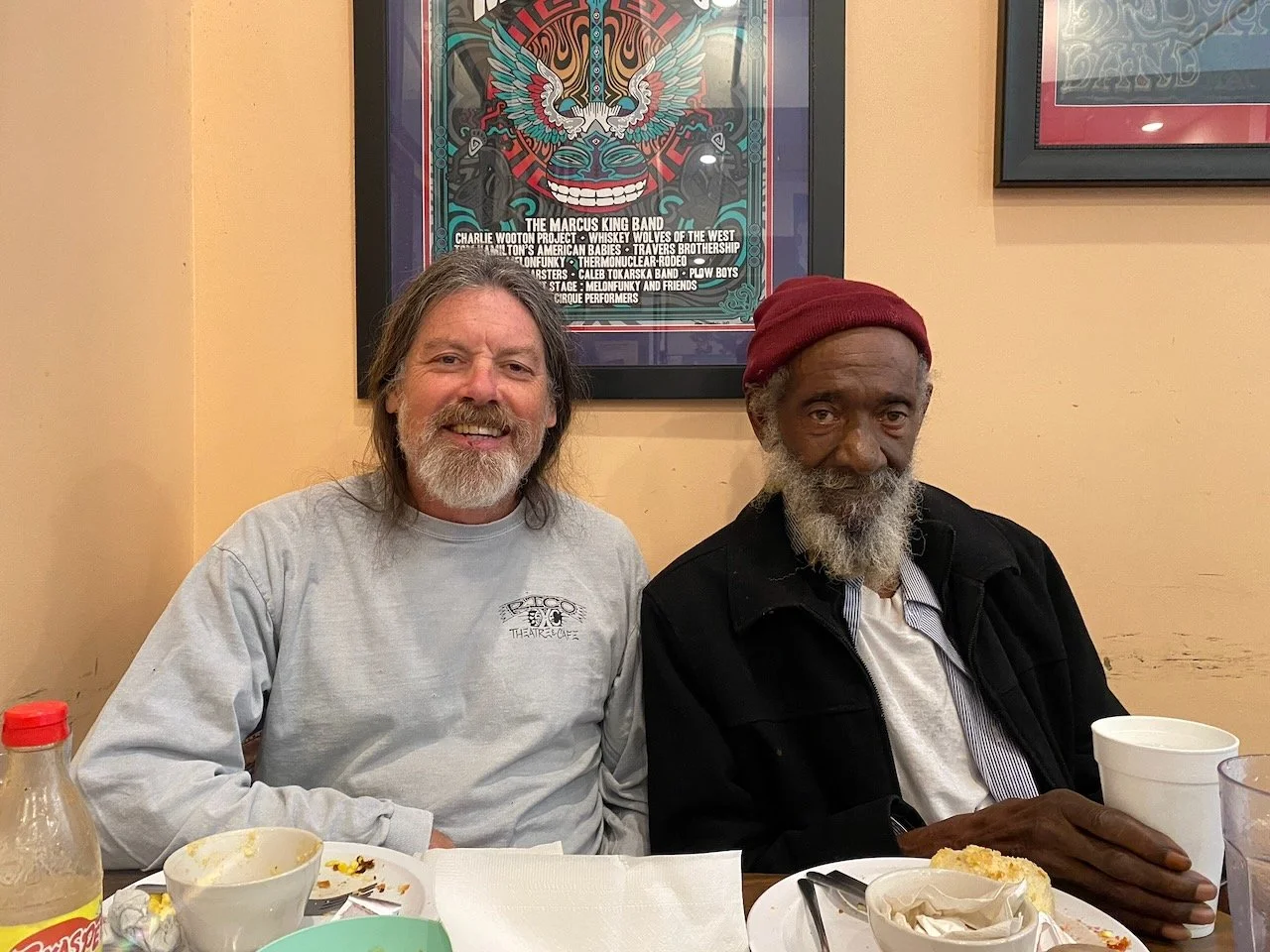
Johnny Mollica and Robert Lee Coleman enjoying breakfast at Famous Mike’s on Poplar Street.
Johnny slides into the booth at Famous Mike’s next to Robert, bringing good news; Robert is confirmed for an April 11 date at Grant’s Lounge, one more night on a stage he has played since the early 1970s.
During breakfast, Robert doesn’t make speeches about legacy. He doesn’t talk much about what the city owes him. He talks about his band, about the young players who sought him out, about the next show at Grant’s, about teaching himself to play the guitar.
Today, when he steps off a curb downtown, the distance between past and present is measured in doorways, not miles. The same blocks that once watched a long‑legged kid in a sharp suit hustle from club to club now watch an older man walk more slowly, steadying himself on a friend’s arm, moving toward another stage, another plate of food, another small room full of people who have come to listen.
If there is a measure of success for a working musician, maybe it is this, to be able to walk the same streets at eighty that you walked at twenty and find the music you made is still echoing, reshaped in other people’s hands but still traceable back to your own.
When Robert lifts a guitar on a stage or raises a coffee cup in a corner booth, he’s continuing a conversation between a city and its music that started before he was born. His notes are one of the ways Macon knows itself, and as long as he is here to play them, the story of this place is still being told in his key of blues.
When he and Johnny stand to leave, Stephanie appears with the check and a teasing scold that he didn’t finish all his cheese grits. She calls him by name. Johnny holds the door for Robert as they step back onto Poplar, into a cool morning washed in sunlight. Cars move past the blocks where bars once stood shoulder to shoulder. Somewhere nearby, a bus with Robert’s face printed on the side makes its loop through the city, part of a tribute to the city’s “Macon Music Masters,” including his childhood friends Arthur “Bo” Ponder, Newt Collier, and Johnny Jenkins, and his later colleagues like Chuck Leavell, R.E.M., the Allman Brothers Band, and Phil Walden.
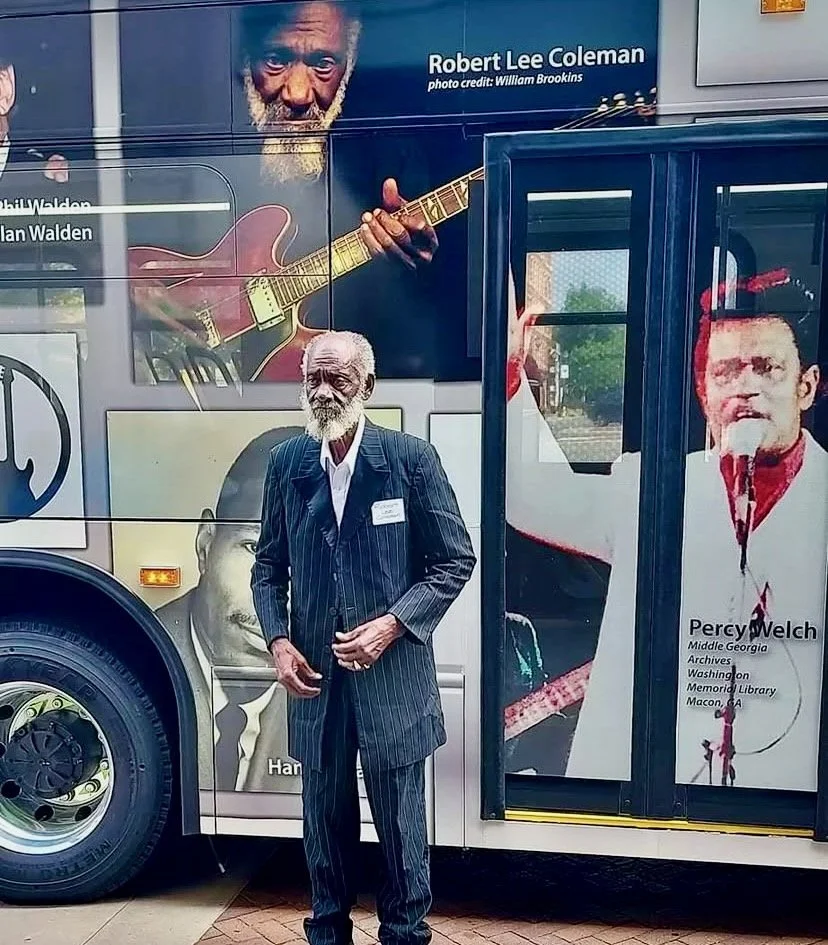
Robert Lee Coleman stands beside his image displayed on the Macon Music Masters bus, both photos taken by William (Bill) Brookins.
Robert has lived long enough to see Macon change around him, long enough to see his friends make it big and return home, juke joints vanish, labels rise and fall, highways cut through neighborhoods, and museums and festivals spring up to honor the music that once paid his rent. Long enough to see his own face on a side of a city bus and his name framed on the walls of a breakfast joint.
And still, on certain nights, when the lights go up at Grant’s and his band leans in for the downbeat, the sound that comes out of his hands is the same language he began speaking under his stepfather’s bed.
It’s the blues, the way Robert Lee Coleman speaks it.
Unhurried, clear, and very much alive.
Why Held Here
Robert Lee Coleman carried the spotlight quietly, consistently. In red pants and on worn-out frets, on smoky stages and behind the scenes, he’s held Macon’s music pulse with a steady grip.
He made history with Percy Sledge and James Brown and he made home here. Mentored here. Stayed here. In a town that hasn’t always celebrated its Black pioneers while they’re still living, Robert plays on because the sound still moves through him. He became the mentor he never had.
He’s a living archive, giving back what was never handed to him. A teacher without a podium. A man whose silence says as much as his solos.
Robert has become part of the city’s musical bedrock, settled and immovable. He’s held here by Macon, and by every soul who’s ever found themselves in the pause between his notes.
With Thanks
A big thank you to DSTO Moore for the use of his photo of Robert Lee Coleman as the featured image. And to Bill Brookins for his photo of Mr. Coleman by Macon’s bus.
Much gratitude to John Mollica (Johnny Mo) for his generosity in arranging a breakfast conversation with Robert Lee Coleman and for lending his discerning eye to this profile. Deep thanks as well to the many Macon friends and documentarians, including Kirk and Kirsten West, whose long commitment to Robert’s work and story helped make this profile possible. Errors, if any, of fact or interpretation are entirely my own.
This profile drew from Chuck Reece's portrait of Robert Lee Coleman published by Salvation South, and from the Living Blues magazine feature on Mr. Coleman, two pieces of journalism that treated his life and music with the seriousness they deserve.
Additional context was drawn from archival recordings, concert documentation, and conversations with people who know Robert Coleman's work firsthand. I’m grateful to them all.
________________________________________________________________
About the Author
Cindi Brown is a Georgia-born writer, porch-sitter, and teller of truths, even the ones her mama once pinched her for saying out loud. She runs Porchlight Press from her 1895 house with creaking floorboards and an open door for stories with soul. When she’s not scribbling about Southern music, small towns, stray cats, places she loves, and the wild gospel that hums in red clay soil, you’ll find her out listening for the next thing worth saying.
