
Stillwater’s Al Scarborough: The Mystic
Alison “Al” Scarborough grew up in the first generation of Warner Robins kids raised inside the fast-growing military town that emerged beside Robins Air Force Base after World War II.
By the time Southern rock exploded across the South in the 1970s, Al was part of the loose, talented circle of Middle Georgia musicians helping shape the sound coming out of garages, school bands, clubs, and rehearsal houses stretching between Warner Robins and Macon.
As a member of Stillwater, Al’s bass-playing carried them onto bigger stages during the Capricorn Records era, but his story reaches far beyond the rise-and-fall of Southern rock mythology.
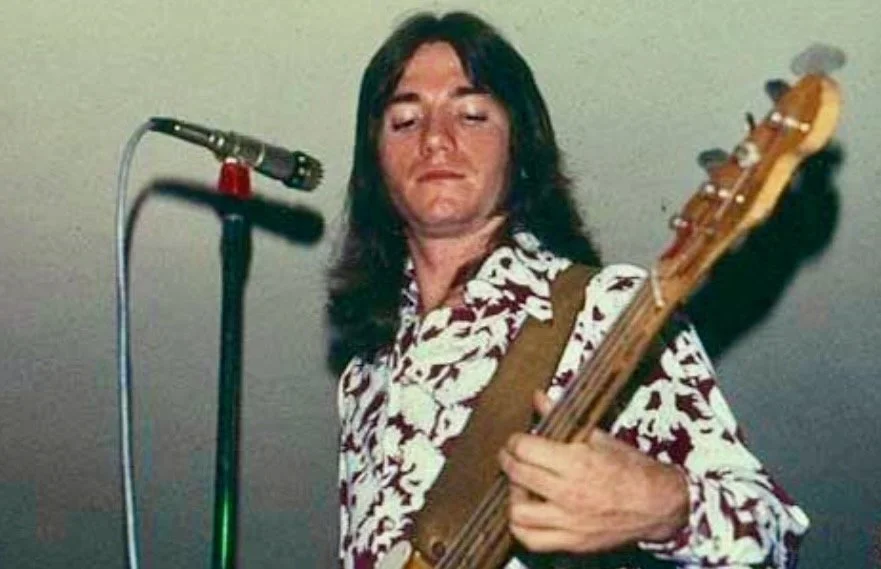
Al Scarborough has been the bass line under Warner Robins rock and roll for most of his life, and he carries that same low‑end steadiness into every room he walks into. People tend to meet him in fragments as Stillwater bassist, The Wall’s anchor, Grapevine’s newest bassist, Chuck Carter’s duo partner playing stand-up bass, but what draws them in is his energy.
He’s usually in a great mood, quick to laugh, sharp with his comebacks. Long blond‑white hair swinging as he turns his head, he’s just as ready with a one‑liner as with a word of encouragement. Al talks about music the same way he talks about physics, creek water, God, and human connection, as if they all belong to the same invisible current flowing underneath ordinary life.
A Boy Who Wouldn't Cut His Hair
That hair has always been part of his story. Warner Robins High School wanted him to cut it and he refused, so they asked him to leave. He tried Northside High but the welcome there wasn't much warmer. He ended up at Halley-Turner, a progressive private school on Napier Avenue in Macon that suited him better. But to afford tuition he had to play gigs.
A teenager funding his own education through bass lines is, in retrospect, a perfectly Al Scarborough solution to a perfectly Al Scarborough problem.
For Al, spirituality is something you experience directly rather than argue about. So while at Halley-Turner, he gravitated toward religious studies because there were few electives available and because history fascinated him anyway.
“God is real to me,” he says simply. “And I love history”
That conviction exists alongside everything else about him: the long hair, the bass guitar, the physics talk, the peace-and-love philosophy, the occasional flashes of volcanic temper.
One day at school, carrying an armful of books across the auditorium stage, Al was grabbed from behind by an older, wealthier student who apparently thought humiliating the local hippie would entertain the room. Before he fully realized what he was doing, and having no idea who had grabbed him up, Al swung the history book behind him and cracked the boy upside his head.
The reaction shocked them both.
“No one had ever fought back against him,” Al says. The bully never bothered him again.
It’s hard not to see the moment as an early glimpse of the contradiction Al still embodies comfortably decades later: deeply spiritual but unwilling to surrender dignity, peaceful but not passive, openhearted but perfectly capable of defending himself when a line has been crossed.
Ironically, the school wasn’t certified so he had to take the GED to graduate. All that gigging to pay his tuition and putting up with the elites to get a degree and he could have passed it all up by simply taking the GED. But he’s never really done anything the easy way.
And he still wears his white hair long. Women who meet him tend to notice it immediately, silver but closer to blonde, wavy without being unruly, smooth without being flat. They seriously discuss those aspects of Al’s hair, just like that. Al probably has no idea. Twice, he’s cut it all off and donated it to people undergoing cancer treatment, which you find out about sideways from friends, because he'd never mention it first.
Folks want to be around Al because he makes being alive feel like a privilege, not a chore.
But he’s known struggle and heartache.
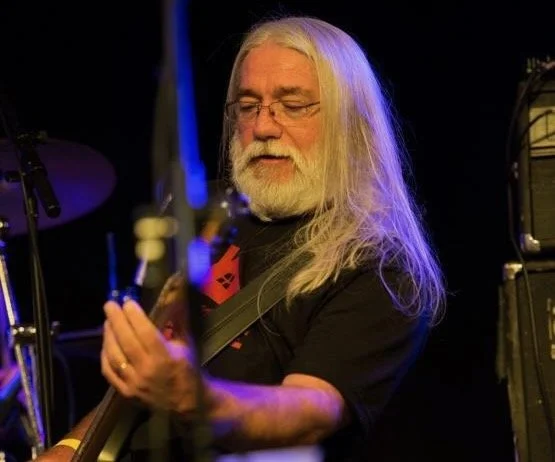
Photo courtesy of Wayne Skaggs.
The Youngest of Eleven
When his father, Hoke Smith Scarborough, died, Al was twelve years old, the youngest of eleven children. They had moved from Dublin, Georgia, to Warner Robins when Hoke took a civil service job at Robins Air Force Base.
Hoke had served eight years in the Army, belonged to the Scottish Rite in Macon, and carried the steady, working-man identity common to so many middle Georgia families shaped by war, church, and the base. His death left a crater in the household.
Al picked up a bass almost immediately. Music became the place he put the grief.
His mother, Sarah Frances Graham Scarborough, became the center of his world, a woman he describes simply as the best mother in the world.
Both of Al’s parents grew up in Dublin, a town along the Oconee River. The migration from places like Dublin and other small towns into the fast-growing Air Force town of Warner Robins repeated itself across middle Georgia in the years after World War II. Families arrived carrying older Southern roots and ways into a place that was still inventing itself. Old met new. Possibilities were endless. Opportunities were growing by the day.
Other musicians who helped shape Macon’s wider music culture also came from Dublin, including E.G. Kight and John Stanley Killingsworth, just to name two.
Sarah Scarborough carried those same South Georgia roots and ways into Warner Robins, but after Hoke’s death at age 62, she also carried the full weight of holding her large family together.
“I could talk to her about anything and everything,” Al says.
She was also, when the situation called for it, a mama tiger, showing up to challenge school officials, mostly men, who tried to hold Al back, or standing between him and promoters who saw a young musician and thought they saw opportunity. Those men, according to Al, almost always came around to Sarah Scarborough’s way of thinking.
She didn’t just tolerate his music obsession, her support for Al’s music became practical. She owned an old apartment, and when Al asked if his bands could rehearse there, she said yes.
The place soon evolved into what amounted to a teenage musician commune. Band members drifted in and out carrying amplifiers, guitars, drum kits, sleeping bags, and whatever new songs they were trying to learn that week. They deadened the walls as best they could and played for hours.
The lineup combinations changed constantly, no matter which apartment or basement they were playing in. When one Warner Robins band broke apart, another seemed to form immediately from the surviving pieces.
Al loved every second of it.
Sarah gave Al and his teenage band the rehearsal space despite criticism from older family members who thought she was encouraging chaos instead of responsibility.
“Mama said she supported my music because I got into a better band every time I broke up with a band,” Al recalls with a laugh.
Then, speaking about his older siblings, he adds: “She told the family, ‘You try to stop him.’” With the emphasis on you.
Sarah understood something essential about her youngest son early on: he was headstrong enough that brute resistance would only push him harder. So instead, she tried to channel all that restless energy, wild-card instinct, and love of music toward safer harbors whenever she could.
“My Mom always said be kind, help people, let people help. Be gracious.”
That philosophy settled deep and never left, even as life complicated everything around it.
Sarah Frances Graham Scarborough lived to be ninety-seven. She earned every one of those years.
In Stillwater’s original recording lineup, Al’s name sits in the middle of the roll call: bass and backing vocals, the man keeping Mike, Rob, and Bobby’s triple-guitar braid tied to the ground.
Those records, Stillwater and I Reserve the Right, are remembered for their guitar fireworks and songs like “Mind Bender,” but it’s the rhythm section that lets those parts breathe. Under all the triple-guitar mythology, Al’s bass lines anchor and push the songs forward.
Al is also quick to point out that Stillwater’s sound was never built on guitars alone. To him, keyboard player Bob Spearman was one of the band’s secret weapons, helping move Stillwater beyond straightforward blues-rock through the use of synthesizers, clavinet textures, piano, and organ.
“Bob made us sound more modern,” Al says. “That’s what set us apart from a lot of bands at the time.”
Offstage, Al still carries the restless energy of the youngest child in a huge South Georgia family, quick-talking, alert, ready for the next story, the next idea before the current one has fully settled. But something different happens when he plays. The motion organizes itself.
Maybe that’s what music became for him after his father died: not escape exactly, but direction. A place to pour all that motion, grief, instinct, hunger, noise, humor, and restless energy into something that could lock onto a groove and hold.
Ronnie Barnes and the Byron Field
At fifteen, he stood in a field at Middle Georgia Raceway in Byron for the Second Atlanta International Pop Festival, watching Hendrix, the Allman Brothers, B.B. King, and a who’s-who of rock and soul turn a racetrack on Warner Robins’ edge into one of the largest music gatherings in the country.
“Yes, I attended and it changed my life,” he says now.
For Al, the festival became more than a concert. It felt like a glimpse of another possible world. America was convulsing at the time with assassinations, Vietnam, riots, televised violence, generational anger everywhere you looked. Against that backdrop, the sight of hundreds of thousands of people gathered peacefully in a field in Middle Georgia felt almost miraculous to him.
Stephanie, the young woman who would later travel with him to Pennsylvania, was there too, either during the festival itself or shortly afterward.
“We were gaga about love and peace and people coming together,” Al remembers. “There was so much crap going on in the late sixties. Leaders were being taken out on TV.”
Then the grin returns.
“I was standing there half naked with all these people in a field and nobody got hurt and the music was overwhelming. You could actually see the music.”
Al insists he wasn’t really into the drugs swirling around the festival culture, but the experience altered him anyway. The scale of the sound, the energy moving through the crowd, the sensation that music could temporarily dissolve fear, anger, class, race, and loneliness into something collective and ecstatic. All of it burrowed inside him.
“I walked around with my head in the clouds,” he says.
For a teenager already playing in local bands, the festival compressed the distance between Warner Robins and the wider musical universe into something he could suddenly imagine crossing.
He hadn't arrived at that field as a civilian. By fifteen, Al was already playing in bands assembled, managed, and booked by Ronnie Barnes, the Warner Robins High School teacher who had an extraordinary instinct for young talent.
Ronnie pulled Al into the Princes of Wails alongside Sebie Lacey while simultaneously organizing other young musicians into a constantly evolving ecosystem of teenage bands playing teen clubs, bowling alleys, officer clubs, and dance halls across Middle Georgia and beyond. Some groups changed names every few months. Players drifted from one lineup into another. But Ronnie seemed to understand instinctively which young musicians belonged together.
In fact, the U.S. Kids played the International Pop Festival in Byron.
Al and Jimmy Hall were in a band together before Stillwater was ever dreamed of. And when Al later worked the flight line on Robins Air Force Base alongside Sebie Lacey’s father, Lonnie Lacey, he kept telling Al he ought to join the band.
For all these young musicians, Ronnie was the headwaters. And that field in Byron was downstream.
The Long Haul
When Capricorn collapsed and Stillwater’s first chapter closed, Al did what a lot of Middle Georgia players did. He went to work. He spent more than three decades with the United States Postal Service, building a life around routes and time clocks while playing in bands on weekends. Like other Macon‑area musicians who found stability in federal jobs, he became a USPS lifer who also carried the region’s sound on his back, delivering mail by day, delivering grooves by night. That working‑life discipline is part of why fellow musicians talk about him as “the hardest working bass player in Middle Georgia.”
Bassist Tim Pinson, also a long-time Macon musician and USPS retiree, calls Al his hero.
Maybe Al’s playing is based on his philosophical leaning toward spirituality, physics, and human connection.
Performing live for Al feels closer to transcendence than entertainment, moments when the exchange between band and audience becomes so powerful it no longer feels entirely rooted in ordinary reality.
“It’s like somebody plugged you into a wall,” he says. “You can feel the audience giving it back to you.”
To Al, those moments feel almost physical, a kind of joyful force moving between musicians and crowd, something bigger than any individual person onstage. When he tries to put it into words, music becomes plasma, vibration, mysticism, light. Einstein enters the conversation sooner or later. So does God.
“Physics is becoming my religion,” he says.
For Al, curiosity itself seems spiritual. History, science, music, religion, and sound itself are all pieces of the same giant puzzle humanity keeps trying to solve.
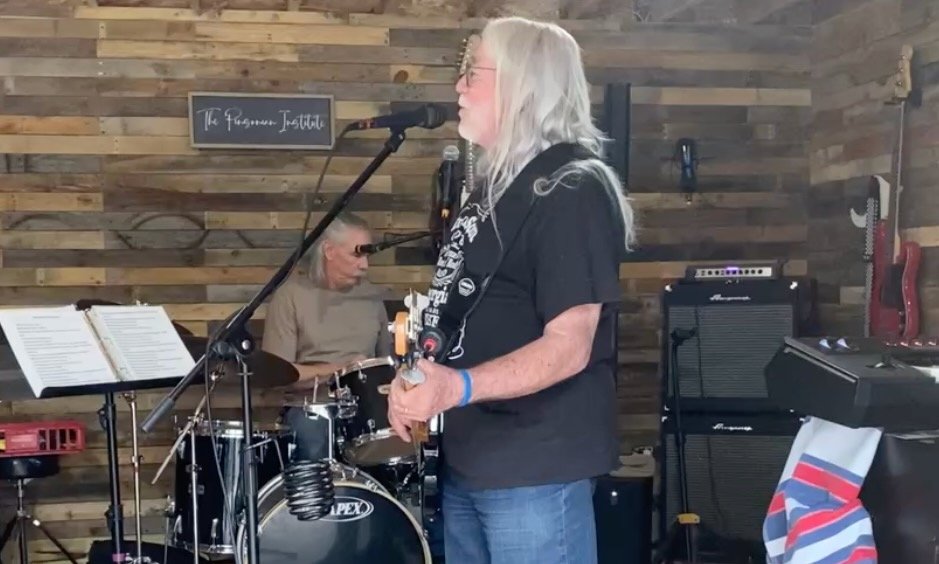
Al Scarborough in April 2026, jamming, playing bass and singing with Gary Porter on drums in Tim Pinson’s Lizella, GA, practice shed, aka The Pinsonian Institute.
Pennsylvania
At seventeen, Al sold a triple-stack amplifier covered in glitter naugahyde, bought two bus tickets, and helped his girlfriend, Stephanie, leave what he describes as a deeply toxic home environment.
The original plan had been Florida. Instead, Al took them north to Rehoboth Beach, a place he already knew from traveling through with The Princes of Wails. They arrived nearly broke, carrying little besides clothes, a guitar, and the conviction common to young musicians that something would work out if they just kept moving.
Almost immediately, it did.
The two teenagers befriended a street busker everyone called Tater, a guitar player working the sidewalks and playing songs nobody around them had heard yet, including cuts from James Taylor’s first Apple Records release before it had widely circulated in the United States.
“I started singing along with James Taylor songs,” Al remembers. “Tater freaked out because nobody else knew who James Taylor was yet.”
Music opened the door again.
Tater told them about a nearby hotel where they could work in exchange for meals and a room. Stephanie became a waitress. Al washed dishes and played music whenever he wasn’t working. The three drifted into an improvised little community built around songs, survival, and whatever possibilities might come next. Al and Stephanie talked about starting a new band and eventually making their way west to San Francisco or Los Angeles.
Then the story took another improbable turn.
Tater had been accepted into a music program at Penn State University. While filling out his housing paperwork, he realized if he listed himself as single he would qualify him for only a small room and limited stipend money. Listing himself as a family would mean larger housing and additional support.
He looked at Al and Stephanie and asked, essentially: Want to be my family?
They said yes.
Suddenly the runaway teenagers from middle Georgia were living in a Penn State suite with a wandering musician they had met busking on the street only weeks earlier.
Everything was going great until Al made the mistake of writing a letter.
Still thinking like a musician building the next band, he mailed a letter to Jimmy Kelly back in Warner Robins, telling him he ought to come north and join them on their adventure to L.A..
Jimmy’s mother handed the letter straight to Sarah Scarborough.
Within two days, Sarah and Al’s recently widowed sister were standing at the suite door.
Al went home with them.
Stephanie’s ending was harsher. Her parents had authorities take custody of her, and she was eventually placed in the state hospital on College Street in Macon for several months. The experience only deepened the bond between the two teenagers. The Pennsylvania chapter might have ended, but the instinct behind it didn’t disappear.
Al has spent most of his life moving toward people, music, strangeness, conversation, possibility, and whatever unexpected doorway might open next.
For instance, during Stillwater’s touring years, road manager Dink Laggard developed his own strategy for dealing with overly persistent street evangelists, cult recruiters, and sidewalk missionaries in cities like New York. Dink would start saying outrageous things just to unsettle them, offering to buy them hamburgers or launching into bizarre conversations until they backed away in confusion.
Al usually handled those encounters differently.
One afternoon, members of the band were approached by Hare Krishnas handing out copies of the Bhagavad Gita. Some of the guys brushed them off. Bob Spearman, suspicious of the whole thing, reportedly asked bluntly what they wanted.
The answer was simple: buy the book.
Al did, but only had a $10 bill for a $5 book.
The young man handed Al an extra copy and then handed a free book to Bob and said, “Read the book, Bob.” Al didn’t experience the moment as threatening or strange. He experienced it as human. A brief exchange between travelers moving through the same city carrying different versions of truth. And an opportunity to learn.
That openness has followed him through life. He’s still trying to understand the world, searching for whatever current runs beneath things and connects people to each other. He suspects it’s love.
“Love people and treat them well,” he says. “You don’t need no other commandments.”
Believing in love, however, did not necessarily make love simple.
Fighting for Chris
The Pennsylvania adventure had ended, but Al and Stephanie’s story didn’t. They had a son, Chris, and when the relationship later collapsed, the fight over Chris became painful fast. Stephanie’s family made clear they intended to push Al completely out of his son’s life. What followed was a bruising custody battle full of accusations, hurt feelings, and adults choosing sides.
Al fought the way he tends to fight most things that matter: by showing up.
One moment from those years never left him.
Chris was being babysat at the home of Reverend Rastus Salter of Second Baptist Church, one of the most respected ministers in Warner Robins at the time. Salter’s teenage daughter Janet was helping care for the little boy that day. When Al learned Chris was there, he drove over to pick him up.
Stephanie and another man arrived at almost the exact same moment.
Tensions that had already been simmering exploded in the yard. Voices rose. Demands were made. Reverend Salter called the police and stepped out onto his front porch.
Al can still hear his voice.
“The baby’s going with Al,” Brother Salter said. “And if you’re still here when the police arrive, you’re going with them.”
That ended it.
Al never forgot the moment because Brother Salter had no particular reason to take his side. Al wasn’t even a member of Second Baptist. But in the middle of all that confusion, one of the town’s most respected moral authorities looked at the situation and made a clear decision about where Chris belonged.
Not long afterward, Al went to the attorney handling the divorce, hoping only to get temporary guardianship paperwork signed so Chris could be enrolled in daycare. Stephanie refused to sign the papers.
Then the lawyer stunned him.
“Here’s your paper,” he said. “I’m your lawyer now.”
The attorney was L.A. McConnell, a civic leader who would later become a judge and whose name would eventually be placed on Warner Robins’ McConnell-Talbert Stadium. McConnell switched sides completely and asked Al a question he hadn’t expected.
Did Al want full custody? Al’s answer was, “I’ll have to ask my Mom.”
By then Stillwater was beginning to gain momentum, and Al understood the reality of his life. A nineteen-year-old musician chasing a record deal could not raise a little boy alone. Sarah Scarborough would be the one carrying much of that responsibility while he was on the road.
She never hesitated. Of course they wanted full custody of Chris.
Looking back, Al understands what carried him through those years wasn’t just the court system. It was a handful of older adults in Warner Robins, a preacher, a lawyer, and his mother, who looked past the noise surrounding a restless teenage musician and recognized something steady in him anyway.
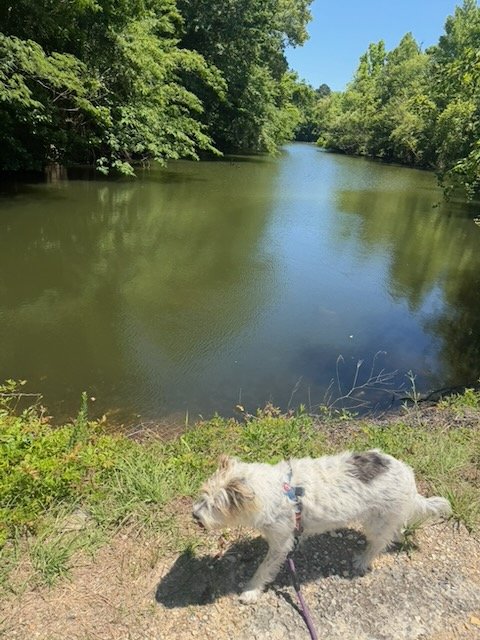
Al Scarborough’s Paradise.
Sweet Mena loves walking along the Echeconnee with her dad.
Paradise on the Echeconnee
Home for Al now is a stretch of land between Macon and Warner Robins on Echeconnee Creek, a place he calls Paradise. From his porch he can look out over water and woods, with enough privacy to feel like the world falls away at his will. He can slide a canoe into the creek whenever the mood hits, trading stage lights for reflected sky, the thump of a kick drum for the drip of a paddle.
Early on, that peace was disturbed by land disputes and unneighborly behavior that would sour a lesser person. Al can still get riled up telling those stories, just as he can get fired up about the pandemic‑era bureaucratic mess that slowed money owed to him when he retired from the Post Office. It's that little devil he says lives on his shoulder and pipes up every now and then, waving his tiny pitchfork and railing against some injustice.
Mike will tell you the same thing with a grin. There's a mischievous streak in Al that surfaces just often enough to remind you the gentle man and the reactionist live in the same body. But in the next breath Al tends to circle back to the view from that porch, to the blessing of quiet, to the fact that it all worked out in the end.
His body has its own set of stories. A year ago, driving his RV home after a practice in the dark, he hurt his string-plucking hand, the one his whole musical life runs through. No surgery was required and his hand is still finding its way back, healing into something that feels closer each month to what it used to be. The story usually ends where most of his stories do, on the fact that he's still alive, still able to play, still able to stand on a stage with the people he loves and make a room move.
But there was another more serious health scare, and he almost died on his way to finding Paradise.
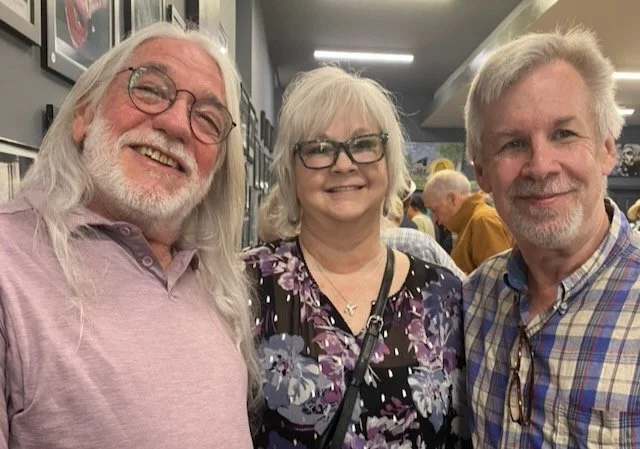
May 1, 2026: Al Scarborough and his wife Karen with Tim Griggs of COMP at Gallery West during Kirsten West’s retirement celebration. One more evening where musicians, archivists, storytellers, and old friends gathered to honor the people who helped shape Macon’s creative spirit.
Resurrection on the Echeeconee
The land came to Al during one of the darkest stretches of his life, arriving almost simultaneously with the realization that he might not survive long enough to enjoy it.
In late 1998, not long after Stillwater’s third album, Runnin’ Free, was released by the band, Al underwent surgery for what doctors believed was appendicitis. Something went terribly wrong afterward. He was sent home while sepsis spread through his body, his condition deteriorating so badly that even Al, who tends to meet most hardships with humor or philosophy, understood he was dying.
Anger still flashes across his face when he talks about it.
At one point, convinced the original doctor had effectively given up on him, Al called and unleashed what he now describes as “the demon on his shoulder,” threatening lawsuits, vengeance, whatever language a terrified man reaches for when he realizes somebody’s carelessness may have cost him his life.
But another doctor intervened in time. Dr. McEver, brother of Warner Robins music figure Mike McEver, the same guy who owned Duck’s Breath Saloon and was a friend to Gregg Allman, immediately recognized the severity of what was happening. According to Al, Dr. McEver bluntly told him he likely had only hours left if he didn’t get to the hospital right away.
His son Alex, only fourteen years old at the time, helped get him there. Al remembers waking up the next morning surprised to still be alive.
That moment altered something fundamental in Al.
While he was still in the hospital recovering, his friend Wayne Powers walked in and announced he had found the perfect piece of land they’d been hoping to find, twenty-two acres along Echeconnee Creek between Macon and Warner Robins. Al had already been dreaming about a quieter place surrounded by woods and water, somewhere removed from noise and crowded roads and the general foolishness of the world.
The two friends planned to buy the property together and then split it.
When Al saw it, the creek property felt spiritual to him. “It was paradise,” he says simply.
The timing was absurd. Al was barely out of danger, hooked to machines, morphine pump nearby, still weak from sepsis, and now suddenly trying to buy land. The property cost nearly everything he had. He qualified for the loan on Christmas Eve, emptied his savings, hawked his truck, and moved forward, convinced the place was meant for him.
And then, Powers, who had initially talked about splitting the property purchase, quietly filed paperwork positioning himself to benefit from the deal without actually contributing financially. Al discovered the maneuver while handling permits and zoning approvals for the manufactured home he planned to move onto the land.
Powers’ betrayal stunned him less because of the money than because of the broken trust. Al has little patience for dishonesty, especially from people he once considered friends.
So he kept going alone.
He bought that Palm Harbor home from a military JAG officer being stationed elsewhere, handled much of the work himself as his own general contractor digging trenches for water lines, managing permits, overseeing utility installations, and slowly transforming the property into the sanctuary he had imagined while lying in a hospital bed wondering if he would survive the week.
At one point, the Air Force Base attempted to acquire portions of the surrounding land. Neighboring families sold out. Al stayed.
Now he lives inside what has effectively become a protected wildlife corridor, where deer wander close to the porch and the creek reflects the sky back at him in long strips of silver.
The whole experience hardened and softened him at the same time.
The little devil still surfaces when he tells the story, especially the parts involving betrayal, incompetence, or bureaucracy. But underneath the anger is something deeper: gratitude.
He survived a near-death experience and wonders at still being here.
And because he did survive, he talked to attorney Ken Lucas about suing the doctor who had been willing to let him die. Within days, Ken had a massive and fatal heart attack. Al took that as a sign to drop the law suit and the bitterness and enjoy what he had created.
Sitting beside Echeconnee Creek, it’s easy to understand how Al’s ideas about energy, death, and physics fuse together for him. The land became more than property. It became proof that after almost dying, after watching people disappoint him, he could still build something lasting with his own hands.
And he did.
Not long after getting out of the hospital, still recovering and heavily medicated, Al showed up to play an Elvin Bishop gig. Of course he did. Music was never something he waited to feel fully ready for.
That night he met Karen Brown, introduced to him by singer Dave Ricketson, aka Dangerous Dave.
At the time, neither Al nor Karen knew where the meeting would lead. Karen was still disentangling herself from an unhappy marriage and helping care for her parents. Al was fresh out of a near-death experience, trying to rebuild his body, his finances, and his sense of direction all at once.
What neither realized immediately was that they had already orbited each other for years. Karen had grown up in Warner Robins, and her brother had been one of Al’s childhood friends, one of the boys he camped with and ran around town alongside.
“I didn’t even know he had a sister,” Al says, still amused by it.
The relationship unfolded slowly after that, rooted in endurance, not drama. The creek land eventually became theirs together, not just his resurrection project but a shared life built carefully after both of them had seen enough hardship to know what truly matters.
Now when Al talks about the place, about the woods and the water and the quiet, Karen is part of the landscape too.
The Bass Line Under It All
That famous Winterland gig, when Stillwater opened for the Charlie Daniels Band, is where one of the great Al Scarborough stories was born, though Al spent that day less interested in Bill Graham's famous backstage spread than in a guitar shop down the road.
He walked into Star Guitars and asked the tech to install new pickups in a vintage bass Telecaster, a modification so unconventional that no guitar tech back East would touch it. The Star Guitar guy had no problem with it. He didn't just do the job; he added lights along the frets so Al could see them in low-stage lighting.
Al still has that bass guitar and calls it the Stelecaster, a mashup of Star Guitar and Telecaster.
Right now, guitarist and tech Greg McKinney is updating its innards. Greg is the go-to for most Macon musicians, and recently installed gold Duane Allman pickups made by a craftsman in Croatia onto Macon guitarist Phil Palma's gold top Les Paul.
Al’s wild-card quality has produced some memorable moments over the decades. Once, he had just had surgery and showed up to a gig at Whiskey River anyway, in pajamas and puppy dog slippers, fully prepared to take the stage dressed exactly like that. Mike told him no. Al changed.
Al has never met a system he didn't feel compelled to test.
He was barely out of his teens when he joined Stillwater, young enough to believe talent and momentum might actually be enough.
For a while, it almost seemed true.
The band had the songs, the triple-guitar attack, the crowd reaction, the Capricorn connection, and chemistry onstage. But from Al’s perspective, the machinery surrounding Southern rock started becoming unstable long before most fans realized Capricorn was collapsing.
“Everything got crazy,” he says now.
The label’s internal politics, distribution disputes, publishing battles, management negotiations, and growing financial problems swirled around the musicians faster than many of them could fully understand at the time. Al remembers conversations with Phil Walden, rumors about Warner Brothers tensions, industry figures circling the band, and confusion over who controlled what anymore.
Meanwhile the broader Southern rock world was already shifting under everybody’s feet. The Scooter Herring trial had consumed headlines. Gregg Allman’s testimony fractured loyalties inside the scene. Drugs, money, ego, lawsuits, and exhaustion began overtaking the idealism that had fueled Capricorn’s rise in the first place.
From where Al stood, the music slowly stopped being the center of the conversation.
The disillusionment hit hardest around publishing and ownership. Stillwater’s members had entered the business as musicians, not businessmen, and years later some of them realized just how much control they had signed away while still in their early twenties.
“It got kinda weird,” Al says carefully.
By then, Capricorn was unraveling financially. Al remembers stories of borrowed money, shifting accounts, desperate maneuvering, and executives trying to hold the whole thing together as it slipped apart.
Stillwater kept working anyway.
The band continued writing, recording, and chasing a second chapter, eventually self-funding sessions at Studio One with Rodney Mills while searching for another label. Some of that material would not be fully completed as Runnin’ Free until nearly two decades later.
Looking back now, Al doesn’t talk about the period with bitterness as much as bewilderment. What he remembers most clearly is not contracts or lawsuits, but the feeling the band still had when they played together.
“We loved each other and we were getting a reaction,” he says. “We wanted to create our own songs.”
That, in the end, is still the version of the story he trusts most.
Musically, Al’s post‑Capricorn years are their own rich chapter. In Warner Robins and Macon, he became a pillar of The Wall, the cover band that could move from Beatles to Allman Brothers in a single breath, holding down bass and contributing vocals alongside fellow Stillwater alum Bob Spearman on keys. For years they were a go‑to weekend band at places like Pub 96, local institutions that kept the catalog alive while the industry’s attention wandered.
Later, when Macon’s Grapevine Band brought him in, they introduced him as a major talent on bass and vocals and, without hesitation, the hardest‑working bassist in the region, a line that landed because it matched what everyone already knew. If there was a band that needed a dependable, musical low end, Al was either in it, had been in it, or was on a short list to be asked.
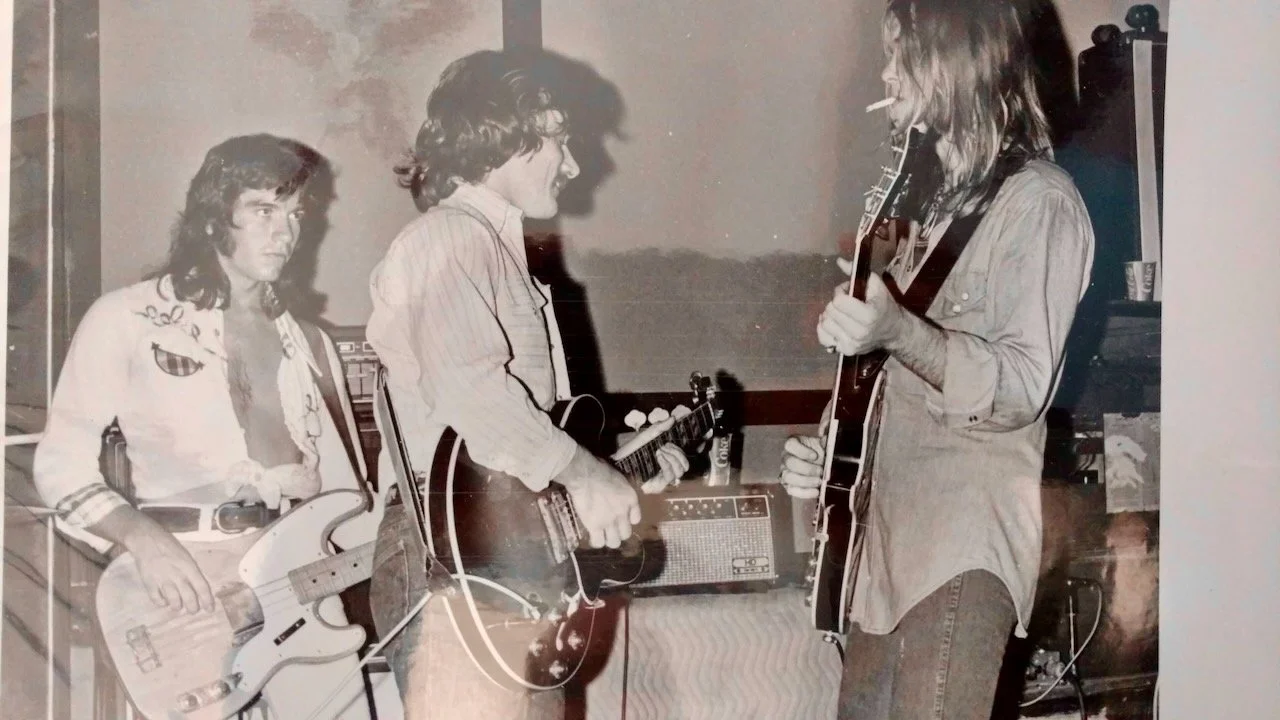
Al Scarborough left, jamming with Dickey Betts and Gregg Allman.
The Scarboroughs
Al talks about his family with the same mixture of awe, humor, and affection that colors most of his stories. Being the youngest of eleven meant he grew up surrounded by fully formed adults before he was old enough to understand what adulthood even was. By the time he was playing bass in teenage bands around Warner Robins, his older siblings were already building lives that stretched across the military, business, education, and public service.
One brother rose from mailman to Army officer while earning a master’s degree. Another became a jet mechanic. One sister became a social worker and psychiatrist after surviving breast cancer. Others built successful careers through military service, business, education, and public service.
Al talks about them all with visible pride, often laughing that his sisters are millionaires now, some self-made and some by marriage. And beneath the joke is genuine admiration.
He says it laughing, but there’s admiration underneath it.
Al’s own wealth arrived differently.
His riches are measured less in accumulation than continuation: children and grandchildren, creek water, old friendships, songs still being played, a wife he adores, and enough stories to fill several lifetimes.
Chris, the little boy at the center of those custody battles years ago, is now grown and married to Lisa, and together they work in the world of high-level defense contracting, the kind of classified work Al jokingly admits he isn’t allowed to hear.
His son Alex built a career in Nashville as a sound engineer, recently mixing performances at the Ryman Auditorium for artists tied to both modern country and Capricorn’s extended musical family. Before that, Alex played drums in a band that won a national competition leading to a television appearance and an opening slot for Pitbull in Seattle.
Al beams talking about all of it.
There are great-grandchildren too. A sprawling extended family stitched together through marriages, second chances, music, survival, and time. Karen brought children and grandchildren into the circle as well, and Al speaks about the whole blended constellation with gratitude rather than distinction.
For a man who nearly died before he could build his creekside home, the continuation of the family line feels significant to him in a deep and spiritual way.
For him, music is magic, its energy moving through people, an unseen current connecting one life to another. It’s clear family may be the thing that most convinces him life is magic. Not fame. Not money. Not even survival itself.
Continuation.
That’s the miracle he seems most grateful for.
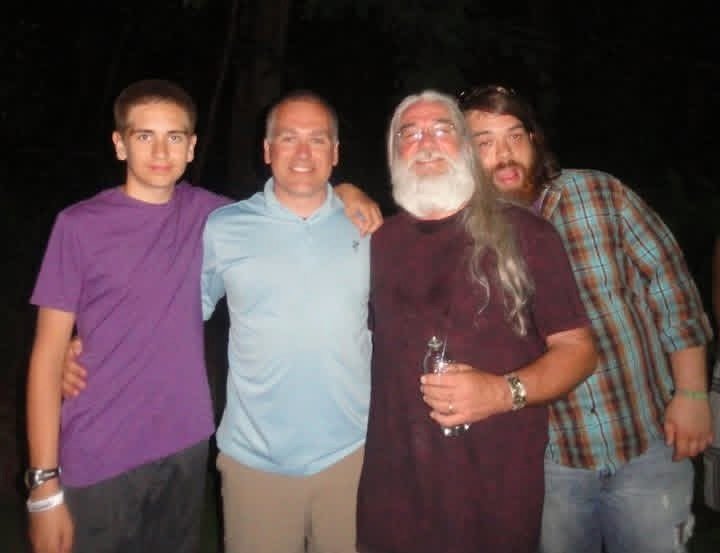
Grandson Jake, and sons Chris and Alex with Al.
Still Learning, Still Playing
These days, one of the places you might find Al is Churchill's Cigar Bar on Cherry Street in Macon, on Jazz Night, playing upright double bass alongside Chuck Carter on keys. The bass in question is a giant wooden instrument he describes as "like carrying a chest of drawers" through Macon's streets and alleys. His wife Karen, who has lately taken to calling herself Betty Karen (the Karen reputation being what it is these days), tripped and fell onto the double bass, doing some damage Al is careful not to hold against her. Tom Dodson is working on the repairs. Al is working on the instrument itself, learning its long fretboard and considerable girth, coaxing jazz out of it one practice at a time.
"I'm not a jazz player," he says. “I’m jazzing up my rock.”
Chuck and Al have known each other for 50 years and never played together, until now.
They recently settled a piano into Churchill’s so it’ll be there for them. And now they want one for Jalapeno’s on Poplar Street, where they’ll also play regularly. They’re like kids still walking the neighborhood looking for kindred spirits to play music with. Lynn Lavery, a promotions item saleswoman in Macon and friend to musicians, gave chuck and Al a $25 tip one evening as they played at Churchill’s.
“We went for ice cream!” Al laughs.
Off the stage, Al has added another role to his long list. When Mike McEver reached out and asked if he'd be interested in managing bands, Al said yes, partnering with Stan Martin, a fellow veteran of the Grapevine. Together they manage Fall Line Ramblers out of Milledgeville, a band that gives Al yet another reason to stay embedded in Middle Georgia's music world, not just as a player but as someone invested in the next generation.
What ties all of this together is his temperament. Al has had his share of trials, of industry ups and downs, federal bureaucracy, near‑fatal medical mistakes, and yet he remains one of the bubbliest presences in any circle he joins.
His Stillwater bandmates know Al well enough to occasionally tell him to slow down, calm down, or stop trying to fight somebody on principle. Don’t let that little demon out, they’ll imply.
Al Scarborough is more than the bass player on a couple of Capricorn records. He’s one of the region’s great working musicians. A USPS veteran who turned his off‑hours into a second career, a creek‑side homeowner who calls his little patch of Georgia “Paradise,” a survivor who nearly didn’t make it but now laughs louder and plays with even more joy.
Mike says without Al on bass and David Heck on drums, the band wouldn’t be able to play.
Al’s life, like his bass lines, gives the music weight, reminding us that behind every song is someone like Al who’s keeping it together in a life packed with living.
Like the current moving through Echeconnee Creek beside his home, Al has spent a lifetime holding the rhythm steady. Somewhere along the way, he arrived at a personal philosophy simple enough to fit in a sentence:
“Hold your power in an open palm and share it.”
Which is another way of describing exactly how he’s lived.
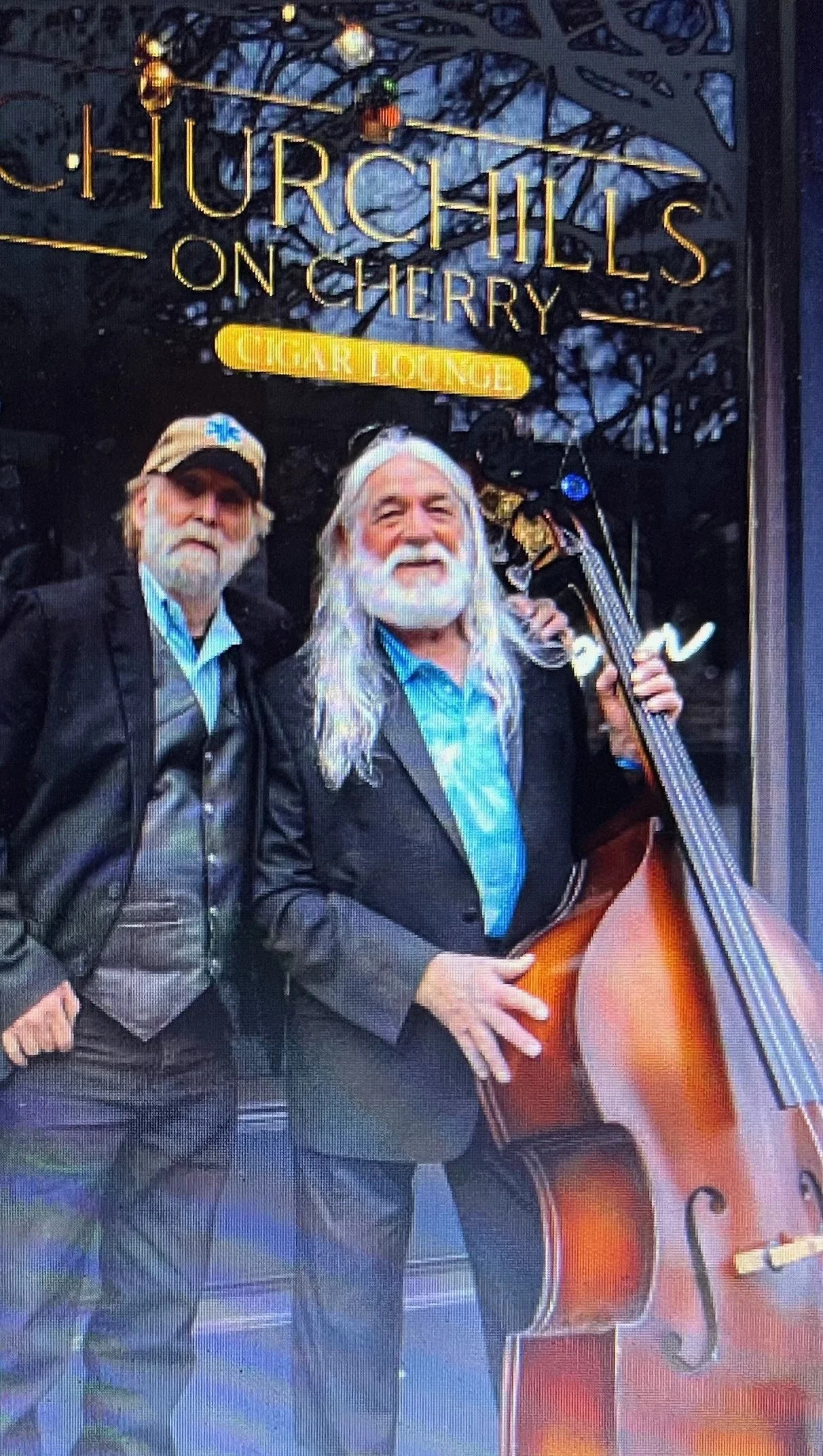
Chuck Carter and Al.
Playing jazz at Churchill’s on Cherry.
Photo courtesy of Chris Murman.
Stillwater’s story stretches across decades. Explore these other voices that helped shape the band and the world around it:
• Stillwater: Hittin’ Like a B-52
About the Author
Cindi Brown is a Georgia-born writer, porch-sitter, and teller of truths, even the ones her mama once pinched her for saying out loud. She runs Porchlight Press from her 1895 house with creaking floorboards and an open door for stories with soul. When she’s not scribbling about Southern music, small towns, stray cats, places she loves, and the wild gospel that hums in red clay soil, you’ll find her out listening for the next thing worth saying.
