
Stillwater’s Sebie Lacey: The Showman
Sebie Lacey’s drumming, singing, and charisma helped carry Stillwater from Warner Robins rehearsal rooms onto Southern rock stages during the Capricorn Records era.
In school, he was known around Warner Robins as a football player, athlete, musician, and easygoing personality who seemed to fit naturally into every corner of student life.
Over the following decades he built businesses and survived throat cancer, becoming one of the emotional anchors keeping Stillwater’s reunion spirit alive.

Blind Lemon & Commercial Circle
The nights when Sebie Lacey steps up to the mic at La Cabana in Warner Robins, joining Tony Elmore's Tres Hombres group and his own Stillwater bandmates, the room goes quiet before he sings a note. People who have been watching him for decades know what it’s taken for Sebie to get back behind a microphone after throat cancer. So when he opens his mouth you can feel the gratitude move in both directions at once; Sebie toward the crowd, the crowd back at him.
Everyone is aware this had not been guaranteed.
Sebie pushes back against descriptions that make him sound exceptional, though. When thinking about his legacy, he laughs off the idea of being placed on any pedestal.
“I’m the plain ol’ guy I was before,” he says. “We’re just regular old guys.”
To him, Stillwater’s story is not about celebrity so much as a group of hometown kids who took their shot when the window opened. “The worst thing is to grow older and wish you’d done something,” he says. “Well, we did it. We rolled the dice and went after it.”
In Stillwater's story of going for it, Sebie is the drummer and singer who helped turn these Warner Robins kids into a Capricorn Records act. But before any of that, he was one of the youngsters hanging around the town’s social center: Commercial Circle.
Back then, the Circle was more than a shopping district, especially for teenagers. Kids drifted between storefronts, burger joints, parking lots, music stores, and the nearby recreation department where friendships, rivalries, and bands formed. Northside and Warner Robins kids mixed there in ways they might not at school. The military town was still small enough that everybody eventually crossed paths.
Sebie had an unusual kind of home base inside that world.
His father, Lonnie Lacey, opened a teen club called Blind Lemon on Commercial Circle, giving local kids a supervised place to gather at a time when few spaces existed specifically for them. The club occupied a storefront and glowed at night with black lights, neon colors, artwork by Flip Jones, and the low electric energy that made teenage spaces feel slightly magical. Sebie remembers the room itself almost glowing in the dark.
Bands like the Bushmen and U.S. Kids played there. Young musicians hung around there. For Sebie, Blind Lemon became less a business than an extension of home. He could move easily between the club, the rec department, nearby shops, and the sidewalks of Commercial Circle, absorbing the rhythms of the town as it expanded around Robins Air Force Base. He met older musicians, younger kids, athletes, troublemakers, and future professionals all in the same few blocks.
And importantly, Lonnie Lacey treated music as something worth building around. He created created space for it, like Duke Golden did at his home in Kathleen, where Stillwater later practiced and lived.
Sebie still remembers seeing Rodney Mills and The Bushmen around the local scene in those years. Mills, slightly older and already emerging as a serious young musician and engineer, represented the possibility that somebody from South Georgia could move beyond local stages into the larger world of recording and production. Rodney became one of Georgia’s most important studio engineers and producers, but first he was another talented kid navigating musical corridors around Warner Robins.
The environment around Blind Lemon helped shape Sebie’s ease with people. He learned how to move comfortably among different kinds of people, how to make strangers feel welcome, and how music could dissolve barriers between groups that otherwise stayed separated across school rivalries.
Raised Around People
Lonnie Lacey’s family came from Rochelle in Wilcox County, part of the older rural South that fed workers, farmers, tradesmen, and entrepreneurs into the rapidly growing Warner Robins area after World War II. Lonnie had served in the Navy. Sebie’s mother, Doris Hattaway Lacey, grew up in a large Middle Georgia family whose roots stretched through Cochran, Houston County, and the farming communities surrounding the new military town.
Like many women of her generation in Warner Robins, Doris worked on the base while raising a family. Around her, brothers and relatives spread into the kinds of businesses and labor that built postwar Houston County from the ground up. One of Sebie’s uncles, Arthur Hattaway, worked for the Bateman peach operations along Highway 247, part of the agricultural backbone that still surrounded Warner Robins while the city expanded outward. Another uncle, Claude Hattaway, became one of the town’s best-known retailers.
Claude co-owned The Toggery, a popular men’s clothing store in Warner Robins that dressed generations of local residents through the middle decades of the city’s growth. By all accounts, Claude possessed the same outgoing warmth people later recognized in Sebie himself. He “never met a stranger,” relatives recalled, and was known throughout town as the kind of businessman who remembered names, shook hands easily, and treated customers like neighbors rather than transactions.
That atmosphere of community-centered business surrounded Sebie growing up.
His father Lonnie shared much of that same entrepreneurial instinct. Rather than dismiss music as a distraction, Lonnie leaned toward it. In 1966, when Sebie was still a teenager, Lonnie bought him a professional Ludwig drum set from Bibb Music in Macon for the staggering sum of $730.
“He must have thought I was going to make it,” Sebie says now with a laugh.
Before the Ludwigs arrived, Sebie’s first percussion instruments had been pots and pans he banged on while camping in the backyard with elementary-school friends playing their guitars. He formed his first band: The Coachmen. From there he graduated to a cheap drum set, then eventually to the gleaming Ludwigs that would carry him much farther than any of them could have imagined. Years later, Sebie recorded Stillwater’s first Capricorn album on those same drums before they disappeared forever when the band’s equipment truck was stolen during a tour with The Outlaws in Chicago.
Music entered Sebie’s imagination early and dramatically. Like countless future musicians of his generation, he watched The Beatles on The Ed Sullivan Show and became mesmerized not only by the music but by the sheer electricity surrounding them.
“All those girls screaming,” he remembers thinking. “Put me in, Coach.”
The joke captures something essential about him. Even as a teenager, Sebie moved naturally between worlds that often stayed separate in small Southern towns: athletes and musicians, popular kids and arts kids, local businessmen and long-haired rock-and-roll dreamers.
And the Laceys’ household itself became part of that bridge-building culture.
Prisoners of Time, including Sebie, Mark Crumpton, Tony Elmore, David Stroman, and John Samborski, went on the road in the summer of 1969. When they returned home from a two-and-a-half-month northern tour, several young musicians they had met in New York came back to Warner Robins with them. Doris fed the entire crew in the family kitchen.
“Want any grits?” Doris asked one of them.
“I’ll have one,” the young man replied, not realizing grits were not served individually.
The story still makes Sebie laugh because it captured exactly what Warner Robins was becoming in those years: a Southern military town where local kids suddenly found themselves crossing paths with people, music, accents, and ideas from far beyond Middle Georgia.
Inside the Lacey household, those worlds were welcomed in rather than pushed away.
High School
Being a Northside High School kid in Warner Robins terms meant something specific. Warner Robins High and Northside were the only two high schools in town back then, and the rivalry between them shaped the community's identity for generations.
Football games were accompanied by pranks, stunts, and the foolhardy daring teenagers reserve for enemy campuses. The two schools existed in a state of cheerful, competitive hostility that everyone in town understood and many participated in during their senior year.
Sebie was on the Northside side of that line, and he was not exactly invisible there. He was a jock. A star athlete. He played football and was the athlete teammates and classmates gravitated toward, for what he could do on a field and for who he was off it. His senior year, he was nominated to be Mr. Northside High. He could also play drums and sing, which in any era is an unfair combination to inflict on the people around you.
Sebie was, in the fullest sense of the phrase, the all-around student and high school hero everyone knew.
Which makes it more remarkable that Ronnie Barnes, the drama director over at Warner Robins High, reached across the rivalry and brought Sebie in. Ronnie had been building his annual Follies variety revue into something genuinely serious. He had a gift for recognizing talent wherever it lived, regardless of which side of town it came from.
When the Warner Robins High auditorium was unavailable one year because of fire damage, the Follies moved to Northside, the rival school opening its stage to the program. The arts, as they often do, found a way around the football rivalry. Sebie in the mix made the crossing easier.
There was something in Sebie even then that Ronnie recognized. The same quality he'd seen in the great ones, a natural ease with people that couldn't be taught. Mike, who's watched Sebie’s phenomenon for fifty years, calls him Andy Griffith, not for any resemblance, but for the effect. Wherever Sebie goes, people relax, open up, and leave feeling better than when they arrived.
But there was a time when Ronnie’s belief in Sebie caused some stress. At one point, music was beginning to compete with another powerful force in Sebie’s life: athletics. Coaches pushed him toward football and baseball with the same intensity Ronnie pushed him toward performance. Sebie found himself caught between worlds he genuinely loved.
After returning from the summer tour with Prisoners of Time and then experiencing the overwhelming scale of the Byron Pop Festival in 1970, Sebie remembers realizing he needed to “get a grip and redirect some of my thoughts and energy.” The pressure from coaches had intensified, and for a time he stepped away from the band and from the Follies to focus more seriously on sports.
Ronnie did not take the decision well.
Sebie still laughs remembering Barnes yelling “never” during one emotional conversation at the rec center and then refusing to speak to him for a while afterward. But the estrangement didn’t last. When the Follies later needed Sebie for a particular performance, Ronnie insisted he audition before he could return, a gesture maybe showing pride, stubbornness, and affection.
Sebie got the part. The friendship survived to this day. “We’re great friends still,” Sebie says of 90-year-old Ronnie, now living in Chattanooga.
Three Guitars and a Thousand Rooms
From the early 1970s on, Sebie sat behind three guitars and in front of thousands of people as the band took its triple‑guitar Southern rock out of local rooms and onto bigger stages.
He was in college when the offer came. Mike and Bobby were up at Georgia College and asked if he wanted to be part of what they were building. He said yes, and the math after that was simple. "We dropped out of college for rock and roll 101," he says. "We wanted to write music, record in a studio, and get a record deal. We worked hard at that."
In those early days, they pooled money, went into studios, made demos, mailed them out, and drove up and down the East Coast until the answer they wanted finally came. In 1976, Capricorn said yes.
Reviews of those first albums talk about the “melodic vocals from Sebie Lacey and Jimmy Hall” riding over the guitars on Stillwater and I Reserve the Right, a blend that gave the band both muscle and lift. On songs like “Mind Bender,” you can hear Sebie’s voice threading through the arrangement, grounding Rob’s talking‑guitar with a human line.
On the road, he was as much ringmaster as timekeeper. He remembers Winterland in San Francisco with Stillwater opening for the Charlie Daniels Band, the crowd calling them back for an encore, the Fox Theatre Rebel Jam in Atlanta, the Carter inauguration ball, Volunteer Jam V when they walked offstage and watched Lynyrd Skynyrd return for the first time since the horrible crash.
He also remembers the nonsense, too, like the night in Florida when, killing time before a show, he kept climbing hotel balconies and diving into the pool, floor by floor, splitting the seat of his pants and only stopping when a horrified maid begged him not to go higher. Years later, when people ask which character he would be in Almost Famous, he jokes that you can probably guess.
Even at their wildest, though, he and the band held to a certain standard. They made a pact to save the serious partying until after shows, a decision other bands thought was “just weird” but fit Sebie’s instinct to take the music itself seriously.
When Capricorn’s machinery faltered and “Mind Bender” stalled, he was in the room when Phil Walden owned the mistakes in one blunt sentence. “Boys, we lost ‘Mind Bender,’ that was our fault. We’ll do better.”
Sebie filed the line away, another piece of the story he’d eventually have to carry.
Businessman by Day, Drummer by Night
After Capricorn folded and Stillwater's initial run ended, Sebie didn't walk away from music. He simply wove it into a new life. The path into business came through family. His father-in-law, Mr. Edenfield, had opened Strato Cleaners in Warner Robins in 1960, building it into a community institution over nearly three decades. In 1988, Sebie and his father-in-law Greg Edenfield took ownership together, adding a men's clothing operation to the dry-cleaning side and running both for years. It was entry into Warner Robin’s business culture, a family handing something they'd built to people they trusted.
Owning a dry cleaner meant long days on his feet serving neighbors, learning every family in the zip code by their shirts and their habits, then nights behind a kit with Mike, Al, and others at small-combo gigs and special events. A brief line in a 1990s interview with Bobby Golden saying Sebie "owns a clothing store in town and plays with Mike" only hints at the double shift. Sebie was businessman by day, drummer-singer by night. Like many of his bandmates, he chose a life where music remained central but not the only pillar.
Music even found its way into the family business itself. In the 1980s, Vicki Edenfield-Lacey opened a bridal shop on Corder Road in Warner Robins, creating another gathering place built around celebration, ritual, and community life. Whenever brides asked about live music for ceremonies, Vicky already knew exactly who to call.
So Sebie and Mike Causey found themselves stepping into churches and wedding halls on Saturday afternoons, former Capricorn Records musicians suddenly dressed in jackets and ties instead of denim and stage clothes. Sebie would sing while Mike played piano, helping support the business and the family in the most Middle Georgia way imaginable, through reliability and music.
The work may not have carried the glamour of touring with national acts or playing packed rock venues, but it carried something else: permanence. These were not anonymous crowds passing through a concert hall. These were neighbors getting married, local families beginning new chapters, people Sebie and Vicki would continue seeing around town for years afterward.
One surviving photograph from those weddings captures the truth of that era better than any résumé ever could. Sebie stands at the microphone in a necktie and boutonniere while Mike sits at the piano beside him. Not aging rock stars trying to relive the past. Just two musicians helping family build a life.
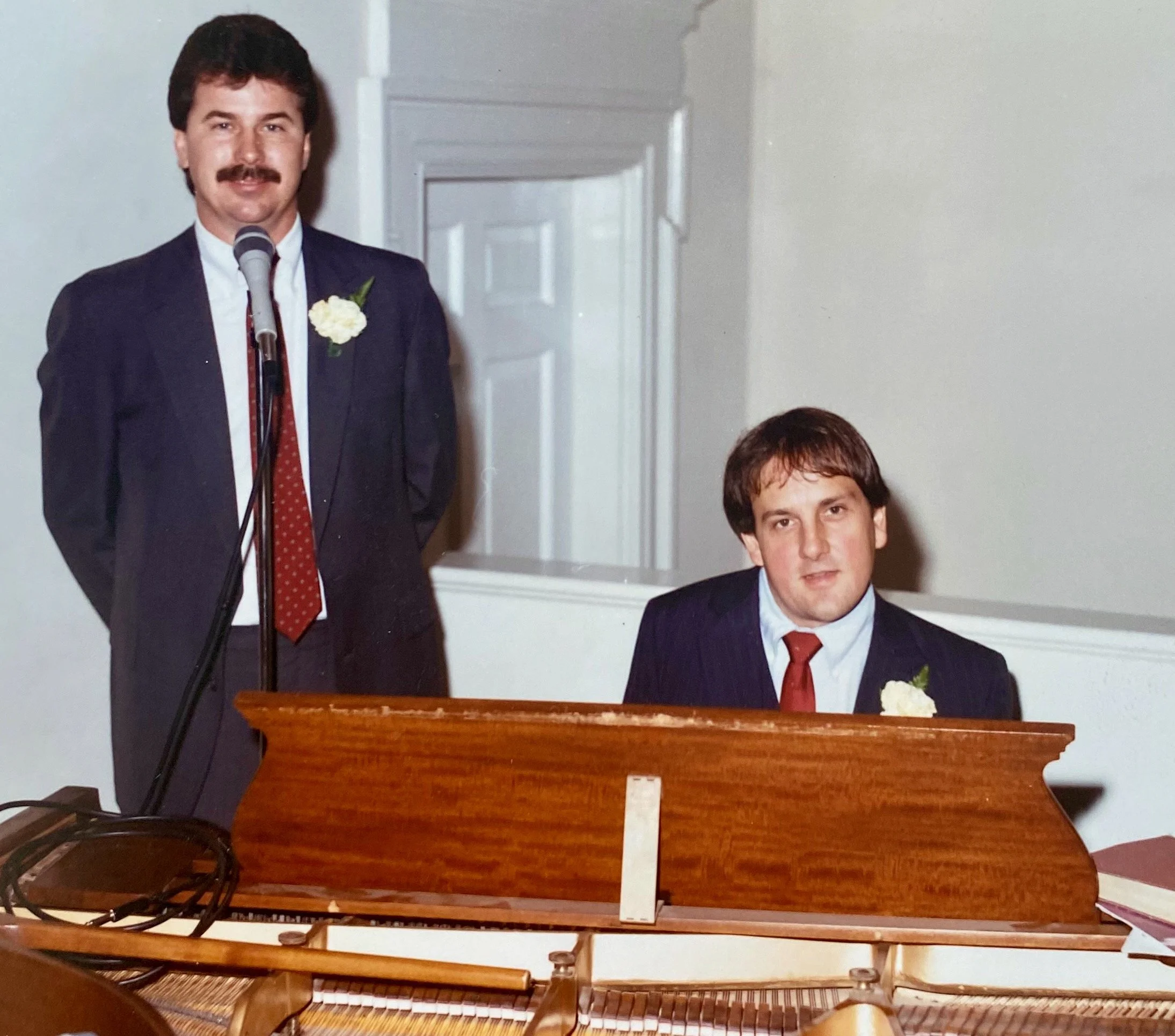
Sebie Lacey and Mike Causey performing at a Middle Georgia wedding during the years when Sebie and his wife Vicki were building both a family business and a life rooted close to home.
His business life eventually expanded beyond the dry-cleaning counter. He partnered with Stanley Wright to develop the Landing Pointe shopping center in Bonaire, a 44,300-square-foot commercial development that brought upscale dining, shopping, and fitness to the south Warner Robins corridor. And it wasn’t far from the Kathleen fields where Stillwater once lived together in an old farmhouse owned by Bobby Golden’s mother.
The man who had lived in that farmhouse as a young musician helped build the neighborhood that grew up around it. He and Wright sold the shopping center a few years ago. He has since sold Strato Cleaners as well. After decades of running businesses and managing tenants, Sebie Lacey is officially retired.
Away from the business ledger, Sebie stayed woven into the life of the town. He served as master of ceremonies at Aviation Museum fundraisers, played in charity golf tournaments, joined Bobbie Eakes on the stage at McConnell Stadium for several Warner Robins' Fourth of July celebrations, with fighter jets overhead and his old Follies castmate beside him. At least once Sebie walked into a local school to talk to students about music. He showed up when the community called.
Then throat cancer stepped into his story, threatening his voice, the thing that had always set him apart. Treatment, recovery, and the slow, sometimes painful return to singing make nights like singing with Tres Hombres feel like a triumph.
When he took the mic there, his wife Vicki in the crowd, old classmates and friends watching, his presence carried years of hospitals, uncertainty, and silent work just to be able to stand and sing again. The way people clapped, the way faces softened, is its own declaration. It clearly says the people see what he's come through, and they're glad he's here.
One thread from those early recordings has never fully resolved. The master tapes from their first two albums, recorded at Studio One in Doraville with Buddy Buie, have never been definitively located. When Georgia State acquired Studio One, someone called Mike Causey and asked if Stillwater wanted their masters. Mike, not fully understanding at the time what possessing them would mean, declined, assuming the tapes would be catalogued and preserved somewhere. They weren't, or at least they haven't surfaced.
"We can't seem to find the masters," Sebie said in a 2011 radio interview. The albums were recorded, released, praised, and then their source material vanished into the institutional shuffle that swallowed Capricorn's physical legacy.
What Sebie did take ownership of was the reunion. After the band disbanded in 1983, and they’d get together to just play, he was the one who suggested they play a reunion. That instinct launched what became nearly annual reunion shows, starting in 1984, continuing at Whiskey River for thirty years, and eventually extending to the Big House in Macon.
It turned out to be one of the decisions that have kept Stillwater alive.
The Hollywood Connection
Sebie also became, unexpectedly, the point of contact between the real Stillwater and Hollywood. In 2000, while home in Kathleen running his business, he received a phone call from DreamWorks explaining that a film called Almost Famous had been using the name Stillwater and needed legal clearance to continue.
At first he thought the call was a prank.
The band eventually read Cameron Crowe’s script, liked the story, and agreed to let the fictional group carry their name. The payment, $5,000 split seven ways, wasn’t life-changing, but Sebie has always viewed the experience less in financial terms than cultural ones. The film brought renewed attention to the band and nudged Stillwater’s story back into public conversation.
Musically, Sebie’s post-Capricorn years became their own map of persistence. He continued playing smaller regional shows and special events with Mike, Al, Bobby, and others, bringing Stillwater’s musical vocabulary into more intimate rooms.
Still Making That Music With Friends
What stands out as you watch Sebie now is how little ego seems to have survived the decades, and how much warmth has. That Andy Griffith quality of making people on a tour bus in 1977 feel at ease, the same way people at La Cabana do today, is just who he is. Given his résumé, he could coast on the fact that he co‑founded a Capricorn band, that his voice is preserved on records people still seek out, that a Hollywood film borrowed his band's name.
Instead, he comes across as open, approachable, genuinely delighted to have another chance to sing. The reaction when he leans into a mic these days is about recognizing resilience in real time. And recognizing talent.
Warner Robins remembers him as the young drummer‑singer who helped blast our town into something mythic. Seeing him now, older and battle‑scarred, holding a microphone, closes a loop. The band that played us into adulthood is still here, and so are we.
In a Warner Robins‑and‑Macon landscape full of guitar legends and front‑man myths, Sebie Lacey's journey is his Southern rock testimony, not written in album sales or arena crowds, but in the faces of people watching him sing in a Mexican restaurant or at a benefit concert, glad he's still here, still smiling.
Maybe that’s why people grow quiet when Sebie sings now.
They are hearing more than a voice. They are hearing survival. Friendship. Youth that somehow never completely disappeared. The old Warner Robins still flickering beneath the newer one. Blind Lemon. The rec center. Football fields. High school rivalries. Summer nights. Long highways. Capricorn dreams.
The band that once sped toward a promising horizon eventually returned home.
And there beneath the lights again, Sebie stands as what he always insisted he was: not a legend towering above his hometown, but one of its own boys who rolled the dice on music and came back home.
The Circle still holds. And somewhere inside it, Sebie is still singing.
Stillwater’s story stretches across decades. Explore these other voices that helped shape the band and the world around it:
• Stillwater: Hittin’ Like a B-52
About the Author
Cindi Brown is a Georgia-born writer, porch-sitter, and teller of truths, even the ones her mama once pinched her for saying out loud. She runs Porchlight Press from her 1895 house with creaking floorboards and an open door for stories with soul. When she’s not scribbling about Southern music, small towns, stray cats, places she loves, and the wild gospel that hums in red clay soil, you’ll find her out listening for the next thing worth saying.
