
Stillwater’s Jimmy Hall: The Soul Singer
Jimmy Hall, The Soul Singer
Jimmy Hall grew up in the same fertile Middle Georgia culture that shaped Stillwater, a world where young musicians learned songs by ear, carried equipment into smoky clubs and school gyms, and built lifelong friendships.
By the time Southern rock emerged as a national force in the 1970s, Jimmy was already part of the deeply connected network of players moving between Warner Robins, Macon, and stages across the Southeast.
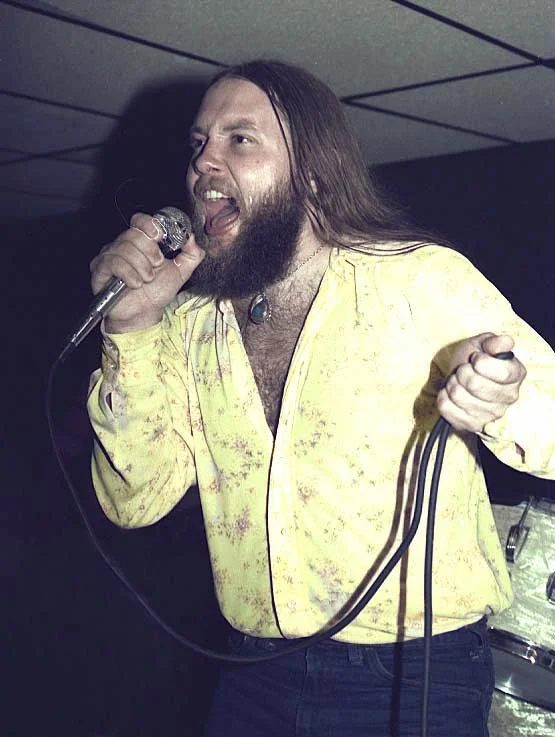
Jimmy Hall in full flight during the 1970s Southern rock era, bringing the raw soul, blues grit, and stage energy that made him one of the South’s most electrifying frontmen.
Photo courtesy of Markham White.
The First Bands
Jimmy Hall began performing in his teens, in the years when Cochran, Georgia, was producing young musicians who learned everything by ear and had nowhere to play except school gyms and whatever space someone could clear on a Friday night.
The promotional photo for his early band The Tyme Peace tells the story plainly: there he is, already at the microphone, wearing a matching floral shirt with five other teenage boys under a hand-lettered sign that reads The Tyme Peace. The Dance Records promo sheet names him simply as Vocalist. Mike Causey is listed beside him on lead guitar. Freddie Curtis on drums, Stevie Dupree on lead trumpet, Wayne Jiles on organ, Kenny Tucker on bass.
For booking, call Wayne H. Jiles, day or night.
Jimmy kept that promo sheet. Years later, he made a wooden frame for it with his own hands and brought it to Gigi's Comfort Food on Manor Court in Warner Robins, where it now hangs on a wall that owner Debbie Boyd has dedicated to Stillwater memorabilia. The building where Gigi's stands was once Guthrie's Music Store, the same shop where young Mike Causey took guitar lessons as a kid. Jimmy understood what that meant. The frame was his way of saying so.
Before Stillwater
Before Stillwater had a name, Jimmy Hall was already circling the same musicians. In Warner Robins, he had joined Bobby Golden, Bobby's brother Kenny, and keyboardist Bob Spearman in Coldwater Army, a horn-driven Chicago-style rock outfit that had already recorded an album.
When Sebie Lacey, Mike Causey, Rob Walker, and Al Scarborough stepped in, the name changed and the sound tightened into what would eventually become Stillwater. By the time Jimmy found himself in that band, he had already been in the room with most of those players for years. His presence in Stillwater wasn't an audition. It was a continuation.
The Voice in the Middle
It's Jimmy Hall's fate to share a name with another Southern rock singer, and the irony is baked right into the record. Stillwater lineups and fan notes have long felt compelled to clarify him as "Jimmy Hall — percussion, lead and backing vocals (not the Jimmy Hall who sang lead for Wet Willie)." That parenthetical points to something deeper.
Both men were signed to Capricorn Records at the same time, both singing Southern rock, and the confusion wasn't just a future archival problem, it was almost certainly happening in real time, at the label, in music press offices, on stages across the Southeast. Stillwater's Jimmy Hall is a reminder of how many gifted voices lived in Middle Georgia, voices that history has sometimes struggled to tell apart.
In Stillwater's classic era, Jimmy was one of the voices that made the band feel like songs rather than just a three-guitar showcase. He had heard Joe Cocker and decided that's what he wanted to do with his life, and you can hear the influence in the grit and soul of his performances, and in the way he leans into a line instead of simply landing on it.
What the credits don't always make visible is that Jimmy was more than a voice the band pointed toward a microphone. He was a songwriter in the room.
On Stillwater's 1977 debut, his name appears on five of the album's eight tracks:
"Out on a Limb" with Bob Spearman, Mike Causey, and Rob Walker
"Sunshine Blues" with Spearman, Bobby Golden, and producer Buddy Buie
The sprawling nine-minute "Sam's Jam" with nearly the whole band
"Universal Fool" with Buie and Walker
"Fantasy Park" with Scarborough, Buie, Causey, and Walker
That's a collaborator shaping the sound of a record, not a hired voice. The credits also name him as percussionist alongside lead vocalist, which meant he wasn't standing still at a microphone, he was keeping his body inside the rhythm of the band, singing while moving, making the performance look as physical as it sounded.
When the Arithmetic Changed
Then came the years when Capricorn Records began to fracture. Jimmy had been watching the situation closely, along with Al Scarborough, attending court hearings, trying to read what was coming. When it finally became clear, Jimmy put it simply: "That's pretty much it, we're done."
By 1980, he had left the group. His wife was pregnant and the band was generating roughly a hundred dollars a week per member. He had been in Stillwater since before it was Stillwater, and his departure was the clearest signal yet that the arithmetic of continuing no longer worked. He had done the math and accepted the answer.
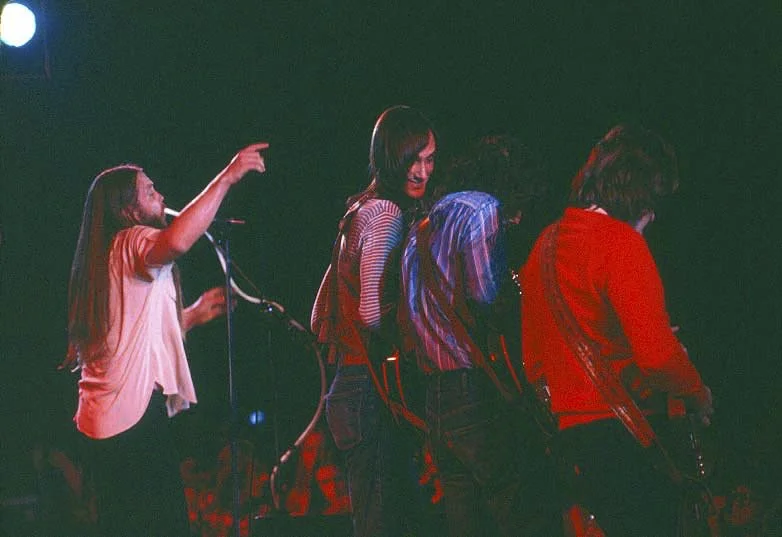
Jimmy Hall onstage with Rob Walker, Mike Causey, and Bobby Golden.
Photo courtesy of Markham White.
Middle Georgia Real
After Stillwater, his life turned Middle Georgia-real. Jimmy landed in sales through a connection with Robert Hintz, former co-owner of Duck's Breath Saloon with Mike McEver, starting out at a box manufacturing plant in Macon. He later moved into machinery parts and tools, working a Middle Georgia territory out of Byron. He was good at sales.
He and Mike Causey, who was in media sales, would get together and talk trade, how sales is fundamentally a people business, and how being known from their music had a way of opening doors.
Jimmy survived a bout with cancer. He made a point of coming back around for the Stillwater reunions when he could, not as a frontman trying to recapture something, but as a man returning to the part of himself that never entirely disappeared.
He still shows up. On any given afternoon, you might find Jimmy Hall eating lunch at Gigi's in Warner Robins alongside Rob Walker, Mike Causey, and Sebie Lacey, the same men he came up with, still in each other's orbit the way people are when the original thing was real.
The wall nearby holds the framed Tyme Peace promo sheet. It is, in its own way, an act of preservation, one founding member making sure a piece of the origin story doesn't disappear into a drawer somewhere, giving it back to the building where much of it began.
Still Carrying the Grain
Jimmy's presence in the Stillwater story is valuable precisely because it complicates the usual Southern rock plot. Plenty of stories track the guys who stayed until the last club date. Fewer honor the singer who stepped off while there was still momentum, made a life, and kept showing up anyway. He showed up because the friendships were real and the music was always bigger than the band.
Jimmy went to work. He came back when he could.
He’s still here, still carrying the original grain in his voice.
Stillwater’s story stretches across decades. Explore these other voices that helped shape the band and the world around it:
About the Author
Cindi Brown is a Georgia-born writer, porch-sitter, and teller of truths — even the ones her mama once pinched her for saying out loud. She runs Porchlight Press from her 1895 house with creaking floorboards and an open door for stories with soul. When she’s not scribbling about Southern music, small towns, stray cats, places she loves, and the wild gospel that hums in red clay soil, you’ll find her out listening for the next thing worth saying.
