
Stillwater’s David Heck: The Professional
David Heck joined Stillwater after the band’s initial Capricorn Records breakthrough, stepping behind the drums at a moment when Southern rock’s golden era was beginning to shift beneath the musicians living it.
A percussion major from Warner Robins with the discipline to memorize a two-hour set before his first show, David became the steady rhythmic center of the band’s later years, helping take Stillwater through the long miles between Southern rock mythology and real adult life.
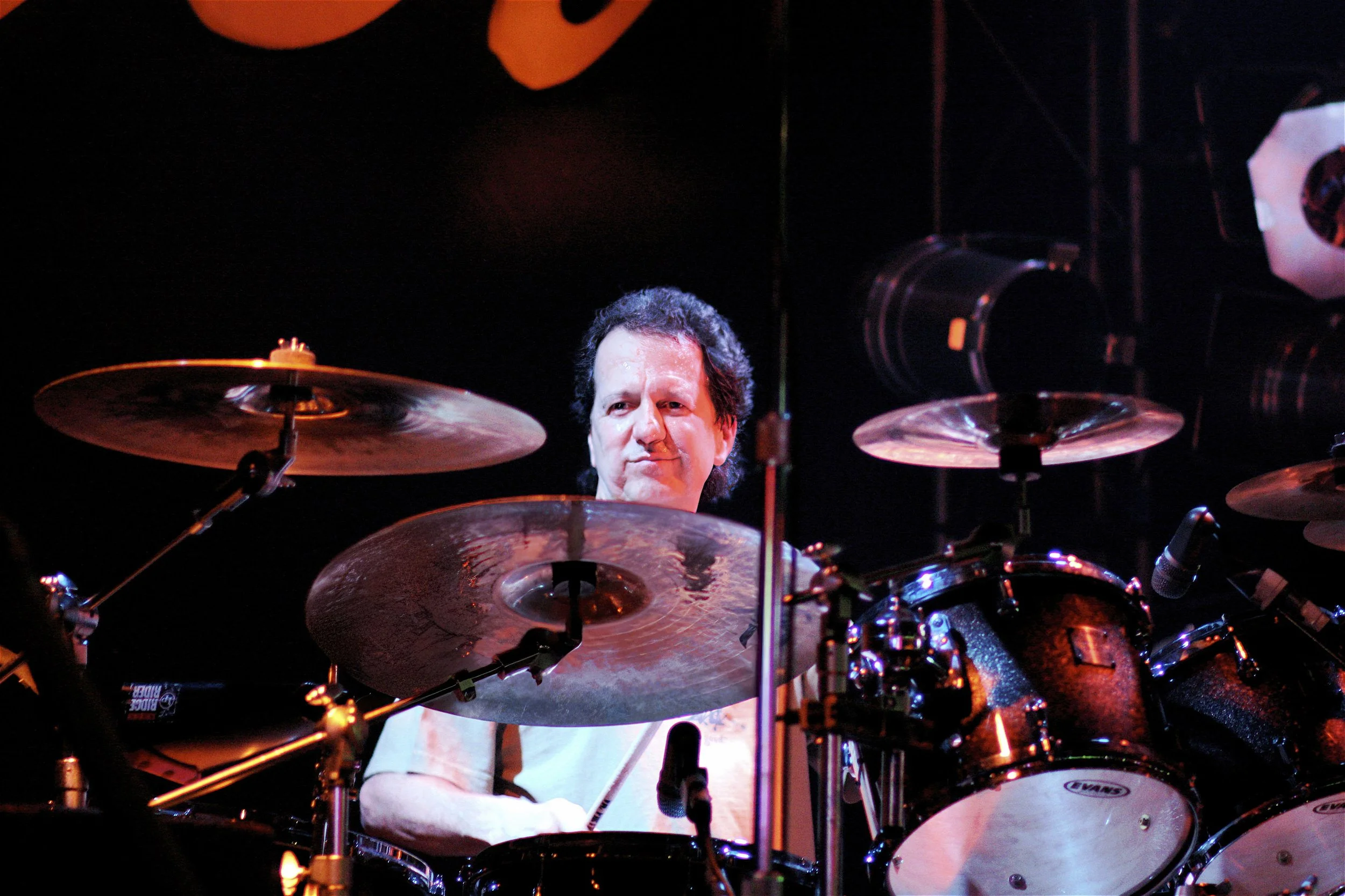
David Heck drumming during the Stillwater reunion in 2008. Photo by Markham White.
David Heck’s story isn’t about a man who burned his life down for music. It’s the story of a man who took music with him while building a life sturdy enough to hold it all.
He’ll tell you, with complete sincerity and only mild exaggeration, that he biked twelve or fifteen miles each way to Stillwater rehearsals after joining the band in 1981. He’d moved back into his childhood home in Warner Robins when the band needed a drummer, and a bicycle was the transportation he chose, so he pedaled out to practice all day, then pedaled home, then did it again the next morning.
That combination of endurance, practicality, and cheerful stubbornness is about as David Heck as it gets.
He wasn’t part of Stillwater’s original Capricorn-era mythology. He joined later, after the first rush of Southern rock glory had already crested and the ground beneath it was beginning to shift. But he arrived prepared. He memorized two full hours of music before ever stepping onstage with the group. He learned the material cold. No charts. No shortcuts. Just repetition, discipline, and trust in his own ability to do the work.
Mike Causey still says the band plays differently with David behind the drums. More naturally. More completely. The way it’s supposed to sound.
David had been circling in the band's orbit for years before he joined it, close enough to the Warner Robins scene to know all the players. And close enough to Stillwater that Rob Walker had invited him to the 1978 Rebel Jam in Atlanta, where he stood on the side of the stage watching Stillwater, the Dixie Dregs, and Sea Level perform. He had no way of knowing that five years later he'd be on stages like this one playing in Stillwater.
Briardale Avenue
To understand David Heck, it helps to understand the home he grew up in, the one on Briardale Avenue, close to Northside High School.
His home was formed by Glenn and Margaret Stephens Heck, and it was unlike most houses in Warner Robins, in ways that mattered.
Glenn Heck arrived in Warner Robins in 1952 as a bassoonist with the 769th Air Force Band, part of the early wave of military families helping shape the fast-growing town that had risen beside Robins Air Force Base after World War II. A Wisconsin farm boy with formal musical training and seemingly inexhaustible civic energy, he spent the next half-century helping build the cultural identity of the city around him.
He came for his four-year military stint and stayed, coining Warner Robins’ enduring nickname, “Georgia’s International City,” that reflected the constant movement of military families arriving from around the world. He later helped establish both the Houston Arts Alliance and the Macon Arts Alliance, served on the Houston County school board for thirteen years, and wrote “200 Years of Freedom,” a bicentennial composition celebrating the nation’s 200th birthday in 1976.
David’s mother Margaret Stephens Heck brought another layer of regional identity into the household. She came from Dublin, one of the old river towns whose culture long predated suburban Warner Robins and whose influence quietly traveled outward through families, churches, schools, and music. Her father served as a Superior Court judge in Laurens County. Margaret led the Victory Corps at Dublin High School during World War II, attended Mercer University, wrote radio copy after college, made costumes for Northside High productions, and wrote opinion letters to newspapers when she thought something needed saying. The family jokingly called her “The Bureau of Information.”
None of this happened from some grand estate or political dynasty. They lived in a regular neighborhood in a city still inventing itself. But inside that house, music, civic responsibility, curiosity, and participation were treated as ordinary parts of daily life.
The creativity inside the Heck household extended far beyond David alone. His younger sister Becky played flute in the Northside band alongside him and also played piano, which meant music regularly spilled into family life. At Christmas the family gathered around the piano singing carols together.
David’s youngest sister Karen gravitated toward theatre and performance, thriving under legendary Northside drama teacher Ray Horne, whose productions shaped generations of students in Warner Robins. Karen was voted Miss Northside High in her senior year and later elected Miss Valdosta State, before heading first to New Jersey for summer theatre training and then west to Los Angeles to pursue acting and singing professionally. In California she worked on the production staff for television writer and producer Danny Jacobson, whose credits included Mad About You, Roseanne, and Two Guys, a Girl and a Pizza Place. Karen even appeared briefly onscreen in an episode of Two Guys, a Girl and a Pizza Place.
“We all came out of the same musical household,” David says. “We had one heck of a time.”
David was born into that ethic. His middle name is Stephens, after his mother's family. The discipline, the civic instinct, the sense that music was both a private joy and a public responsibility was all modeled at the dinner table before he ever sat behind a drum kit.
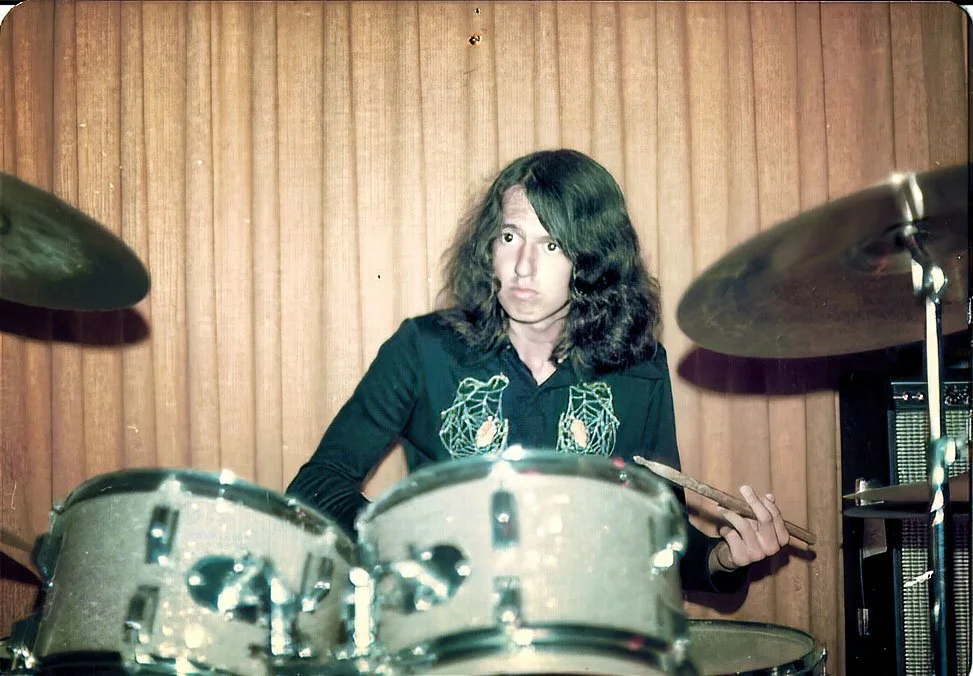
David during his Suntower years. Photo by Markham White.
Learning Rooms
Music in the Heck household started early. David was playing piano at seven, taught by his father. In fifth and sixth grade Glenn taught him clarinet. By high school David had moved to bass clarinet in the Northside band, playing both the concert and marching seasons. But somewhere along the way he became fascinated with drums.
One day he told his father and the band director he wanted to play drums. The band director said there was no budget for another snare drum so Glenn went to Bibb Music in Macon and ordered one that matched Northside High's blue drums.
Problem solved.
That became a recurring rhythm in David’s life. A door opened, and he walked through it.
As a freshman he entered the Northside talent show playing organ arrangements of “Classical Gas,” “Baby Elephant Walk,” “Up, Up and Away,” and the Mission Impossible television theme, accompanied by a primitive rhythm machine. He wasn’t expecting much when the winners were announced. Then the emcee called his name for first place.
“I couldn’t believe it. I was five-foot-two back then and the kids were cheering like crazy,” David recalls.
He made the organ cool.
By high school he was playing dances after football games, earning fifteen dollars, and moving through bands with Rob Walker and other young musicians from the Warner Robins scene. He eventually joined Suntower, a regional group that worked fraternity parties and clubs throughout the Southeast, from Pensacola to Daytona, threading through the old Southern college circuit that once kept countless musicians employed.
He transferred from Macon Junior College to the University of Georgia in 1976, and became a percussion major, studying marimba, timpani, and multiple percussion while playing drum set in the Redcoat Band and Jazz One, the school’s top jazz ensemble.
He had learned to read charts formally from an early age, but like many Southern musicians of his generation, his deepest training came another way.
“You just put the needle down and learned the song.”
That ability to absorb music quickly would later make him invaluable to Stillwater.
Joining Stillwater
David pulled out of college before finishing, as musicians do when the road starts calling louder than the classroom. He moved to Nashville in 1980 and started touring with Cristy Lane, a country and Christian singer.
Then the call came.
Stillwater needed a drummer so Sebie Lacey could move more fully into frontman duties. David moved back to Warner Robins, climbed on his bicycle each morning, and started rehearsing with the group.
His first show with Stillwater came in Jacksonville, Florida, opening for the Rossington-Collins Band before fifteen thousand people.
He had memorized the entire two-hour set but had never performed it live with the band in front of an audience.
“I was so focused on nailing it that I can barely remember what was going on during the show,” he says.
Afterward he stood in the wings watching Rossington-Collins perform, still coming down from the intensity of concentration.
Stillwater continued hard for several more years, but David’s role in the band extended beyond simply holding down the rhythm section. Mike Causey still describes him as the steady presence who could keep rehearsals loose, the guy whose quick wit and sharp observations could break the pressure in the room and keep everybody laughing.
That balance suited David naturally. He took the music seriously without taking himself too seriously. He’s not the chaotic rock-and-roll archetype. He’s the stabilizer. The grounded guy with a sense of humor. The person who helps a room function better simply by being in it.
So Stillwater with David behind the kit hit it hard for three more years, until, as he puts it plainly, "everything died." By then the Southern rock industry that had once sustained bands like theirs was shifting beneath everyone’s feet. Capricorn Records had collapsed. The business changed. Touring changed. The dream itself changed shape.
David watched it happen without bitterness.
That may be one of the things that makes him unusual.
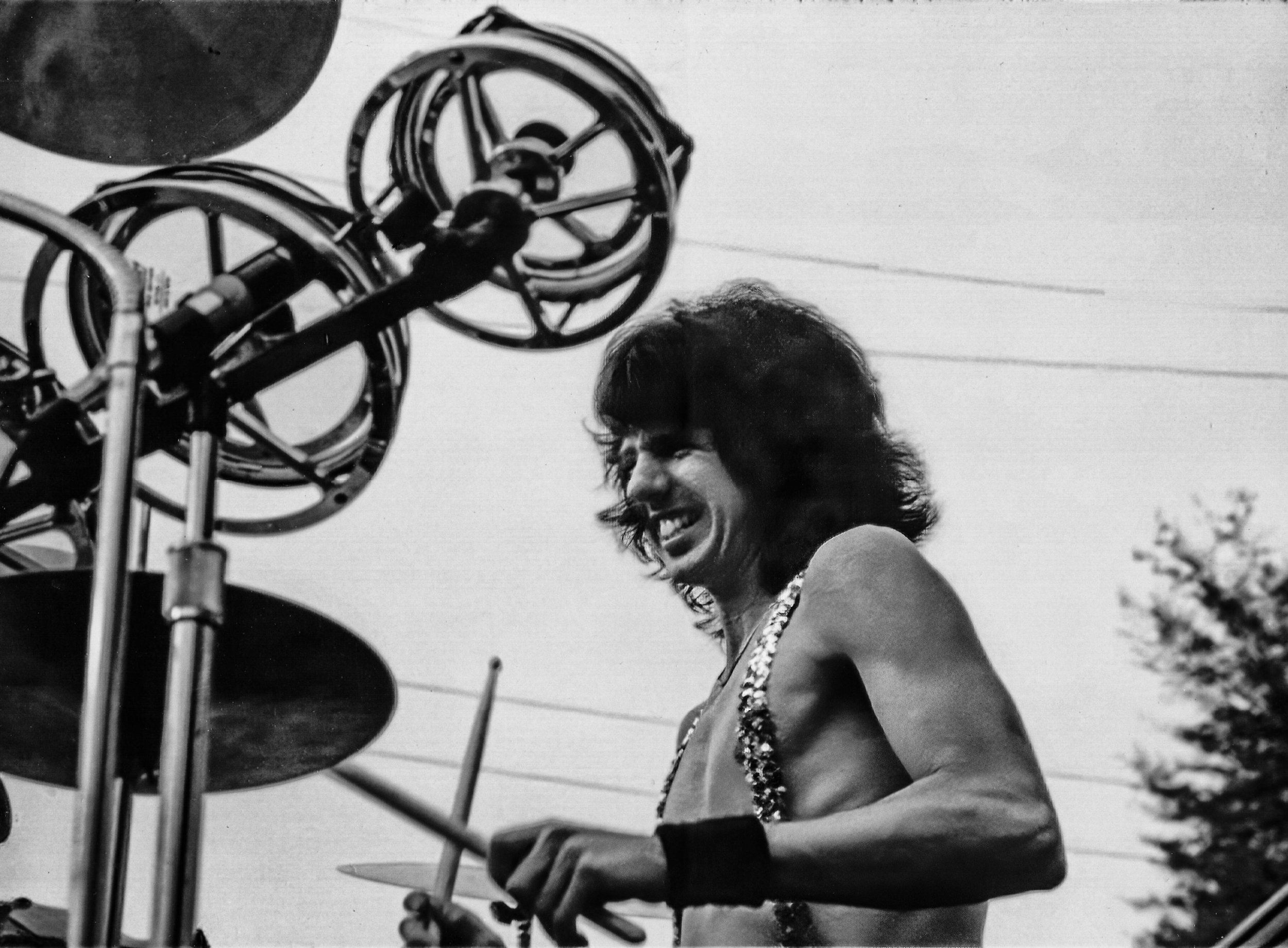
David in Blackjack, circa 1978. Photo by Markham White.
Building a Life
David went back to Nashville, back to Cristy Lane, back to the road. He met his wife Sherri in the Cristy Lane organization's office, where the band came in to help box albums. Sherri was working the front desk. She was from California, a singer who had studied music in Long Beach, part of a jazz choir there assembled by a director connected to Karen Carpenter, who had come through that same program. Sherri had moved to Nashville on her own, met David and they married in 1988.
Like his sister Becky and her husband John Crawford, who have now been married fifty years, David and Sherri built the kind of long marriage that reflected the stability and loyalty modeled in the Heck household growing up. His sister Karen, too, has been in a 20-year marriage with Nancy Krimendahl, whose career included working on PBS specials.
Between tours with Cristy, he played two summers at Opryland amusement park, backed various artists through the Nashville circuit, and played the Grand Ole Opry a couple of times. When Cristy Lane bought a theater in Branson, joining Andy Williams, Roy Clark, and a wave of performers planting themselves in the Missouri Ozarks, David and Sherri went with her. Sherri sang backup. David played drums.
Over the years David performed in every U.S. state except Alaska and Hawaii, working with artists that ranged from Cristy Lane to a Beach Boys Tribute Band call Kahuna Beach Party. He played select dates with singer-songwriter Jim Salestrom, who first rose to prominence performing with John Denver before later touring extensively with Dolly Parton. David also spent a couple seasons performing at the Colorado State Fair alongside Peter Noone of Herman’s Hermits fame, a reminder of how musicians often remain in American touring culture.
One performance especially stayed with him. In 1986, while touring with Cristy Lane, David performed aboard a ferry circling the Statue of Liberty during the monument’s 100th anniversary celebration, sharing the event lineup with Lee Greenwood as New York Harbor filled with music, lights, and patriotic spectacle.
Eventually David and Sherri decided they wanted something different from Nashville and Branson, so they drove west looking for a new place to build a home.
They found it in Colorado.
First Westminster, then Bailey near Conifer, high in the mountains at 8,500 feet. They raised their sons Daniel and Kyle there while teaching music, gigging locally, and piecing together the unpredictable economics familiar to working musicians everywhere.
David was never reckless about responsibility.
The combination of long mountain commutes, two young children, and the gap between what they earned and what the family needed, eventually forced a reckoning.
By 2000 he was looking at temp work and ultimately landed at University of Colorado Health, where he spent twenty-five years, and now works from home full-time.
When the pandemic hit, live entertainment faded in 2019 and stopped in 2020. Since then he has deliberately remained out of the circuit life.
"There are pros and cons to playing and touring,” David says. “Hauling drums, traveling, rehearsing is taxing mentally and physically. Now that I've stepped back, I can breathe."
What Runs Alongside Everything Else
Running and cycling have followed him through every phase of life: Warner Robins, Nashville, Branson, Colorado. Hundred-mile bike rides. Half-marathons. Ten Boulder-to-Boulder races. Training runs through mountain roads and Denver suburbs alike.
David just ran the Denver Colfax Marathon, a Boston qualifier, and while he didn’t qualify to run in Boston’s 2027 marathon, he’s gonna’ try to qualify next year to run in Boston in 2028.
The drums are still set up in the basement for the days when running isn't enough.
And then there are the unicycles.
David learned to ride one as a kid. Years later he discovered Rob Walker rode them too. Naturally, they started bringing unicycles to Stillwater rehearsals and riding between sessions because apparently two musicians left unsupervised long enough will invent their own circus.
At one hotel during a Florida tour, David borrowed Rob’s six-foot unicycle and rode it around the parking lot among a group of Shriners driving their miniature cars. One of them handed him a Shriner hat to complete the spectacle.
Somewhere there is a photo. We want to see it.
He still has his unicycles and gets them out occasionally, riding them in his neighborhood.
"The neighbor kids think I'm crazy," he says.
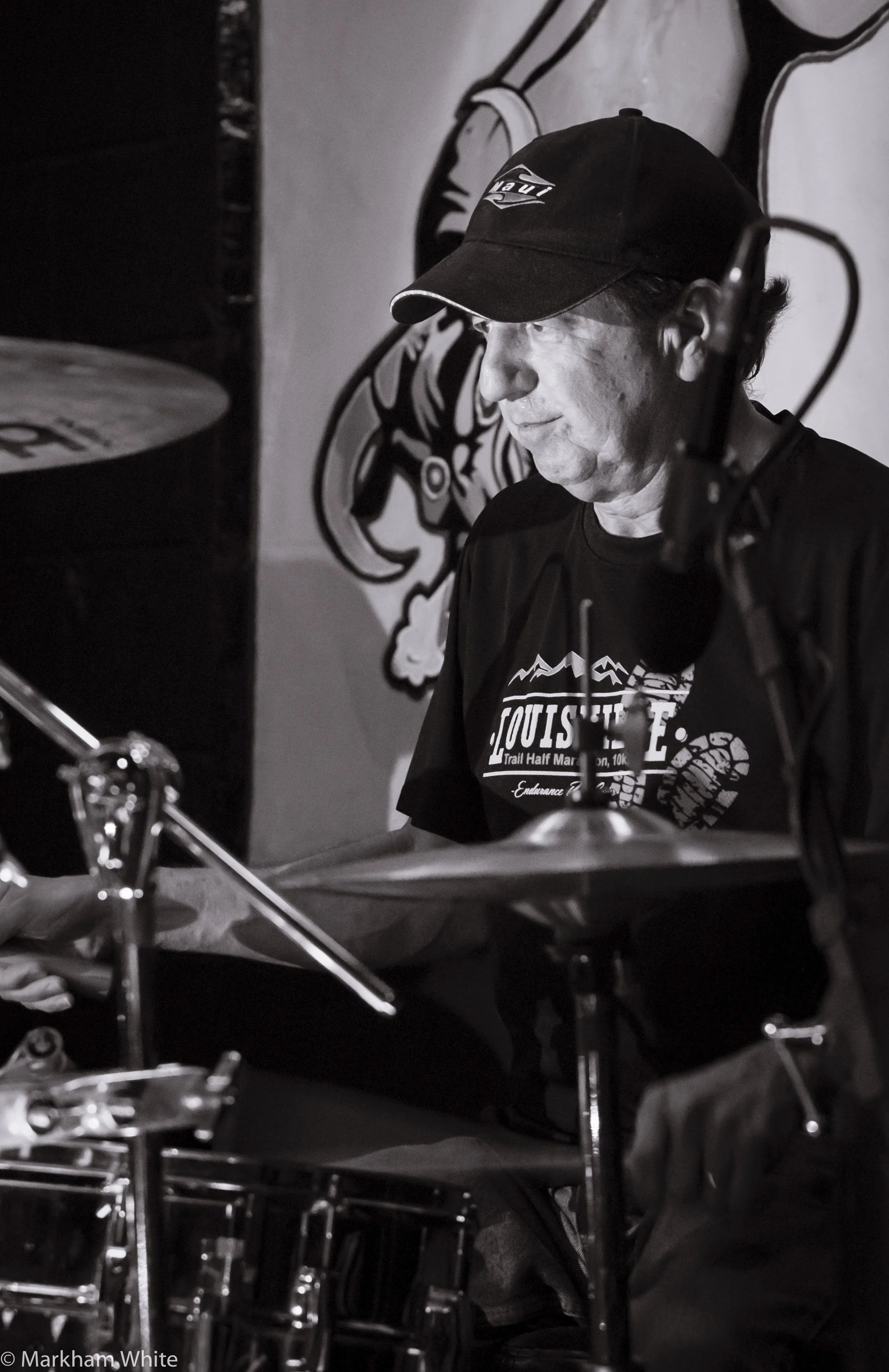
David Heck playing the Stillwater reunion show in 2016.
Photo by Markham White.
Coming Back to Where It Started
David Heck does hard physical things for the love of them. Biking fifteen miles each way to rehearsal, unicycling among Shriners in hotel parking lots, running Boulder-to-Boulder ten times, memorizing two hours of set list for a show he'd never played in front of an audience. That disposition comes from somewhere.
Glenn and Margaret modeled it at the dinner table and in community involvement before David picked up drum sticks, or the clarinet, or sat at an organ.
David Heck has no blood relatives left in Warner Robins now. His parents are buried in Dublin. His sisters live elsewhere. Much of his adult life unfolded far from Middle Georgia.
And yet the place never entirely let go of him.
The friendships remain. The music remains. The old connections remain.
When news spread that Stillwater planned a reunion performance this summer, friends started reaching out almost immediately. Urgently. Like people reclaiming part of their own history.
That says something not only about the band, but about the kind of loyalty David inspires.
Mike Causey is blunt about it. When other drummers were suggested for the reunion performance, Mike refused.
“It has to be David.”
He is, in Mike's estimation, the only drummer who makes the band play optimally, not just adequately, not just competently, but the way it's supposed to sound.
David himself describes it differently.
For him, the concert is almost secondary. The real meaning lies in seeing the people again, returning to the town his parents helped shape, reconnecting with friendships that survived decades, distance, marriages, children, career changes, and the long strange drift of adulthood.
“We’re like brothers,” he says. “The biggest thing for me is getting back to Warner Robins and seeing everyone. The concerts are the icing on the cake.”
His father helped give Warner Robins its nickname. His mother stitched costumes for school productions and carried old Dublin culture into a young military town still discovering itself.
And David Heck, their steady son, is still showing up for the things that matter.
Stillwater’s story stretches across decades. Explore these other voices that helped shape the band and the world around it:
About the Author
Cindi Brown is a Georgia-born writer, porch-sitter, and teller of truths, even the ones her mama once pinched her for saying out loud. She runs Porchlight Press from her 1895 house with creaking floorboards and an open door for stories with soul. When she’s not scribbling about Southern music, small towns, stray cats, places she loves, and the wild gospel that hums in red clay soil, you’ll find her out listening for the next thing worth saying.
